Is Amazon Translate the Right Choice for Your Multilingual Applications in 2026?
In an increasingly globalized digital landscape, bridging language barriers is paramount for businesses aiming to reach diverse audiences. But when it comes to machine translation, can a tool like Amazon Translate deliver the fluency and accuracy your applications demand? As senior tech writers at WiseRankr.com, we dive deep into Amazon Translate, an AWS offering, to assess its capabilities, pricing, and overall value in 2026.
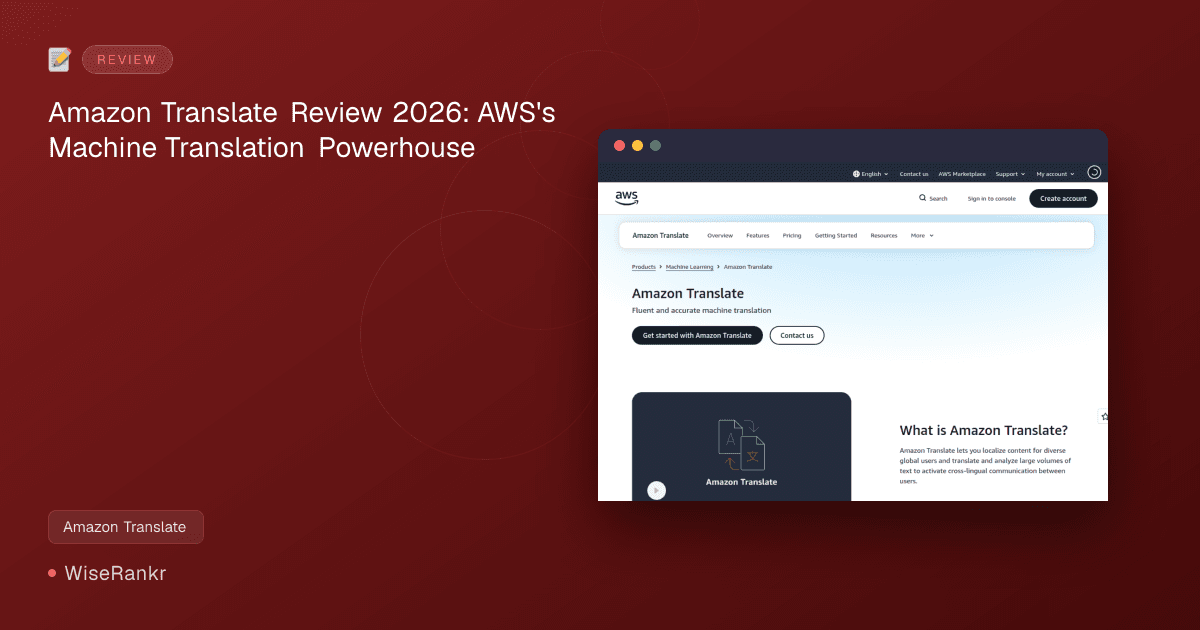
Amazon Translate is a neural machine translation service designed for developers to integrate high-quality, customizable language translation into their applications. It's built within the robust Amazon Web Services (AWS) ecosystem, aiming to simplify the process of localizing content and enabling cross-lingual communication at scale.

Essential Features of Amazon Translate
Amazon Translate offers a suite of features tailored for developers and businesses needing scalable and flexible translation solutions. These features aim to provide both high-quality output and the necessary controls for specific use cases.
Broad Language Coverage
Supporting translation between 75 languages, Amazon Translate provides extensive coverage for global applications. This broad range includes common languages like English, Spanish, French, and German, along with numerous others such as Afrikaans, Amharic, Bengali, Gujarati, and Haitian Creole, allowing for wide international reach.
Neural Network-Based Translation
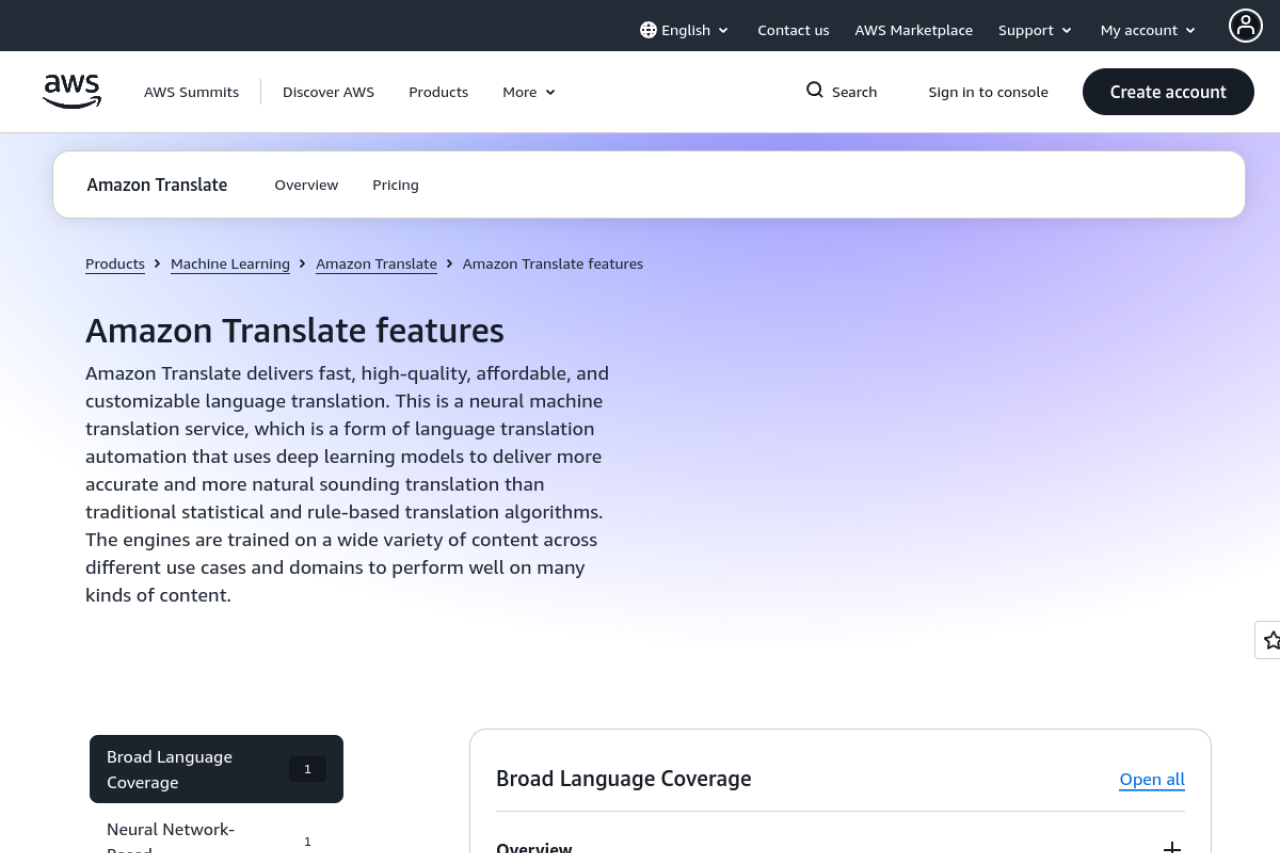
At its core, Amazon Translate leverages neural machine translation (NMT). This advanced form of language translation uses deep learning models to produce more accurate and natural-sounding translations compared to older statistical or rule-based methods. The engines are continuously trained on diverse content to enhance performance across various domains.
Customized Machine Translation
One of the standout features is its customization capability. Users can define specific brand names, model names, and other unique terms to ensure consistency and accuracy in translated output. This is crucial for maintaining brand identity and technical precision across different languages.
Named Entity Translation Customization
Building on general customization, Named Entity Translation Customization allows for fine-tuning how specific entities (like product names, geographical locations, or personal names) are translated. This helps prevent mistranslations of critical terminology that might otherwise be genericized by a standard NMT model.
Language Identification
For applications dealing with multi-language input, Amazon Translate includes a language identification feature. This automatically detects the source language of text, streamlining the translation workflow and ensuring the correct translation pair is used without manual intervention.
Batch and Real-Time Translations
Amazon Translate supports both batch and real-time translation capabilities. Developers can integrate a single API call to handle large volumes of text for offline processing (batch) or provide instant translations for interactive applications (real-time). This flexibility caters to various operational needs.
Real-Time Document Translation
Beyond simple text, the service also offers Real-Time Document Translation. This extends its utility to translating entire documents, providing a more comprehensive solution for businesses dealing with contracts, manuals, or other extensive written content.
Secure Machine Translation
Given its AWS foundation, Amazon Translate emphasizes secure machine translation. While specific details on security protocols are typically part of the broader AWS security framework, the implication is that data handled by the service benefits from AWS's robust security measures.
Pay-Per-Use Model
Amazon Translate operates on a pay-per-use model, meaning users are charged based on the number of characters translated. This provides cost flexibility, especially for varying usage demands. An AWS Free Tier is also available to help users get started.
Amazon Translate Pricing: A Pay-As-You-Go Approach
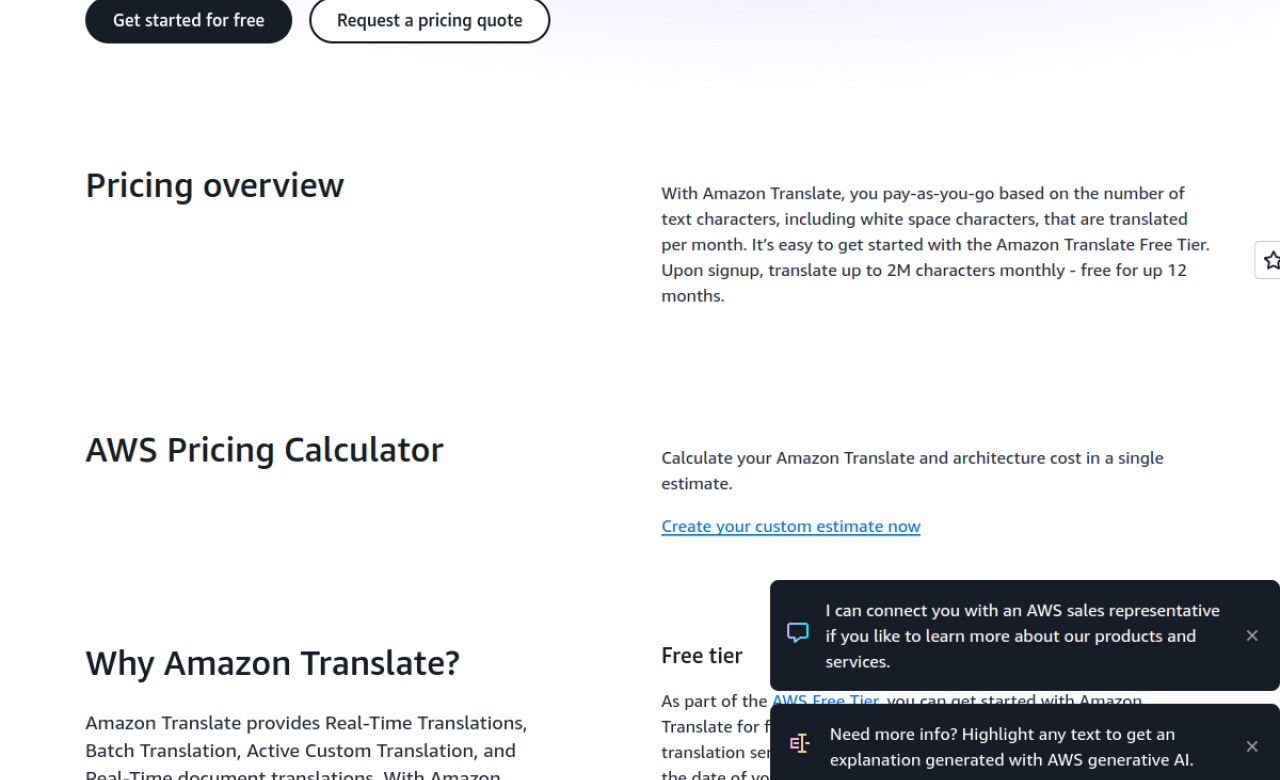
Amazon Translate employs a pay-as-you-go pricing model, which can be advantageous for businesses with fluctuating translation needs. Costs are determined by the number of text characters translated per month, including whitespace characters. While this offers flexibility, it requires careful monitoring to manage expenses effectively.
Free Tier
AWS offers a generous free tier for new users to explore Amazon Translate. Upon signup, you can translate up to 2 million characters per month for 12 months for Standard Text and Batch Document Translation. For Active Custom Translation, there's a free tier of 500,000 characters per month for 2 months. This allows ample opportunity to test the service without immediate financial commitment.
Standard Text Translation
- Cost: $15.00 per million characters.
- This applies to direct text translation requests made via the API.
Batch Document Translation
- Cost: $15.00 per million characters.
- This is for processing large volumes of text documents in a single request.
Real-Time Document Translation (Text & HTML)
- Cost: $15.00 per million characters.
- Note: There is no free tier specifically for this service.
Real-Time Document Translation (DOCX)
- Cost: $30.00 per million characters.
- This specialized service for DOCX files also does not include a free tier.
Active Custom Translation
- Cost: $60.00 per million characters.
- This higher-tier service includes 200 GB of free parallel data storage.
- Excess data storage is charged at $0.023 per GB per month.
For sustained usage exceeding 1 billion characters per month, volume discounts may be available. It's important to use the AWS Pricing Calculator to estimate costs accurately based on your projected usage.
User Reviews and Sentiment
User feedback provides crucial insights into the real-world performance and user experience of Amazon Translate. While the service is praised for its integration within the AWS ecosystem, some common themes emerge regarding its quality and pricing structure.
Users on G2 report an average rating of 4.4 out of 5 stars based on 21 reviews. Many users appreciate its ease of use and its ability to provide accurate translations, especially for basic needs. It scores particularly high in real-time translation (8.9) and auto-detect language capabilities (8.7).
However, the sentiment on Reddit is more mixed. While some developers find it easy to integrate within AWS projects and useful for basic translation, others express significant concerns about translation quality. Reddit threads suggest that "Quality of translation is so terrible. Often contains ungrammatical sentences. Their translation engine is clearly worse than what Google or DeepL currently offers." This indicates a potential struggle with complex or idiomatic language, often leading to misunderstandings.
A recurring critical point from G2 reviews is the cost after the free tier expires, with users noting that "we have to pay for this after the free tier service when there are free and open translation apps, especially like google translate." The setup process is also considered more complex (7.7 score) compared to alternatives like Google Translate (9.6 score), likely due to the API-first nature and the broader AWS ecosystem learning curve.
Integrations: Seamlessly within the AWS Ecosystem
As an AWS service, Amazon Translate is designed for deep integration within the broader Amazon Web Services ecosystem. While specific integration partners are not explicitly detailed on its homepage, its nature as an API-first service means it can be programmatically integrated with virtually any application or service running on AWS or elsewhere. This includes:
- Amazon S3: For storing source and translated documents.
- AWS Lambda: To trigger translation events based on file uploads or other actions.
- Amazon Comprehend: For pre-processing text (e.g., sentiment analysis) before translation.
- Amazon Transcribe: To translate transcribed audio content.
- Amazon Polly: To convert translated text into speech.
- AWS SDKs: Providing libraries for easy integration into various programming languages.
This tight integration makes Amazon Translate a natural fit for organizations already heavily invested in the AWS cloud infrastructure, simplifying deployment and management.
Pros and Cons of Amazon Translate
Pros
- Deep AWS Integration: Seamlessly connects with other AWS services, making it ideal for existing AWS users.
- Scalable API: Built to handle high volumes of translation requests, suitable for enterprise-level applications.
- Customization Options: Features like Active Custom Translation and Named Entity Translation Customization allow for tailoring output to specific terminology and brand voice.
- Real-time & Batch Processing: Offers flexibility for different use cases, from instant chat translation to bulk document processing.
- Broad Language Support: Translates between 75 languages, covering a significant global audience.
- Generous Free Tier: Provides ample opportunity to test the service before committing to paid usage.
Cons
- Translation Quality Concerns: Users report that for complex, idiomatic, or culturally nuanced language, the output can be ungrammatical or less accurate than competitors like Google Translate or DeepL.
- Cost for High Volume: The pay-per-character model, including whitespace, can become expensive for high-volume users, especially after the free tier expires.
- API-First Nature: Lacks a user-friendly GUI, making it less accessible for non-developers and requiring AWS account setup expertise.
- Setup Complexity: Setting up custom translation models requires technical knowledge and data preparation.
- Fewer Public Reviews: Compared to more consumer-facing tools, there are fewer public reviews, making comprehensive sentiment analysis challenging.
Who Is Amazon Translate For?
Amazon Translate is primarily an enterprise-grade tool designed for developers and organizations deeply embedded in the AWS ecosystem. It caters to:
- Software Developers: Building multilingual applications, websites, or services within AWS.
- Enterprises: Needing scalable, customizable machine translation for internal communications, customer support, or content localization.
- Data Scientists: Looking to process large datasets of text in multiple languages for analysis.
- Companies with Existing AWS Infrastructure: Those who can leverage seamless integration with other AWS services.
It is NOT ideal for individual users seeking a quick, free, or consumer-friendly translation app like Google Translate's web interface.
Alternatives to Amazon Translate
While Amazon Translate offers robust capabilities, several strong competitors exist, each with its own strengths:
- Google Cloud Translation API: Often lauded for its superior translation quality, particularly for general text, and ease of use for developers already in the Google Cloud ecosystem.
- DeepL: Widely praised for its highly natural and nuanced translations, especially for European languages. It often outperforms others in terms of fluency.
- Azure Translator Text API: Microsoft's offering, providing similar API-driven translation services with strong integration into Azure cloud services.
- Bing Translator: A free, consumer-facing option from Microsoft, also with an underlying API for developers.
- Taia: Combines AI translation with professional human post-editing for higher accuracy and quality, catering to users who need a blend of speed and precision.
- Professional Translation Agencies: For critical, high-stakes content where human precision, cultural nuance, and expertise are non-negotiable.
The best alternative depends heavily on your specific needs, existing cloud infrastructure, budget, and the required level of translation accuracy and nuance.
The WiseRankr Verdict
Amazon Translate stands as a powerful machine translation solution, particularly for developers and enterprises deeply integrated into the AWS ecosystem. Its strengths lie in scalability, extensive language support, and robust customization features like Active Custom Translation, which are critical for maintaining brand consistency and technical accuracy.
However, its API-first nature means a steeper learning curve for those unfamiliar with AWS, and its translation quality, while generally good, can sometimes fall short of competitors like DeepL or Google Translate for highly nuanced or idiomatic content, as noted by Reddit users. The pay-per-character pricing, while flexible, demands careful cost management.
For organizations already leveraging AWS and needing a highly integrated, scalable, and customizable translation API, Amazon Translate is an excellent choice. For those prioritizing absolute top-tier translation fluency for general text or seeking a more user-friendly interface for ad-hoc translations, alternatives might be more suitable. We rate Amazon Translate a solid 4.0 out of 5 stars for its target audience and robust features within the AWS framework.
Frequently Asked Questions (FAQs)
What is Amazon Translate?
Amazon Translate is a neural machine translation service provided by Amazon Web Services (AWS) that allows developers to integrate high-quality, customizable language translation into their applications. It supports both real-time and batch translations across 75 languages.
Is Amazon Translate free?
Amazon Translate offers a free tier for new AWS users, which includes up to 2 million characters per month for 12 months for standard text and batch document translation. After the free tier, it operates on a pay-as-you-go model based on the number of characters translated.
How does Amazon Translate compare to Google Translate?
Amazon Translate is an API-first service designed for developers within the AWS ecosystem, focusing on scalability and customization. Google Translate offers both a consumer-facing interface and a powerful API (Google Cloud Translation API), which some users report provides slightly better general translation quality, especially for complex or idiomatic language. Amazon Translate's strength is its deep integration with other AWS services.
Can I customize translations in Amazon Translate?
Yes, Amazon Translate offers customization features like Active Custom Translation and Named Entity Translation Customization. These allow users to define specific brand names, technical terms, and other unique vocabulary to ensure consistent and accurate translations tailored to their specific needs.