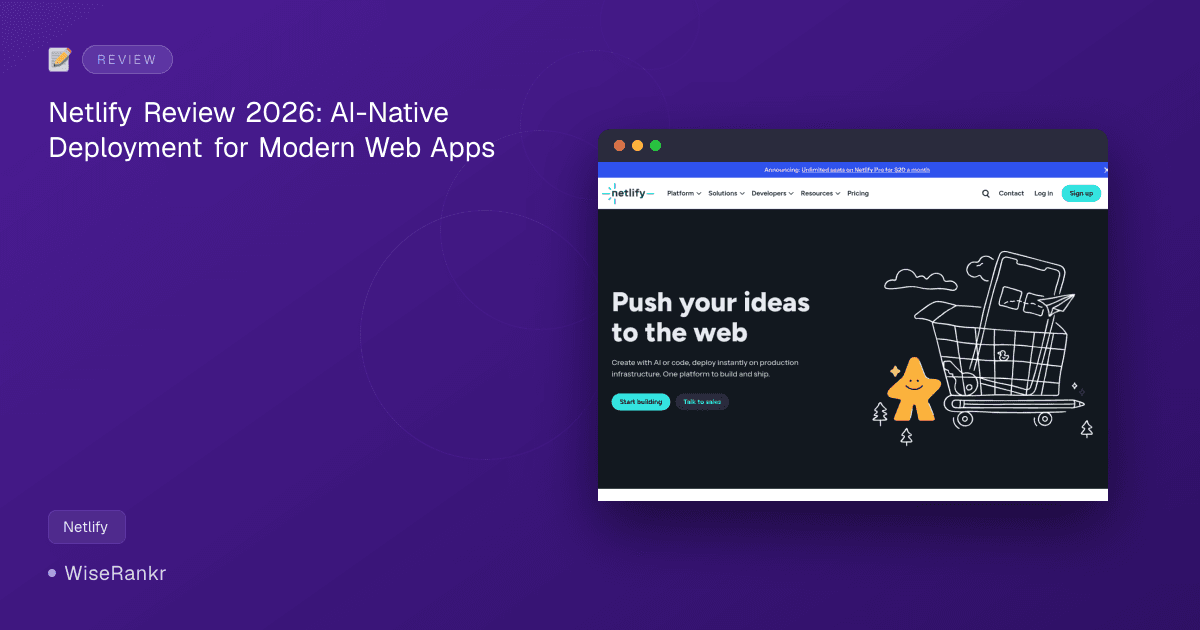

Netlify Review 2026: The Ultimate Platform for Modern Web Development
Are you looking to streamline your web development workflow, from idea to global deployment, with unparalleled speed and flexibility? In 2026, Netlify continues to be a dominant force in the web development landscape, offering a comprehensive platform that simplifies the build, deploy, and scale process for modern web applications. But does it live up to the hype, especially with its recent shifts towards AI-driven development and credit-based pricing?
This in-depth review by WiseRankr.com will dissect Netlify's offerings, pricing, and user sentiment to help you decide if it's the right choice for your projects. We'll explore its innovative features, new AI capabilities, and how its updated pricing model impacts teams and individual developers.
Overview: Netlify's Evolution into an AI-Native Deployment Powerhouse
Founded in 2014, Netlify has grown to become the platform of choice for millions of developers and thousands of enterprises. It's known for its focus on the Jamstack architecture, enabling developers to build, deploy, and scale web applications with high performance and security. In 2026, Netlify has significantly leaned into AI, transforming how developers can create and ship software.
From prompt-to-production workflows to AI agent runners and an AI Gateway, Netlify is positioning itself as a leader in AI-native development. This means developers can start projects from an AI prompt, integrate AI models seamlessly, and leverage AI to accelerate their entire development lifecycle.
Key Features: Building and Shipping with Netlify
Netlify offers a robust suite of features designed to accelerate development and provide a seamless deployment experience. Its core strength lies in unifying various stages of web development onto a single, intuitive platform.
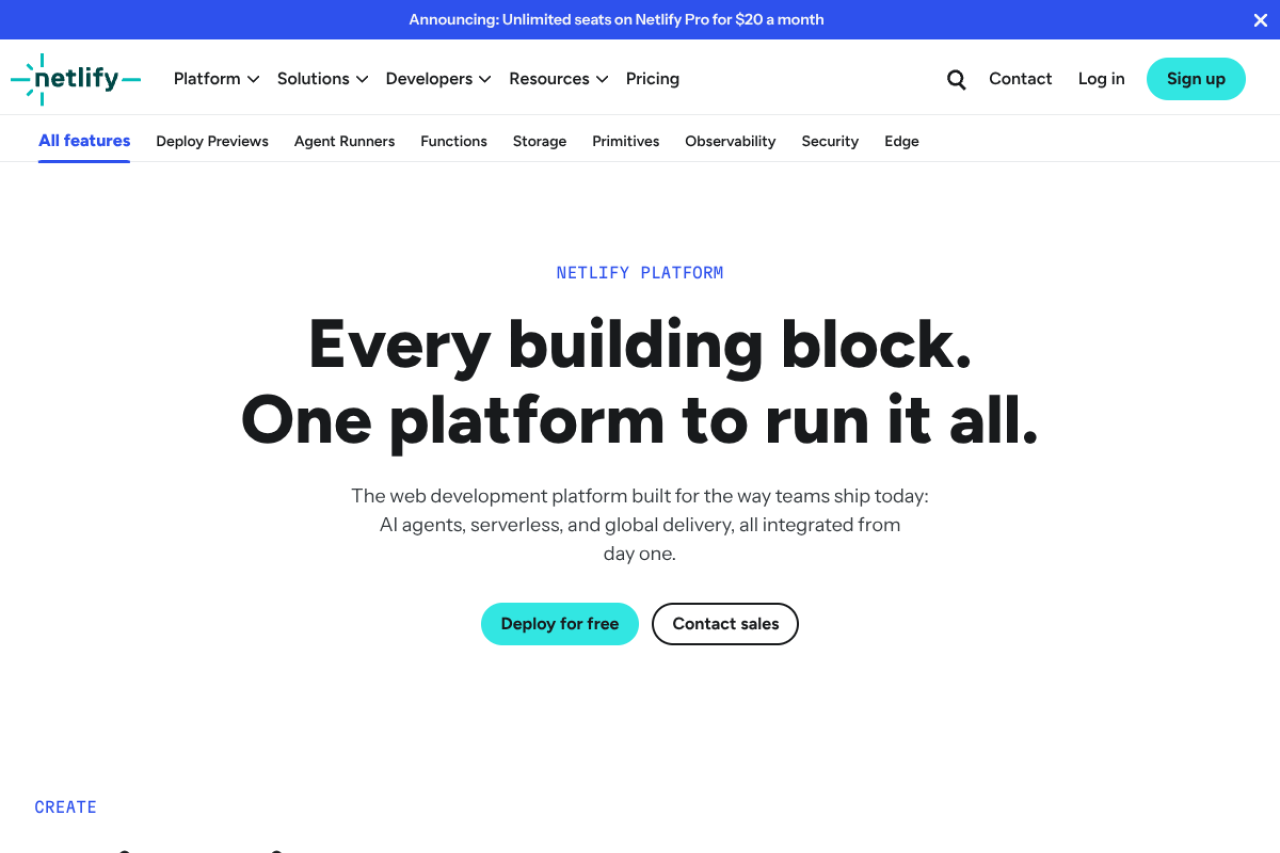
Core Deployment & Workflow Features
- Start with Code or AI: Users can initiate projects from a prompt, push directly from Git repositories (GitHub, GitLab, Bitbucket), or even drag and drop files for instant deployment.
- Build Fullstack Apps: Netlify supports connecting APIs, managing data, optimizing images, and integrating AI features from the initial development stage.
- Global CDN Deployment: Projects are shipped to a global Content Delivery Network (CDN) in seconds, ensuring fast load times for users worldwide.
- Preview Every Change: Every modification or commit triggers a unique preview URL, allowing for thorough testing and collaboration before going live.
- One-Click Rollbacks: The platform enables users to revert to any previous deploy with a single click, providing a safety net for unexpected issues.
Advanced Platform Primitives for Scalability
Beyond basic deployment, Netlify provides "agent-ready primitives" to build sophisticated applications:
- Serverless Functions: Build powerful APIs and backend logic without managing servers, running code at the edge for optimal performance.
- Integrated Storage: Store data and images directly within the Netlify ecosystem.
- Built-in Identity: Handle user authentication with integrated identity services.
- AI Gateway: Connect to various AI models (like OpenAI's GPT Image 2) through a unified gateway, simplifying AI inference and integration into applications.
- Automatic HTTPS & DDoS Protection: Essential security features are built-in, providing peace of mind for site owners.
- Global Edge Network: Netlify boasts a 99.99% uptime guarantee, leveraging its global network for reliable service.
AI-Driven Innovations (New for 2026)
Netlify has heavily invested in AI capabilities, making it a frontrunner for AI-native development:
- AI Prompts to Production-Ready Software: The platform now allows users to start projects from an AI prompt, generating initial code or structures.
- AI Agent Runners: These tools are designed to clear production backlogs, potentially turning days of updates into minutes.
- MCP Server (AI-Native Development Standard): Netlify launched its official MCP Server in June 2025, setting a new standard for AI-native development.
- AI-Enabled Deploy Assist: This feature aims to improve developer productivity and accelerate the shipping of personalized digital experiences.
- GPT Image 2 in AI Gateway: As of April 2026, OpenAI's GPT Image 2 is accessible via the AI Gateway, simplifying image generation within Netlify Functions.
Netlify Pricing: A Shift to Unlimited Seats and Credit-Based Usage
Netlify has recently redefined its pricing strategy, moving away from seat-based charges and embracing a more transparent credit-based model. This change, announced in April 2026, aims to cater to "3 billion builders" by removing barriers for teams.
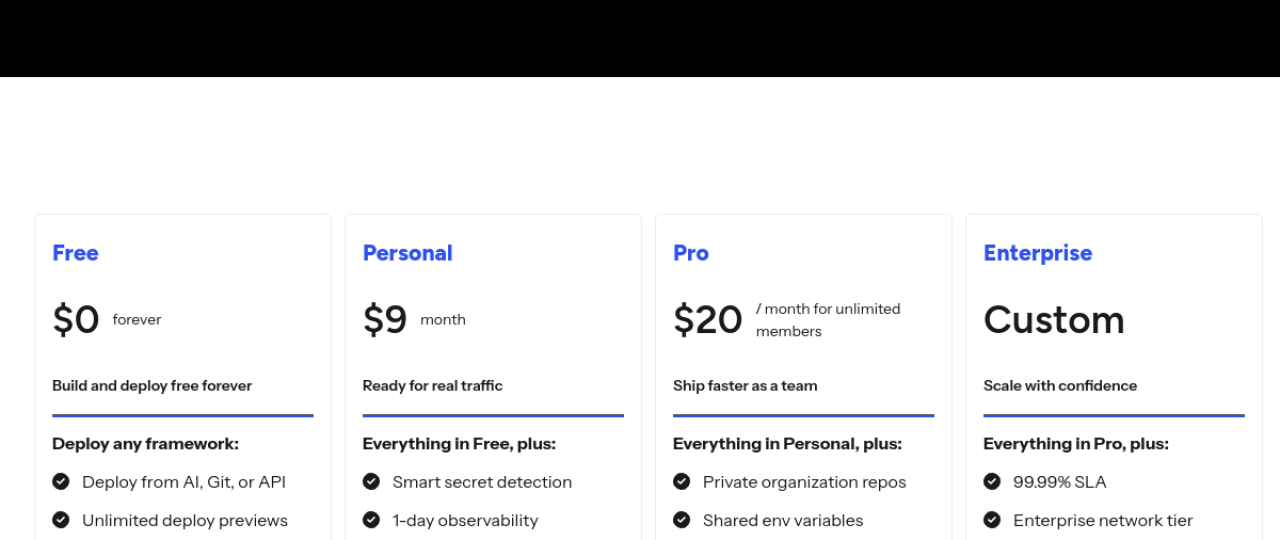
Unlike many competitors, Netlify explicitly states there are "no extra charges or hidden costs for platform features like cache reads, cache writes, image transformations, origin bandwidth, or function invocations." The pricing is based on five transparent usage meters: Bandwidth, Compute, Web requests, AI inference, and Production deploys.
Netlify Plans (as of 2026):
- Free Plan:
- Price: Free (forever)
- Target Audience: Individuals, hobbyists, small personal projects.
- Credits: 300 credit limit.
- Key Features: Deploy from AI, Git, or API; unlimited deploy previews; custom domains with SSL; functions & AI models; file storage; basic firewall; global CDN.
- Personal Plan:
- Price: $9/month
- Target Audience: Solopreneurs, freelancers, small development teams.
- Key Features: All Free plan features, plus smart secret detection, 1-day observability, and priority email support.
- Pro Plan:
- Price: $20/month (with unlimited seats)
- Target Audience: Growing teams, agencies, professional projects requiring collaboration.
- Key Features: All Personal plan features, plus private organization repos, shared environment variables, and 3+ concurrent builds. This plan now offers unlimited seats, a significant change from its previous $20/seat model.
Usage Meter Adjustments & Credit Packs (for scale)
For users with higher consumption, Netlify has adjusted its credit consumption rates:
- Bandwidth: 20 credits per GB (was 10)
- Compute: 10 credits per GB-Hour (was 5)
- Web requests: 2 credits per 10k requests (was 3)
- Form submissions: Now free
Extra credit packs are available at $10 for 1500 credits, making the consumption-based pricing highly competitive:
- Bandwidth: $0.13 per GB
- Compute: $0.07 per GB-Hour
- Web requests: $0.01 per 10k requests
Netlify states that for 98% of customers, their monthly bill will stay the same or decrease due to these changes. However, high-bandwidth or compute-heavy users should carefully monitor their usage.
User Reviews: A Mixed Bag of Praise and Caution
Netlify generally enjoys a strong reputation among developers for its ease of use and powerful features. However, like any widely used platform, it has its detractors, particularly concerning billing and credit usage.
Positive Sentiment
Users on G2 and Capterra consistently rate Netlify highly, with G2 showing an impressive 4.7/5 based on 1,579 reviews, earning it "Leader" and "High Performer" badges. BrandCompare aggregates a 4.6/5 from over 15,000 reviews. Common praises include:
- Ease of Use & Deployment: "For more than a year I have used Netlify to deploy and host several React webpages and it has been way easier, compared to other options," reports a Trustpilot user. The "easy Git deployments" and "excellent developer experience" are frequently highlighted.
- Generous Free Tier: Many solo founders and small project creators appreciate the "great free tier" and its "100GB bandwidth" limit, which is sufficient for many static sites. Reddit users often mention hosting numerous client sites on the free tier without issues.
- Integrated Features: "Good forms and functions" and "built-in form handling without backend" are valued, simplifying common web development tasks.
- Reliability: Features like "instant rollbacks on any deploy" provide a sense of security and control.
Areas for Improvement & Concerns
Despite the overall positive feedback, some significant concerns emerge, particularly from Trustpilot reviews (1.9/5 from 39 reviews) and Reddit discussions:
- Unexpected Bills & Credit Usage: This is the most critical and frequently cited negative. Users express frustration over "build minutes/credits being consumed quickly," especially for larger applications like Next.js projects. A highly publicized incident involved a user receiving a $104,000 bill for a hobby site due to a traffic spike, highlighting a perceived lack of controls compared to platforms like AWS. Trustpilot users report projects being suspended due to exceeding "impossible to calculate credit limits."
- AI Feature Reliability: One Trustpilot review vehemently states, "THEIR AI FEATURE SUCKS ASS!!! IT KEEPS GOING BACK TO PREVIOUS VERSIONS RANDOMLY. SPENT OVER $20 ON EXTRA CREDITS AND GOT NOTHING IN RETURN BECAUSE IT KEEPS EDITING OLD VERSIONS." While this is a single, strong opinion, it suggests potential teething issues with Netlify's newer AI functionalities.
- Debugging Challenges: Some Reddit users have mentioned difficulties with debugging, particularly when errors are not clearly routed or diagnosed within the platform.
- Form Submission Limits: While the pricing update now makes form submissions free, historically, the 100-submission limit per site was a concern for high-traffic forms, leading some users to seek external solutions.
In summary, Netlify excels at developer experience and ease of deployment for a wide range of projects. However, potential users, especially those with variable traffic or complex build processes, should meticulously monitor their credit usage to avoid unexpected costs. The AI features, while innovative, may still be maturing.
Integrations: A Connected Ecosystem
Netlify is designed to integrate seamlessly into a modern web development workflow. While explicit integration lists weren't provided, the platform's core functionality revolves around Git-based deployment and an API-first approach, implying broad compatibility.
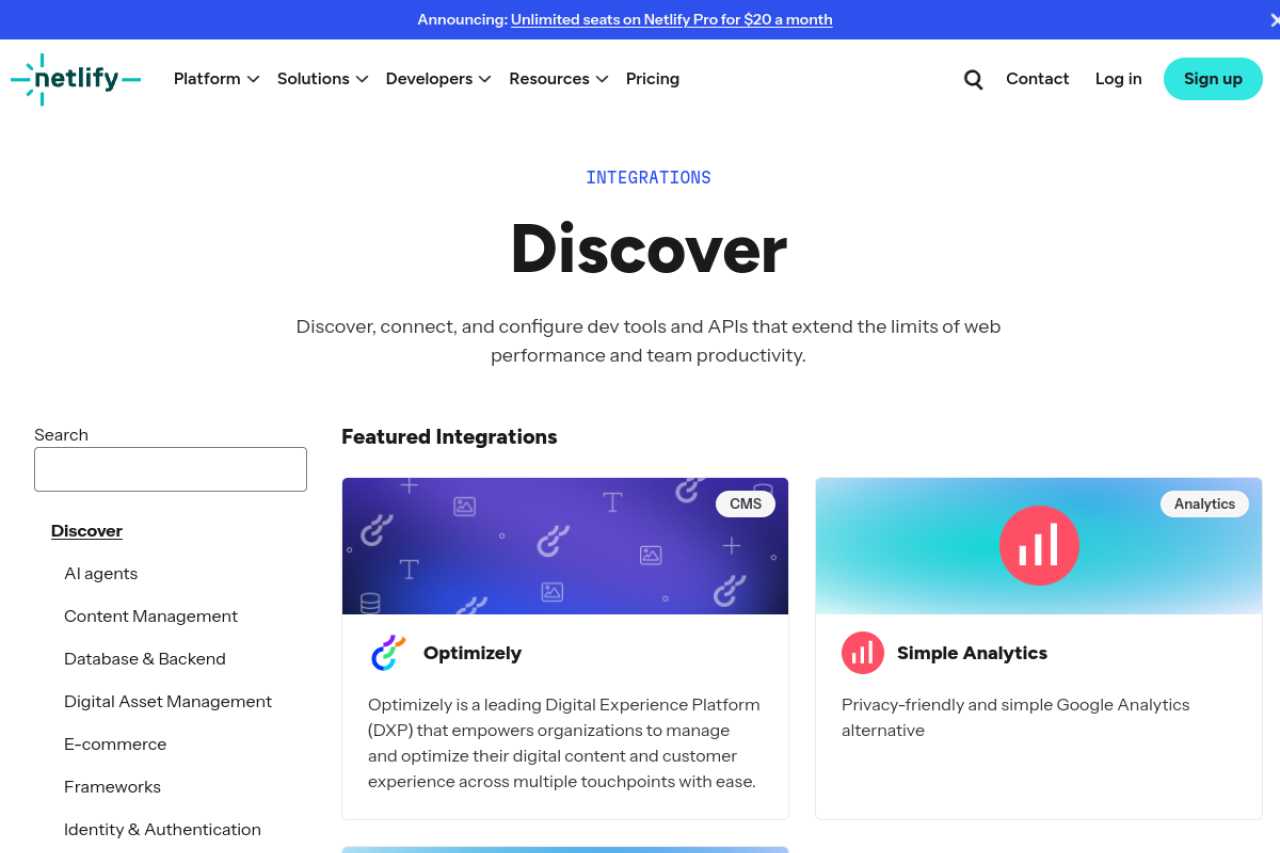
Key integrations and partnerships mentioned or implied:
- Git Providers: Deep integration with GitHub is central to its workflow, and by extension, other Git services like GitLab and Bitbucket are generally supported for continuous deployment.
- AI Models: The new AI Gateway directly supports leading AI models like OpenAI's GPT Image 2, and implicitly other large language models (Claude, Gemini, Codex) for prompt-based development.
- Frameworks: Netlify is framework-agnostic, supporting popular frameworks like Next.js, Nuxt.js, Astro, Remix, and Angular, as indicated by its changelog tags.
- Headless CMS & E-commerce: Netlify is a "platform of choice for running modern composable web applications," including e-commerce and SaaS. Its integration with Adobe Experience Manager Headless was announced in June 2024, indicating support for enterprise-grade headless solutions.
- Developer Tools: Mentions of CLI, SDK, and build tools suggest integrations with various developer environments.
Pros & Cons of Using Netlify
Pros:
- Exceptional Developer Experience: Widely praised for its intuitive interface, easy Git integration, and streamlined deployment process.
- Powerful AI-Driven Features: New capabilities like prompt-to-production, AI Agent Runners, and AI Gateway position Netlify at the forefront of AI-native development.
- Generous Free Tier: Provides substantial resources for individuals and small projects, making it accessible.
- Global CDN & Performance: Ensures fast load times and high availability with 99.99% uptime.
- Automated Workflow: Features like deploy previews, one-click rollbacks, and automatic HTTPS simplify maintenance.
- Transparent Credit-Based Pricing (New): The removal of seat-based pricing and clear meter adjustments are designed to be more predictable and competitive, especially for teams.
- Strong Community & Documentation: Excellent resources available for learning and troubleshooting.
Cons:
- Potential for Unexpected Costs: Despite pricing changes, the credit-based system can still lead to higher-than-anticipated bills for high-usage projects if not carefully monitored. Past incidents of massive bills for traffic spikes are a serious concern.
- AI Features Still Maturing: While innovative, some user feedback suggests that the newer AI functionalities might still have reliability issues or a learning curve.
- Debugging Can Be Challenging: Some users report difficulties in diagnosing and resolving errors within the Netlify environment.
- Vendor Lock-in Potential: While many features are standard, deeply integrating with Netlify-specific functions and identity can make migration more complex.
- Trustpilot Reviews Concern: The significantly lower Trustpilot score compared to other platforms indicates a segment of users have had negative experiences, particularly around billing and support.
Who Is Netlify For?
Netlify caters to a broad spectrum of users, from individual developers to large enterprises, particularly those embracing modern web development practices:
- Individual Developers & Freelancers: The generous Free and Personal plans make it ideal for personal projects, portfolios, and client sites with moderate traffic.
- Small to Medium-Sized Teams: The Pro plan with unlimited seats and collaborative features is well-suited for agencies and development teams building multiple projects.
- Enterprises: Trusted by companies like Meta, Figma, Autodesk, and Mattel, Netlify is a viable solution for complex e-commerce, SaaS applications, and global corporate sites, especially those adopting composable architectures.
- AI-Native Developers: With its strong focus on AI-driven development, Netlify is increasingly becoming the platform of choice for developers looking to integrate AI into their web applications from the ground up.
- Jamstack Enthusiasts: Anyone building static sites, single-page applications, or serverless functions will find Netlify's workflow perfectly aligned with their needs.
Alternatives to Netlify
While Netlify is a leader, several other platforms offer similar services, each with its own strengths:
- Vercel: Often seen as Netlify's closest competitor, Vercel is highly optimized for Next.js and offers a similar developer experience with serverless functions and global deployments. Ideal for React/Next.js heavy projects.
- AWS Amplify: For those already within the Amazon ecosystem, Amplify provides a comprehensive set of tools for building full-stack web and mobile applications, including hosting, authentication, and data storage.
- Google Firebase Hosting: A popular choice for static sites and single-page applications, especially for developers using other Google Cloud services. Offers a generous free tier.
- Cloudflare Pages: Cloudflare's entry into the static site hosting space, offering fast deployments, built-in analytics, and the power of Cloudflare's global network. Often more cost-effective for high-bandwidth needs.
- GitHub Pages: A free option for hosting static websites directly from a GitHub repository, best suited for personal projects and open-source documentation.
Choosing an alternative depends on your specific framework, existing cloud infrastructure, and budget constraints.
Verdict: Netlify Continues to Lead, with Caveats
Netlify remains a powerhouse in modern web development in 2026, particularly for those embracing the Jamstack and now, AI-native development. Its commitment to a seamless developer experience, global performance, and innovative AI integrations makes it an incredibly compelling platform.
The recent pricing overhaul, moving to unlimited seats and refining credit usage, is a positive step towards greater transparency and accessibility for teams. However, the recurring concerns about unexpected billing for high usage or traffic spikes cannot be ignored. While Netlify aims for predictability, users, especially those with fluctuating demands, must remain vigilant in monitoring their consumption.
For individual developers and small to medium-sized teams building modern web applications, particularly those interested in leveraging AI, Netlify offers an unparalleled workflow and feature set. Enterprises will also find its robust infrastructure and composable architecture support highly beneficial. Just ensure you understand the credit system and how your specific usage patterns might translate into costs. Visit Netlify.com for the most up-to-date details.
People Also Ask (FAQ)
Q: Is Netlify free to use?
A: Yes, Netlify offers a "Free" plan that is free forever, providing 300 credits for usage, unlimited deploy previews, custom domains with SSL, and basic AI and function capabilities. It's suitable for individual developers and small personal projects.
Q: How does Netlify's new credit-based pricing work?
A: As of April 2026, Netlify's pricing is based on five transparent usage meters: Bandwidth, Compute, Web requests, AI inference, and Production deploys. Plans include a certain amount of credits, and additional credits can be purchased in packs. The Pro plan now offers unlimited seats, meaning you only pay for usage, not per team member.
Q: Can Netlify handle full-stack applications with AI?
A: Yes, Netlify is increasingly focused on full-stack and AI-native development. It allows you to connect APIs, manage data, and integrate AI features from your first prompt, including serverless functions and an AI Gateway for connecting to models like OpenAI's GPT Image 2.
Q: What are the main concerns with Netlify?
A: The primary concern among some users revolves around the potential for unexpected bills due to high usage, especially with the credit-based system. While Netlify has adjusted its pricing for more transparency, users with variable traffic or compute-heavy builds need to monitor their usage closely. Additionally, some users have reported early issues with the reliability of newer AI features and debugging challenges.