Unlocking Audio Intelligence: An In-Depth Look at OpenAI Whisper in 2026
In an increasingly voice-driven world, accurate and versatile speech-to-text technology is paramount. But can a single, open-source model truly excel across a multitude of languages, accents, and noisy environments? Enter OpenAI Whisper, a groundbreaking automatic speech recognition (ASR) system that has captured the attention of developers and researchers alike since its release in 2022.
As senior tech writer for WiseRankr.com, we've dived deep into Whisper's capabilities, user sentiment, and its place in the 2026 AI landscape to help you determine if this powerful tool is the right fit for your audio transcription and translation needs.
What is OpenAI Whisper?
OpenAI Whisper is an open-source, general-purpose automatic speech recognition (ASR) model developed by OpenAI. It was trained on an unprecedented 680,000 hours of diverse, multilingual, and multitask supervised data collected from the web. This extensive training dataset allows Whisper to demonstrate impressive robustness to accents, background noise, and technical language.
Beyond simple transcription, Whisper can identify languages, provide phrase-level timestamps, and translate speech from various languages into English. It's designed as an encoder-decoder Transformer, processing audio in 30-second chunks to predict corresponding text captions.
Key Features and Capabilities
OpenAI Whisper stands out with a robust set of features that cater to a wide range of speech processing tasks:
- Open-source and Self-hosted Options: Whisper's open-source nature means developers can download the models and inference code to run locally, offering significant flexibility, privacy, and cost control. This is a major draw for users concerned about data sovereignty or those with specific hardware configurations.
- Support for 99+ Languages: Trained on a vast multilingual dataset, Whisper is designed to handle transcription and translation across nearly a hundred languages, making it a powerful tool for global applications.
- GPU-accelerated Local Processing: While it can run on CPUs, Whisper benefits significantly from GPU acceleration for faster processing, especially with larger models and longer audio files.
- API for Scalable Transcription: For those who prefer a managed service, OpenAI provides an API that allows for scalable transcription without the overhead of managing local infrastructure. This is ideal for applications requiring high throughput or seamless integration.
- GPT-4o Transcribe Model for Improved Accuracy: OpenAI has continued to refine its transcription capabilities, with the GPT-4o Transcribe model offering enhanced accuracy and performance building upon the foundational Whisper technology.
- Multitask Capabilities: Beyond just transcription, Whisper can perform language identification, generate phrase-level timestamps, and translate non-English speech into English text.
OpenAI Whisper Pricing
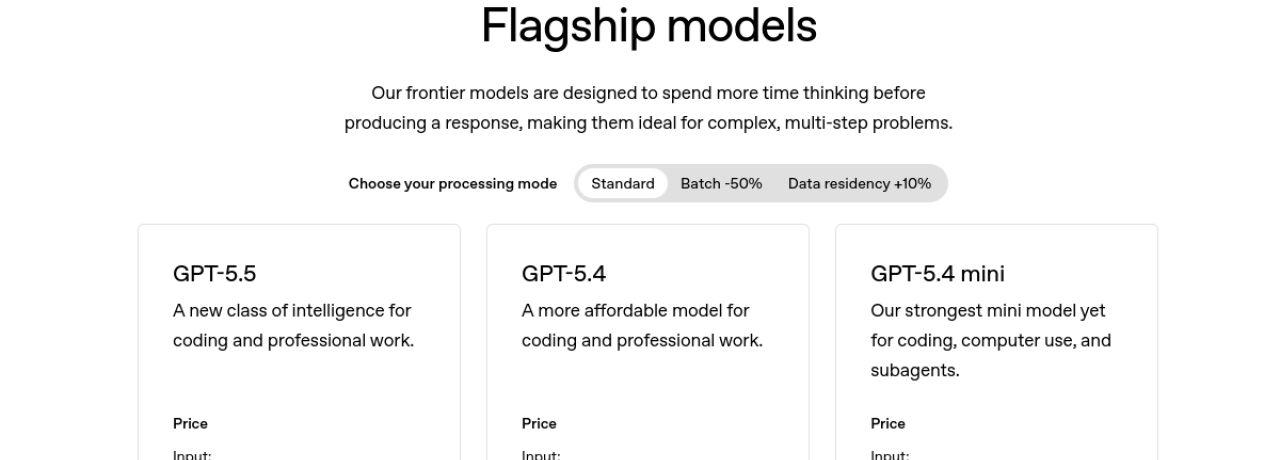
Understanding the pricing for OpenAI's offerings can be a bit nuanced, as Whisper itself is open-source and can be run freely on your own hardware. However, if you opt to use Whisper via OpenAI's API, it falls under a different pricing structure, typically billed per minute of audio processed. The data provided focuses on ChatGPT plans, which are distinct from the Whisper API usage.
For the open-source Whisper model, there are no direct costs from OpenAI beyond the computational resources you provide. For API usage, you would pay based on the volume of audio transcribed. Visit OpenAI.com for exact API pricing details.
The provided data details pricing for ChatGPT plans, which are separate services:
- Free: Limited access to GPT-5.5 Instant, limited messages and uploads, limited and slower image generation, limited deep research, memory, context, and Codex access.
- Go: (Price not provided) Everything in Free, but with more access to GPT-5.5 Instant, more messages, more uploads, more image creation, and longer memory. This plan may include ads.
- Plus: (Price not provided) Everything in Go, plus advanced reasoning with GPT-5.5 Thinking, expanded messages and uploads, more complex and accurate image creation, expanded deep research and agent mode, expanded memory and context, projects, tasks, custom GPTs, expanded Codex usage, and early access to new features.
- Pro: (Price not provided, "From / month") Everything in Plus, with 5x or 20x more usage, Pro reasoning with GPT-5.5 Pro, maximum Codex tasks, unlimited GPT-5.3 and file uploads, unlimited and faster image creation, maximum deep research and agent mode, maximum memory and context, expanded projects, tasks, and custom GPTs, and research preview of new features. Subject to abuse guardrails.
It's crucial to note that the pricing details provided are for ChatGPT plans and do not directly reflect the cost of using the OpenAI Whisper API. For Whisper API costs, users should consult the official OpenAI API documentation.
User Reviews and Sentiment
User feedback paints a comprehensive picture of OpenAI Whisper's strengths and weaknesses, highlighting its impact across various developer communities.
G2 Ratings and Key Quotes
OpenAI Whisper holds a respectable 4.5 out of 5 stars on G2 based on 14 reviews. Users on G2 frequently praise its "intuitive interface and impressive speech recognition capabilities," often citing its "accurate transcription and reliable performance." Ease of setup (9.4/10) and collaboration features (9.0/10) also receive high marks.
However, some critical feedback mentions a "less polished" interface compared to competitors, suggesting a potentially "steeper learning curve" for some users. It's worth noting that some reviews on G2 seem to be mistakenly attributed, praising features of other services like Google Cloud Speech-to-Text or mentioning pricing concerns for AssemblyAI.
Reddit and Developer Community Opinions
Reddit, Hacker News, and DEV Community threads offer a more granular view, particularly from developers. Many users appreciate Whisper's ability to run locally on a CPU, even on laptops, without requiring a GPU or cloud billing. This is a significant advantage for privacy-sensitive applications and cost-conscious developers. The open-source nature also fosters extensive customization and community support.
Users generally find the larger Whisper models to be "surprisingly good in terms of transcription quality." It's frequently used as a backend for diverse applications, from AI-powered voice assistants to content summarization.
Common Criticisms and Limitations
Despite the praise, several common criticisms emerge:
- Speed: Whisper can be "slow" for some users, especially when running on less powerful hardware or compared to highly optimized cloud alternatives. Transcription can take "meaningful time on older hardware" for longer videos.
- Hallucinations: A frequently reported issue is Whisper generating text that wasn't spoken, particularly during silence or low-activity audio. This can include "random words and repetitions" or even "violent language," attributed to its diverse training data, including YouTube videos.
- Punctuation: Users report "broken punctuation" or "degraded punctuation," especially when processing audio in 30-second second chunks.
- Accuracy in Low-Resource Languages: While supporting 99 languages, accuracy can be "unreliable" in under-represented languages.
- Resource Intensity: Running Whisper, particularly larger models, can be "CPU/GPU-heavy."
- Lack of Real-time Streaming (for the base API): The standard Whisper API is file-upload-only with a 25MB cap, lacking inherent real-time streaming capabilities. However, OpenAI has introduced `gpt-realtime-whisper` for streaming, addressing this for some use cases.
- No Diarization: The base Whisper model does not inherently distinguish between speakers, requiring additional tools or engineering effort for speaker separation.
- Installation Issues: Some users report installation challenges, particularly for less experienced developers.
Integrations
As an open-source model, OpenAI Whisper's integration capabilities are largely driven by developer ingenuity and community contributions. While there isn't a pre-defined list of official integrations in the way a SaaS product might have, its Python-based inference code and API allow for broad compatibility.
Developers commonly integrate Whisper into their custom applications using Python, often leveraging libraries like Hugging Face Transformers for easier model management. Its output (transcribed text, timestamps) can then be piped into other tools for further processing, such as:
- AI-powered Voice Assistants: For converting user speech into text commands.
- Content Summarization Tools: Providing transcripts for large audio/video files.
- Data Analysis Workflows: Transcribing interviews or meetings for qualitative analysis.
- Video Editing Software: Generating subtitles or captions automatically.
- Custom Chatbots: Enabling voice input for conversational AI.
The availability of an official OpenAI API also simplifies integration for those who prefer not to self-host, allowing access to Whisper's capabilities through standard API calls.
Pros & Cons of OpenAI Whisper
Pros:
- High Accuracy: Generally praised for impressive transcription accuracy across diverse audio.
- Multilingual and Multitask Capabilities: Excellent support for numerous languages, plus translation and language identification.
- Open-Source Flexibility: Allows for local hosting, customization, and integration into bespoke applications, offering privacy and cost control.
- Robustness: Performs well against accents, background noise, and technical language due to diverse training data.
- Active Community: Strong developer community support for troubleshooting and new developments.
Cons:
- Resource Intensive: Can be CPU/GPU-heavy, especially for larger models or longer audio, potentially slow on older hardware.
- Hallucinations: Prone to generating non-existent text during silence, sometimes with undesirable content.
- Punctuation Issues: Degraded or broken punctuation can occur, particularly with 30-second chunk processing.
- No Native Diarization: Does not inherently distinguish between speakers, requiring additional engineering.
- Limited Real-time Streaming (Base Model/API): Standard API is file-upload only, though `gpt-realtime-whisper` offers a solution.
- Accuracy Varies by Language: Can be unreliable for low-resource languages.
- Initial Setup Complexity: May have a "steeper learning curve" or "installation issues" for beginners.
Who Is OpenAI Whisper For?
OpenAI Whisper is primarily targeted at developers, researchers, and organizations looking for a powerful, flexible, and often self-hostable speech recognition solution. It's ideal for:
- AI/ML Engineers: Who want to integrate advanced ASR into custom applications or conduct speech research.
- Startups and SMEs: Seeking cost-effective, high-quality transcription, especially if they have the technical expertise to self-host.
- Privacy-Conscious Organizations: Those needing to process sensitive audio data on-premises without sending it to third-party cloud providers.
- Multilingual Content Creators: For generating accurate transcripts and translations for global audiences.
- Academics and Researchers: Utilizing the open-source nature for experimentation and building upon the model.
It's less suited for end-users seeking a simple, plug-and-play transcription service without any technical involvement, as its primary interface is programmatic.
Alternatives to OpenAI Whisper
While OpenAI Whisper offers compelling advantages, several alternatives cater to different needs and budgets:
- Google Cloud Speech-to-Text: A robust, enterprise-grade cloud service known for high accuracy, real-time streaming, and extensive language support. It's a strong contender for large-scale, managed deployments with specific SLAs. Users on G2 (mistakenly citing Whisper) have praised its integration with Google Cloud services.
- Amazon Transcribe: Amazon's managed ASR service, offering features like speaker diarization, custom vocabulary, and real-time transcription. Excellent for AWS-centric ecosystems.
- AssemblyAI: Specializes in advanced audio intelligence, offering features like summarization, content moderation, and speaker diarization on top of high-quality transcription. A G2 review (mistakenly for Whisper) noted "The pricing could be better, we could think of using it more" for AssemblyAI, indicating it might be a premium option.
- Deepgram: Known for its speed and accuracy, particularly in real-time streaming scenarios. Offers highly customizable models.
- Mozilla DeepSpeech (Legacy): An older, open-source alternative, though less actively developed compared to Whisper. Suitable for those seeking completely free, self-hosted options with potentially lower accuracy than state-of-the-art models.
- Hugging Face Transformers (other ASR models): The Hugging Face ecosystem hosts numerous other pre-trained ASR models that can be fine-tuned or used directly, offering a similar developer-centric approach to Whisper.
The choice between these alternatives and Whisper often comes down to the need for self-hosting vs. managed services, specific feature requirements (like diarization or real-time streaming), budget, and existing cloud infrastructure.
WiseRankr Verdict
OpenAI Whisper stands as a formidable player in the speech recognition arena, particularly for those seeking an open-source, highly accurate, and multilingual solution. Its ability to run locally provides unparalleled privacy and cost control, a significant draw for developers and organizations with specific security requirements.
However, it's not without its quirks. The occasional "hallucinations," punctuation inconsistencies, and resource intensity mean that while it's powerful, it may require additional engineering effort to refine its output for production-grade applications. For use cases demanding real-time streaming or integrated speaker diarization out-of-the-box, developers might need to explore supplementary tools or consider managed cloud services.
Overall, for its core purpose—robust, multilingual speech transcription and translation—OpenAI Whisper delivers exceptional value, especially given its open-source availability. It’s an essential tool for developers building the next generation of voice-enabled applications, provided they are prepared to handle some of its inherent limitations through clever implementation.
Frequently Asked Questions
Q: Is OpenAI Whisper free to use?
A: Yes, the core OpenAI Whisper model is open-source and can be downloaded and run on your own hardware for free. If you choose to use it via the OpenAI API, there will be associated costs based on usage (e.g., per minute of audio processed), which are separate from the ChatGPT subscription plans.
Q: Can OpenAI Whisper perform real-time transcription?
A: The base Whisper API is primarily designed for file-upload transcription (up to 25MB). However, OpenAI has introduced `gpt-realtime-whisper` for streaming, and developers can implement real-time processing by chunking audio and feeding it to locally run Whisper models.
Q: Does Whisper support speaker diarization (identifying different speakers)?
A: No, the base OpenAI Whisper model does not inherently perform speaker diarization. To distinguish between speakers, you would need to integrate additional tools or apply engineering solutions on top of Whisper's output.
Q: How accurate is OpenAI Whisper for different languages?
A: OpenAI Whisper generally offers high accuracy across many languages, thanks to its diverse training data. However, user reports suggest that its accuracy can be "unreliable" in "low-resource languages" compared to more widely spoken ones.