
Quartile Review: Unlocking E-commerce Ad Performance with AI
As senior tech writers at WiseRankr.com, we're constantly evaluating tools designed to give businesses an edge in the competitive digital landscape. Today, we're diving deep into Quartile, an AI-powered platform specifically engineered to optimize e-commerce advertising campaigns across various marketplaces. In an era where every ad dollar counts, and customer acquisition costs are steadily climbing, tools promising intelligent automation and performance uplift are more critical than ever.
Quartile positions itself as a comprehensive solution for brands and agencies looking to maximize their return on ad spend (ROAS) on platforms like Amazon, Walmart, Instacart, and Google. But does it truly deliver on its ambitious claims? Let's break down what Quartile offers, how it works, and whether it's the right fit for your e-commerce advertising strategy.
Overview: What is Quartile?
Quartile is an artificial intelligence and software-as-a-service (AI/SaaS) platform designed for e-commerce advertising management and optimization. Its core mission is to help brands and agencies achieve better performance from their ad campaigns by leveraging machine learning to automate bidding, keyword management, budget allocation, and even product targeting. Essentially, it aims to take the guesswork and manual labor out of managing complex ad portfolios across multiple retail media channels.
Founded in 2016, Quartile has grown to manage billions in ad spend, positioning itself as a significant player in the retail media optimization space. It's not just a reporting tool; it's an active management platform that makes real-time adjustments based on performance data and predefined goals. This proactive approach is what differentiates it from simpler analytics dashboards.
The Philosophy Behind Quartile
The fundamental idea behind Quartile is that human advertisers, no matter how skilled, cannot process and react to the sheer volume of data points and market fluctuations as efficiently as a sophisticated AI. By automating these tasks, Quartile aims to free up advertisers to focus on strategic initiatives, creative development, and overarching brand strategy, rather than getting bogged down in daily bid adjustments and keyword harvesting.
Key Features: Diving Deep into Quartile's Capabilities
Quartile boasts an impressive suite of features, all centered around enhancing e-commerce ad performance. Here's a closer look at what makes it tick:
AI-Powered Bid Optimization
This is arguably Quartile's flagship feature. The platform uses machine learning algorithms to analyze historical performance data, market trends, and competitive landscape information to automatically adjust bids across your campaigns. Instead of relying on static rules or manual adjustments, Quartile's AI continuously learns and adapts to maximize ROAS or other specified objectives (e.g., sales volume, ACOS/TACOS targets). It can manage bids at the keyword, product, and campaign level, ensuring granular control.
Cross-Channel Campaign Management
One of Quartile's significant strengths is its ability to integrate and manage campaigns across multiple major e-commerce advertising platforms. This includes:
- Amazon Ads: Sponsored Products, Sponsored Brands, Sponsored Display, and DSP.
- Walmart Connect: Sponsored Products and Sponsored Brands.
- Instacart Ads: For grocery and CPG brands.
- Google Shopping/Ads: Extending optimization beyond just retail media networks.
- Facebook/Instagram Ads: For a more holistic ad strategy.
This multi-platform capability is a huge time-saver for brands selling on various channels, providing a unified view and centralized management hub.
Automated Keyword Harvesting and Management
Identifying new, high-performing keywords and pruning underperforming ones is a continuous challenge for advertisers. Quartile automates this process. It can analyze search term reports, identify emerging trends, and automatically add relevant keywords to your campaigns (both exact and broad match). Conversely, it can also identify and negative match irrelevant or costly search terms, preventing wasted ad spend. This feature is particularly valuable for long-tail keyword discovery.
Budget Optimization and Allocation
Quartile's AI doesn't just optimize bids; it also intelligently allocates budgets across campaigns and even across different platforms. If one campaign or product line is significantly outperforming others, the system can dynamically shift budget towards it to capture more sales, all while staying within overall spending limits. This ensures that your ad spend is always directed towards the areas with the highest potential return.
Advanced Reporting and Analytics
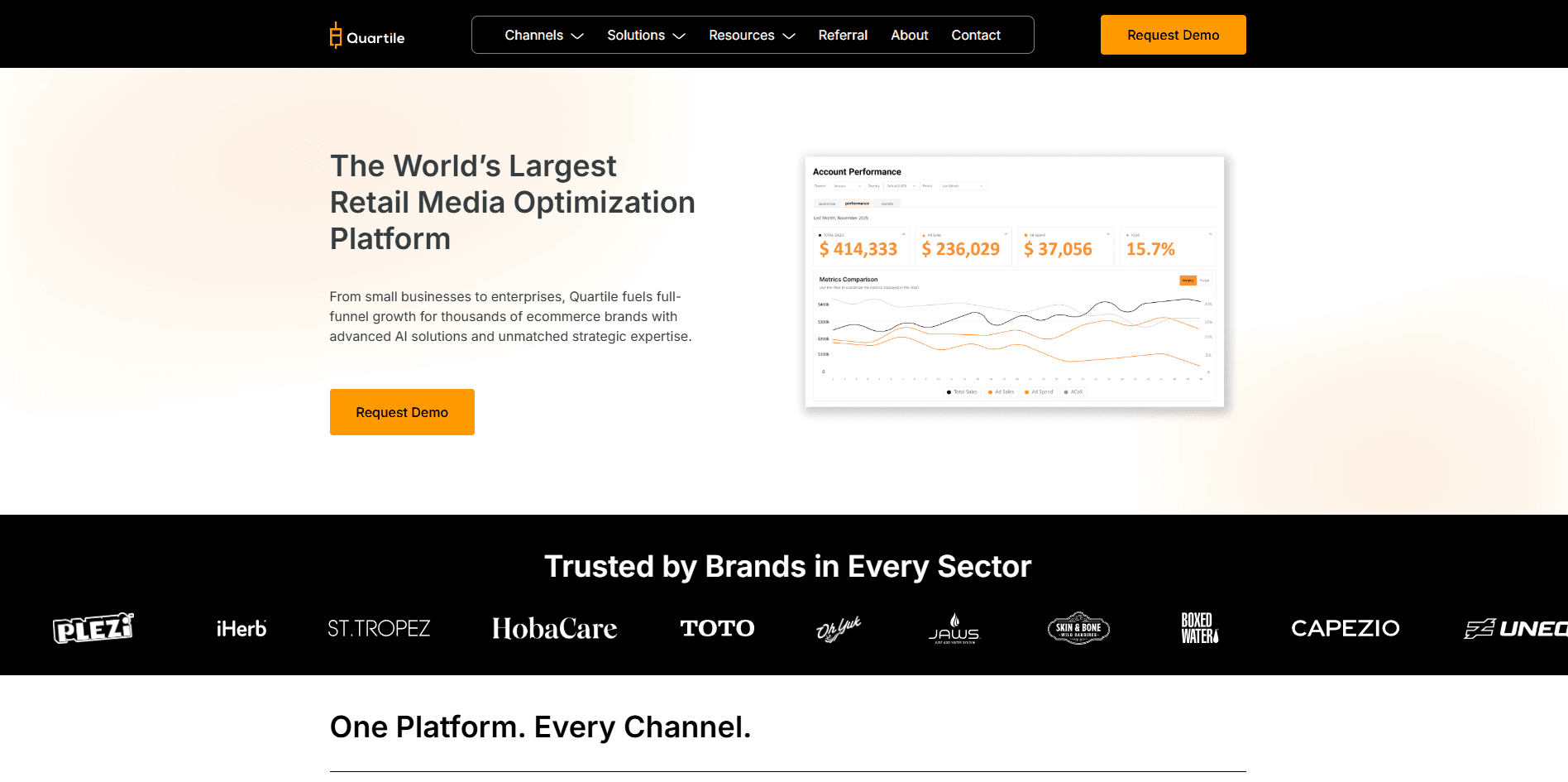
While the automation is key, understanding performance is equally vital. Quartile provides robust reporting dashboards that offer deep insights into campaign performance, ROAS, ACOS, sales attribution, and more. Users can customize reports, track key metrics over time, and gain a clearer understanding of their advertising effectiveness. This allows for data-driven strategic decisions, even if the daily optimizations are handled by AI.
Product-Level Optimization
Beyond keywords and bids, Quartile also focuses on optimizing at the product level. It can identify which products are performing best (or worst) and adjust ad strategies accordingly. This might involve increasing bids for high-margin, high-conversion products, or pausing ads for products that consistently fail to convert, helping to refine your product catalog's advertising efficiency.
Competitive Intelligence (Limited)
While not a primary feature, Quartile can offer some rudimentary competitive insights by showing general trends in your market segment based on aggregated data. However, for deep competitive analysis, you might still need dedicated competitive intelligence tools.
Pricing: The Elephant in the Room
One of the most frequently asked questions about any premium AI/SaaS tool is its pricing. Unfortunately, Quartile, like many enterprise-grade solutions in the retail media space, does not publicly disclose its pricing on its website. This typically indicates a tiered pricing model, often based on a percentage of ad spend managed, the number of channels integrated, or a custom quote based on the client's specific needs and scale.
What we can infer:
- Enterprise-focused: Given its comprehensive features and multi-channel capabilities, Quartile is likely geared towards medium to large e-commerce businesses, agencies managing multiple clients, and brands with significant monthly ad spend (e.g., tens of thousands to millions of dollars).
- Value-based pricing: The pricing model is almost certainly designed to reflect the value it provides in terms of increased ROAS and efficiency. If Quartile can demonstrably improve your ad performance by X%, its fee will be a fraction of that gain.
- Custom Quotes: Expect to engage with their sales team for a personalized demo and a custom pricing proposal tailored to your specific ad spend, desired features, and the complexity of your campaigns.
Our advice: If you're considering Quartile, prepare for a significant investment. However, if your ad spend is substantial and you're struggling to scale or optimize effectively, the potential ROI could easily justify the cost. It's crucial to get a clear understanding of their pricing structure and compare it against the expected performance improvements during your evaluation.
Pros & Cons: A Balanced Perspective
No tool is perfect, and Quartile is no exception. Here's a balanced look at its advantages and potential drawbacks.
Pros of Using Quartile
- Significant ROAS Improvement: Many users report substantial increases in Return on Ad Spend and reductions in ACOS/TACOS due to the AI's continuous optimization. This is the primary reason businesses invest in Quartile.
- Time Savings through Automation: The automation of bidding, keyword management, and budget allocation frees up advertisers to focus on higher-level strategy, creative development, and business growth rather than tedious daily adjustments.
- Multi-Channel Management: Consolidating ad management across Amazon, Walmart, Instacart, Google, and Facebook into a single platform is a massive advantage for brands with a diversified e-commerce presence.
- Data-Driven Decisions: The advanced reporting and analytics provide deep insights, allowing for better strategic decision-making even for those not directly managing the day-to-day optimizations.
- Scalability: Quartile is built to handle large ad accounts and complex portfolios, making it ideal for scaling brands and agencies. It can manage thousands of keywords and products efficiently.
- Proactive Optimization: Unlike reactive manual adjustments, Quartile's AI is constantly learning and making proactive changes, often identifying opportunities or mitigating issues before a human could.
Cons of Using Quartile
- High Cost/No Public Pricing: The lack of transparent, public pricing makes it difficult for smaller businesses to even consider it. The investment required is likely significant, potentially pricing out SMBs.
- Learning Curve: While the AI automates much of the work, understanding how to configure Quartile, set goals, and interpret its advanced reports still requires a certain level of advertising expertise. It's not a "set it and forget it" tool for complete novices.
- Reliance on AI: While a pro, it can also be a con. Over-reliance on AI without understanding its logic or periodically auditing its decisions can lead to unexpected outcomes if the initial setup or goals are misconfigured.
- Limited Creative Control: Quartile excels at the bidding and targeting aspects, but it doesn't directly assist with ad creative development (images, copy, video). That remains a human-driven task.
- Integration Limitations: While it integrates with major platforms, specific niche marketplaces or ad networks might not be supported, requiring separate management.
- Black Box Tendencies: Like many sophisticated AI tools, the exact "why" behind every single bid adjustment or budget shift can sometimes feel like a black box to users, which can be unsettling for those who prefer complete control and transparency.
Who Is Quartile For?
Given its capabilities and likely pricing, Quartile is best suited for:
- Medium to Large E-commerce Brands: Companies with significant monthly ad spend (e.g., $10,000+ per month across platforms) that are looking to maximize their ROAS and scale their advertising efforts.
- E-commerce Agencies: Agencies managing multiple client accounts across various retail media networks can leverage Quartile to streamline operations, improve client results, and free up their team's time.
- Brands with Multi-Channel Presence: If you're selling on Amazon, Walmart, and also running Google Shopping or Facebook Ads, Quartile's unified platform offers immense value.
- Businesses Seeking Automation and Efficiency: Companies where manual ad management is becoming unsustainable due to scale or complexity, and who are willing to invest in AI to gain an edge.
- Advertisers Focused on ROAS/ACOS: Brands whose primary goal is to optimize for profitability and efficiency rather than just raw impression volume.
Who it might NOT be for:
- Small Businesses/Startups: With limited ad budgets, the cost of Quartile might outweigh the benefits, and simpler, more affordable tools or manual management might be sufficient.
- Advertisers with Minimal Ad Spend: If you're spending only a few hundred or a couple of thousand dollars a month, the overhead of a tool like Quartile is likely not justified.
- Those Who Prefer Absolute Manual Control: If you're an advertiser who needs to meticulously control every single bid and setting without AI intervention, Quartile's automation might feel too hands-off.
Alternatives to Quartile
The e-commerce ad optimization space is growing, and several other robust platforms offer similar (though sometimes more specialized) functionalities:
- Pacvue: A direct competitor, offering comprehensive retail media optimization across Amazon, Walmart, Instacart, and other platforms. Similar enterprise-level features and pricing model.
- Flywheel Digital (now part of Ascential): Another major player, often used by very large brands and agencies for Amazon and other retail media management.
- Sellozo: Focuses primarily on Amazon Ads, offering AI optimization and automation. Often seen as a strong alternative for Amazon-centric brands.
- Perpetua: Specializes in Amazon, Walmart, and Instacart, providing AI-powered campaign management and optimization.
- Skai (formerly Kenshoo/Marin Software): A broader enterprise-level platform for search, social, and retail media, suitable for very large, complex advertising portfolios.
When evaluating alternatives, consider the specific platforms you advertise on, your budget, and the level of automation versus control you prefer.
Verdict: Is Quartile Worth the Investment?
After a thorough examination, our verdict on Quartile is largely positive, with important caveats. For the right type of business – specifically, medium to large e-commerce brands and agencies with significant ad spend across multiple retail media channels – Quartile presents a compelling value proposition.
Its AI-powered automation can genuinely transform ad performance, leading to higher ROAS, reduced ACOS, and substantial time savings. The ability to manage diverse campaigns from a single dashboard is a game-changer for operational efficiency. If you're currently struggling with manual optimization, experiencing diminishing returns, or simply can't keep up with the complexity of multi-platform advertising, Quartile offers a sophisticated solution.
However, the lack of transparent pricing means it's not a tool for everyone. Prospective users must be prepared for a substantial investment and should engage with Quartile's sales team to understand the ROI potential specific to their business. It's crucial to go into the evaluation process with clear goals and metrics to determine if the expected performance uplift justifies the cost.
In essence, Quartile is a powerful tool for those ready to embrace advanced AI automation in their e-commerce advertising strategy. It's not a magic bullet, and still requires strategic oversight, but it can be an incredibly effective engine for growth and profitability when wielded correctly by the right hands.