In the rapidly evolving landscape of AI content generation, tools like Rytr and Article Forge promise to revolutionize how businesses create written material. But are these two platforms direct competitors, or do they cater to distinct needs? Understanding their core functionalities and target audiences is crucial for making an informed decision in 2026.
This comparison will delve into Rytr and Article Forge, examining their features, pricing, and user sentiment to help you determine which AI writing assistant best suits your content strategy.
Rytr Overview: Streamlined Short-Form Content Creation
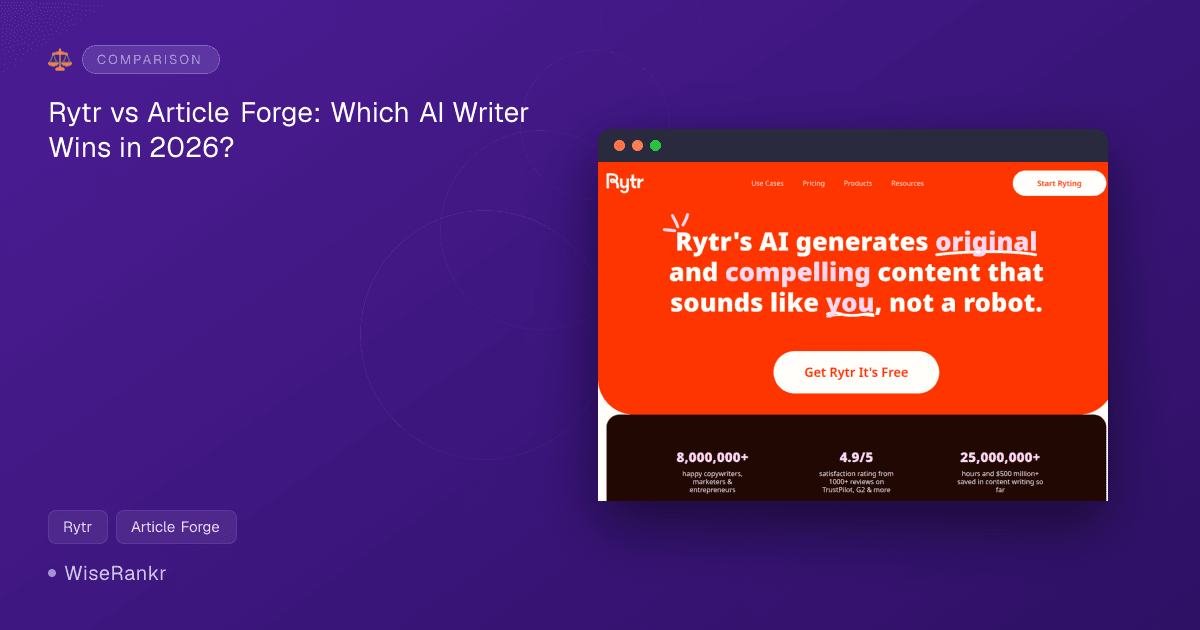
Rytr positions itself as an AI writing assistant designed to help users create high-quality content efficiently and affordably. With over 8,000,000 happy users, it focuses on versatility, offering more than 40 use cases and templates across various content types, including marketing, creative writing, and personal shortcuts. Rytr aims to generate content that sounds human, not robotic, by analyzing and mirroring your custom tone and style.
Users on G2 and Trustpilot frequently praise Rytr for its value for money, speed, and ease of use, especially for short-form content. However, some feedback points to challenges with factual accuracy and repetition in longer articles. Rytr is ideal for individuals, freelancers, and small businesses needing quick, diverse content generation for social media, ad copy, emails, and blog outlines.
Rytr's Key Competitors:
Rytr operates in a crowded market alongside tools like Jasper, Copy.ai, and Writesonic, all offering a range of AI writing capabilities, often with varying strengths in specific content types or user bases.
Article Forge Overview: Automated Long-Form Article Generation
Article Forge is an AI article writer specifically engineered to generate high-quality, 100% unique, SEO-optimized long-form content automatically. It boasts the ability to produce articles of 1,500+ words in about 60 seconds. Unlike general writing assistants, Article Forge's primary focus is on comprehensive article generation, including automatic research and bulk content creation.
Backed by over a decade of AI research, Article Forge aims to drastically cut down the time and cost associated with creating long-form content. It claims to use deep learning models similar to Google's to ensure SEO optimization. While some users report success with specific topics, others on Trustpilot mention grammatical inaccuracies, inconsistent logical flow, and a perceived slow pace of development compared to other AI tools.
Article Forge's Key Competitors:
In the realm of automated long-form content and SEO article generation, Article Forge competes with tools such as Surfer AI, Scalenut, and Frase, which also emphasize creating SEO-friendly, in-depth articles.
Rytr vs. Article Forge: A Feature Showdown
While both leverage AI for content creation, their feature sets highlight their differing specializations. Here's a direct comparison of their overlapping capabilities:
| Feature | Rytr | Article Forge |
|---|---|---|
| Content Use Cases/Templates | 40+ use cases and templates | Generates 1,500+ word articles (primary use case) |
| Long-Form Content Generation | Yes, with "Continue Ryting" and "AI Paragraph Generator" | Yes, specializes in 1,500+ word articles |
| Plagiarism Checker | Built-in, 50-100 checks/month (paid plans) | Content passes Copyscape (implied plagiarism-free) |
| Customizable Tone/Style | Yes, analyze and mirror user's tone, multiple custom tones (Premium) | Limited control over writing tone (user feedback suggests) |
| Languages Supported | 30+ languages (paid plans), 1 language (Free) | Visit ArticleForge.com for details |
| SEO Optimization | Blog posts mention "Supercharging Your SEO Game" | SEO Optimized Content, uses deep learning models for relevancy |
| Bulk Content Generation | Not explicitly highlighted as a core feature | Yes, a core feature |
| Browser Extension | Chrome Extension available | Not mentioned in data |
| API Access | Visit Rytr.me for details | Yes (Standard plan) |
Pricing Comparison: Which Tool Fits Your Budget?
Pricing is often a key differentiator, and both Rytr and Article Forge offer various tiers to accommodate different user needs. It's important to consider not just the monthly cost but also the included word/character limits and features.
Rytr Pricing:
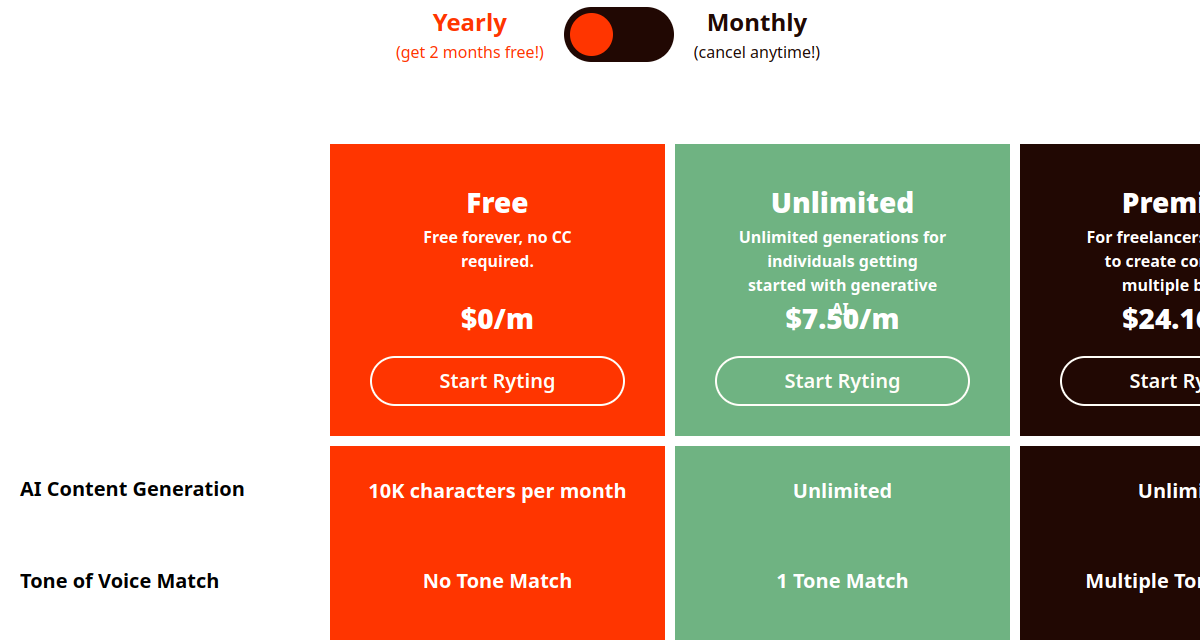
Rytr offers a straightforward three-tier pricing structure, including a generous free plan, making it highly accessible for individuals and small teams.
- Free Plan: $0/month. Includes 10,000 characters per month, 40+ use cases, 1 language, and 5 AI images per month. This plan is excellent for beginners or those with minimal, occasional content needs.
- Unlimited Plan: $7.50/mo billed annually ($9/month billed monthly). Offers unlimited character generation, 50 plagiarism checks per month, 1 tone match, and 20 AI images per month. This plan is well-suited for freelancers and individuals with consistent content requirements.
- Premium Plan: $24.16/mo billed annually ($29/month billed monthly). Provides unlimited character generation, 100 plagiarism checks per month, multiple tone matches, custom use cases, priority support, and 100 AI images per month. This tier targets serious content creators, agencies, and small businesses managing content for multiple brands.
Article Forge Pricing:
Article Forge's pricing is structured around word count and is generally geared towards users with higher volume long-form content needs.
- Standard Plan (1 User):
- 25,000 words/month: $27/mo billed monthly or $13/mo billed annually.
- 250,000 words/month: $57/mo billed monthly or $27/mo billed annually.
- 500,000 words/month: $127/mo billed monthly or $57/mo billed annually.
- Business Plan: Custom words & users. Contact sales for pricing. This enterprise-level plan is designed for larger organizations requiring extensive word counts, multiple user accounts, increased throughput, and a dedicated account manager.
Article Forge also offers a 5-day free trial and a 30-day money-back guarantee, reducing the risk for new users.
Pros and Cons: An Honest Assessment
Rytr
Pros:
- Versatility: Over 40 use cases make it adaptable for diverse short-form content needs.
- Affordability: Excellent value, especially the Free and Unlimited plans, making it accessible for budget-conscious users.
- Ease of Use: Users frequently praise its intuitive interface and quick content generation.
- Tone Customization: Ability to match and create custom tones helps maintain brand voice.
- Chrome Extension: Allows for content generation and improvement directly within other applications.
Cons:
- Long-Form Limitations: Can struggle with generating truly in-depth, nuanced long-form content, often requiring significant editing for coherence and originality.
- Inconsistent Quality: Content quality can vary, sometimes producing repetitive phrases or lacking factual accuracy.
- Customer Service Concerns: Recent AppSumo reviews indicate issues with account downgrades and difficulty contacting support for some users.
Article Forge
Pros:
- Automated Long-Form: Specializes in generating full, long-form articles (1,500+ words) with a single click.
- SEO Focus: Designed to produce SEO-optimized content, aiming for Google's algorithms.
- Bulk Generation: Ideal for users needing to produce a large volume of articles quickly.
- Plagiarism-Free Claims: Content is stated to pass Copyscape, ensuring uniqueness.
Cons:
- Quality Concerns: User reviews mention grammatical inaccuracies, inconsistent logical flow, and generic content, often requiring heavy editing.
- Limited Control: Less granular control over writing tone and style compared to more versatile tools.
- Slow Development: A Trustpilot review from July 2024 noted a lack of updates, raising concerns about its pace of innovation.
- Technical Glitches: Some users have reported issues with integrations and unresponsive support.
- Higher Entry Price: While effective for bulk, the per-month cost is higher for lower word counts compared to Rytr's entry tiers.
Who Should Use Which Tool?
Rytr and Article Forge cater to fundamentally different content creation workflows and objectives. Therefore, the "better" tool depends entirely on your specific requirements.
Choose Rytr if:
- You primarily need to generate short-form content like social media posts, ad copy, email snippets, product descriptions, or blog outlines.
- You are a freelancer, small business owner, or individual content creator looking for an affordable, versatile AI writing assistant.
- You value a user-friendly interface and quick content generation across many different formats.
- You need a Chrome extension to generate and improve content directly within other platforms.
- You want to experiment with AI writing without a significant financial commitment, thanks to its robust free plan.
Choose Article Forge if:
- Your main priority is to automatically generate complete, long-form articles (1,000+ words) for blogs, websites, or PBNs.
- You need to produce content in bulk and are looking for a tool that can handle high volumes of article generation.
- SEO optimization is a critical factor, and you are comfortable with the tool's automated approach to content structure and keyword usage.
- You are an SEO agency, affiliate marketer, or webmaster managing numerous websites that require a constant influx of new articles.
- You are willing to invest time in editing and fact-checking the generated articles to ensure accuracy and human-like quality.
The Ultimate AI Content Tool for 2026
In 2026, the choice between Rytr and Article Forge boils down to your core content strategy. Rytr excels as a versatile, affordable AI writing assistant for diverse short-form content, perfect for quick marketing copy, social media updates, and initial drafts. Its strong user satisfaction and broad range of use cases make it a compelling choice for individuals and small teams seeking efficiency.
Conversely, Article Forge is a specialized tool for automated long-form article generation, particularly for SEO-focused content in bulk. While it promises significant time savings for generating full articles, users should be prepared for potential quality variations and the need for human oversight to ensure accuracy and natural flow. It's a tool for volume, where the initial draft generation is paramount, even if it requires refinement.
For many, particularly those with varied content needs, using both tools might be a complementary strategy: Rytr for daily short-form content and Article Forge for mass-producing long-form articles that can then be edited and optimized further.