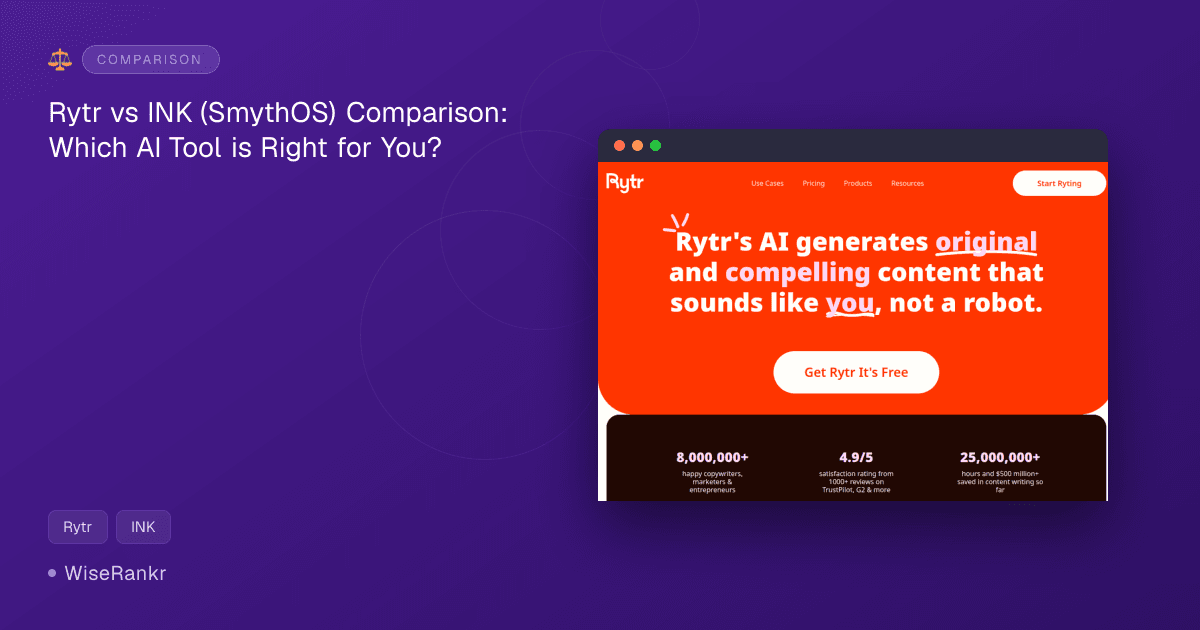
Are you struggling to produce high-quality content consistently? In 2026, the demand for engaging, optimized content is higher than ever, and AI writing tools have become indispensable for many businesses and individuals. But with so many options available, choosing the right one can be daunting. Today, we're diving into a comparison of Rytr vs INK to help you determine which platform best suits your content creation needs.
It's crucial to understand upfront that while both Rytr and INK leverage AI for content, they cater to distinctly different use cases and target audiences. This isn't a head-to-head battle for supremacy, but rather an exploration of which tool excels in its specific domain and when you might even need to consider both.
Rytr: Your Efficient AI Writing Assistant for Diverse Content Needs
Rytr positions itself as an AI writing assistant designed to help users create high-quality content quickly and affordably. It's built for individuals, freelancers, marketers, and entrepreneurs who need to generate a wide variety of short-form and some long-form content without a steep learning curve.
Users on G2, Trustpilot, and AppSumo frequently praise Rytr for its ease of use, speed, and value for money. It aims to streamline the writing workflow across numerous applications, from social media posts to blog outlines.
Rytr's main competitors in the general AI writing assistant space include Jasper, Copy.ai, and Writesonic.
Key Features of Rytr
Rytr offers a robust set of features geared towards versatility and efficiency:
- 40+ Use Cases and Templates: A broad selection for various content types, including blog ideas, ad copy, social media posts, and email subject lines.
- Long-form Content Generation: While primarily known for short-form, it includes features like AI Autocomplete, Text Editing: Continue Writing, and AI Paragraph Generator to assist with longer pieces.
- Supports 30+ Languages: Enables content creation for a global audience.
- Customizable Tone and Style: Users can create multiple custom tones or select from 20+ pre-programmed tones to match their brand voice. Rytr can also analyze writing samples to mirror a user's tone.
- Built-in Plagiarism Checker: Helps ensure content uniqueness, with 50-100 checks per month depending on the plan.
- Browser Extension: A Chrome extension allows users to generate and improve content directly within other applications and platforms.
- Text Editing Tools: Includes Text Inflator, Rewording Generator, Sentence Shortener, and Grammar Checker & Text Improver.
INK: The Enterprise AI Agent Infrastructure for Engineering Teams
INK, or more accurately, SmythOS (as per the scraped data), is presented as an open-source provider of enterprise-grade AI agent infrastructure. This tool is not an AI writing assistant in the traditional sense. Instead, it's a platform designed for engineering teams to build, run, and scale AI agents. Its focus is on secure, aligned automation at scale, providing a complete agent engineering stack.
The target audience for SmythOS is clearly enterprise engineering teams, developers, and organizations looking to implement sophisticated AI agent solutions within their infrastructure. It emphasizes security, scalability, and developer-friendly tools.
Based on the provided data, INK (SmythOS) exists in a highly specialized niche, with no direct competitors listed among general AI writing tools. Its competition would be in the realm of AI agent development platforms and enterprise AI infrastructure providers.
Key Features of INK (SmythOS)
SmythOS offers a comprehensive suite of features for AI agent development and deployment:
- Agent Runtime: Securely runs AI agents cloud-to-edge with strict sandboxing and ACL enforcement, ensuring agent alignment and ROI.
- Agent SDK: A developer toolkit for coding AI agents 10X faster, optimized for cursor & windsurf, supporting pure code, workflows, or visual workflow skills.
- Agent Visual Studio: A visual development environment for drag & drop workflows, text & image interaction with Agent Weaver, and an IDE for observability and testing. It supports one-click deployment to any platform.
- Agent Services: Provides assistance to teams in deploying AI agents into production, including training and long-term support.
- Open Source: Components like Agent Runtime and Agent SDK are available as open source on GitHub.
- Deployment Flexibility: Available as a free Docker Image, hosted SaaS, and on-premise, OEM, or enterprise cloud solutions like AWS & Azure.
Feature Comparison: Rytr vs INK (SmythOS)
Given the distinct nature of these two tools, a direct feature comparison is challenging as they operate in different spheres. However, we can highlight their primary functionalities:
| Feature Category | Rytr | INK (SmythOS) |
|---|---|---|
| Primary Function | AI Content Generation & Writing Assistant | Enterprise AI Agent Infrastructure & Development |
| Content Types | Short-form & some long-form text (blogs, ads, emails, social media) | AI Agent Code, Workflows, Visual Models |
| Target User | Freelancers, marketers, content creators, small businesses | Engineering teams, enterprises, AI developers |
| Plagiarism Checker | Yes (50-100 checks/month on paid plans) | Not applicable (focus on agent integrity, not text uniqueness) |
| Language Support | 30+ languages | Visit inkforall.com for details |
| Tone Customization | Yes (custom tones, 20+ pre-programmed) | Not applicable (focus on agent alignment) |
| Browser Extension | Yes (Chrome) | Not applicable |
| SEO Optimization | Indirectly through content generation for SEO purposes | Not applicable (focus on AI agent performance) |
| Deployment/Access | Web-based, Chrome Extension | Open Source (GitHub), Docker, Hosted SaaS, On-prem, Enterprise Cloud |
Pricing Comparison: Rytr vs INK (SmythOS)
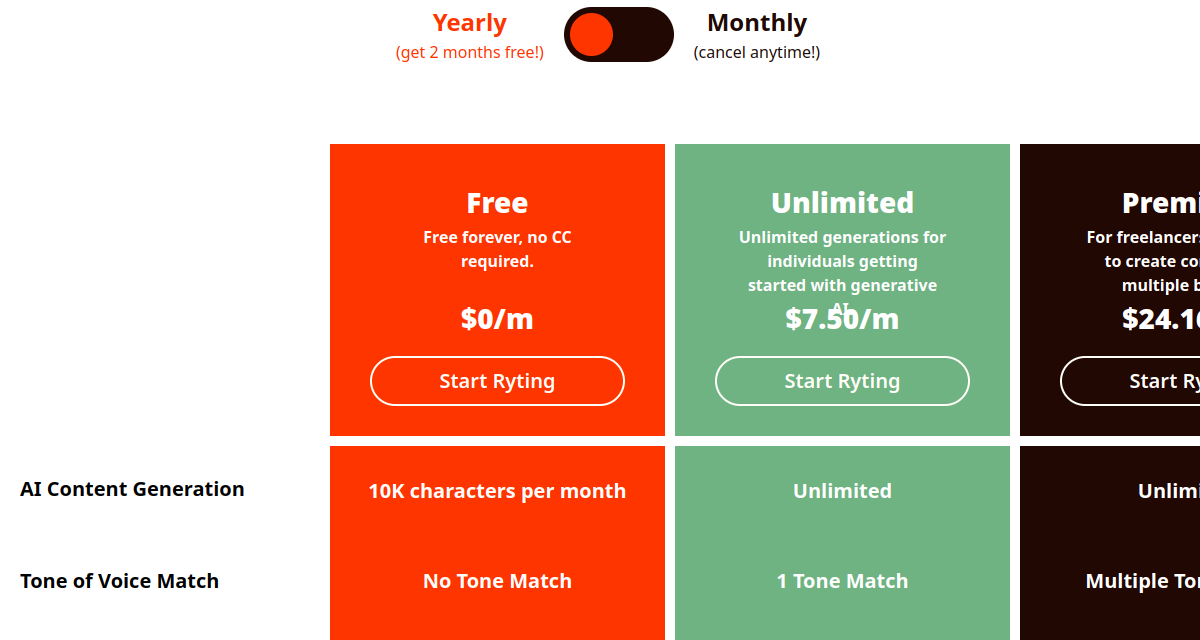
Rytr Pricing
Rytr offers a clear, tiered pricing model, making it accessible for various budgets. All annual plans offer a discount equivalent to two months free.
- Free Plan: $0/month. Includes 10,000 characters per month, 1 language, 20+ Pre-Programmed Tones of Voice, Chrome Extension, and 5 AI images per month. No Tone of Voice Match or Plagiarism Checks.
- Unlimited Plan: $7.50/mo billed annually ($90/yr) or $9/mo billed monthly. Offers Unlimited AI Content Generation, 1 Tone Match, 50 Plagiarism Checks per month, 1 language, Limit Doubled Character Input Limit, and 20 AI images per month.
- Premium Plan: $24.16/mo billed annually ($289.92/yr) or $29/mo billed monthly. Provides Unlimited AI Content Generation, Multiple Tone Match, 100 Plagiarism Checks per month, 35+ Languages, Limit Tripled Character Input Limit, Chrome Extension, 20+ Pre-Programmed Tones of Voice, Access to Exclusive Community, Custom Use Cases, Priority support, and 100 AI images per month.
Rytr's pricing is highly competitive, especially for the unlimited character generation, making it an attractive option for individual content creators and small teams with consistent writing needs. The Free plan is an excellent entry point for those looking to test the waters.
INK (SmythOS) Pricing
Based on the provided data, INK (SmythOS) does not list specific pricing plans on its website. Instead, it encourages users to "Request a Demo" or "Let’s Talk" for Agent Services. It mentions "Download Open Source on GitHub" for Agent Runtime and Agent SDK, and "Available as a free Docker Image, a hosted SaaS for convenience, and on-prem, OEM or enterprise cloud like AWS & Azure" for Agent Visual Studio.
This suggests that INK (SmythOS) operates on a more enterprise-centric model, likely involving custom quotes, potentially subscription-based for hosted SaaS and services, and open-source components with enterprise support options. Therefore, there is no public pricing available for direct comparison.
Who it targets: Given the "Request a Demo" and "Let's Talk" approach, INK (SmythOS) is clearly targeting larger organizations, enterprise clients, and engineering departments with significant budgets for AI infrastructure development and deployment.
Pros and Cons: Rytr
Rytr Pros:
- Affordable & Value-Packed: Users on Trustpilot and G2 consistently highlight its cost-effectiveness, especially for unlimited character generation.
- Ease of Use: Simple interface and a wide array of templates make it easy for beginners to get started.
- Versatile Use Cases: Covers many content types, from short ad copy to blog sections.
- Multilingual Support: Generates content in over 30 languages, beneficial for global outreach.
- Plagiarism Checker: An integrated tool to ensure content originality.
- Chrome Extension: Enhances workflow by allowing content generation directly within other platforms.
Rytr Cons:
- Long-Form Limitations: While it has features for long-form, users on G2 and Trustpilot report that it can struggle with depth, factual accuracy, and repetition in longer articles, often requiring significant human editing.
- Inconsistent Quality: Content quality can vary, and it might produce off-topic or irrelevant output, especially without precise prompting.
- Factual Accuracy Concerns: Like many AI generators, it can occasionally produce factually incorrect information.
- Customer Support Issues (AppSumo): Recent AppSumo reviews mention difficulties with customer support and account downgrades for paid users in late 2025.
- Limited Advanced Features: May not satisfy advanced users needing deep customization or robust SEO analysis tools compared to more specialized competitors.
Pros and Cons: INK (SmythOS)
INK (SmythOS) Pros:
- Enterprise-Grade Solution: Designed for robust, secure, and scalable AI agent deployment.
- Comprehensive Engineering Stack: Offers Agent Runtime, SDK, Visual Studio, and Services for a full AI lifecycle.
- Focus on Security & Alignment: Emphasizes strict sandboxing and ACL enforcement for secure agent operations.
- Developer-Friendly: SDK optimized for rapid AI agent coding.
- Flexible Deployment: Supports open source, Docker, SaaS, and on-premise options.
- Strategic Partner: Positions itself as a full-service partner for secure and aligned automation.
INK (SmythOS) Cons:
- Highly Specialized: Not for general content creation or typical marketing tasks, which might confuse users expecting an AI writing tool.
- No Public Pricing: Requires direct engagement for pricing, indicating a high entry cost for smaller entities.
- Complex for Non-Developers: The platform is clearly built for engineering teams, requiring technical expertise.
- Limited Public Reviews: The provided data lacks extensive public reviews for "SmythOS" specifically, making it harder to gauge widespread user sentiment compared to Rytr.
- Narrow Use Case: Only relevant for organizations building and deploying AI agents, not for everyday content writers.
Who Should Use Which Tool?
Choose Rytr if:
- You are a freelancer, marketer, small business owner, or content creator looking for an affordable and easy-to-use AI writing assistant.
- Your primary need is to generate various types of short-form content quickly, such as social media posts, ad copy, emails, and blog outlines.
- You need a tool that supports multiple languages for international content.
- You want an integrated plagiarism checker and tone customization options.
- You appreciate a Chrome extension for writing assistance across different platforms.
- You are comfortable with some post-generation editing, especially for longer or more nuanced content.
Rytr is an excellent choice for those who need to scale their content output economically and efficiently, understanding that some human oversight will always be necessary for quality and accuracy.
Choose INK (SmythOS) if:
- You are an enterprise, a large organization, or an engineering team focused on developing, deploying, and managing complex AI agents.
- Your objective is secure, scalable, and aligned automation at an infrastructure level.
- You require a comprehensive ecosystem for the entire AI lifecycle, including SDKs, visual development tools, and runtime environments.
- You have the technical expertise and resources to implement and manage enterprise-grade AI solutions.
- You are looking for a strategic partner to assist with AI agent deployment and long-term support.
INK (SmythOS) is unequivocally designed for advanced AI development and infrastructure, not for content generation in the marketing or blogging sense.
Verdict: Two Different Tools for Different Jobs
In the Rytr vs INK (SmythOS) comparison, it's clear these tools are not direct competitors. Rytr is an accessible, versatile AI writing assistant for content creators, emphasizing speed and affordability for generating text. Its strengths lie in its breadth of use cases and user-friendly interface.
Conversely, INK (SmythOS) is an enterprise-level platform for AI agent infrastructure and development, catering to highly technical engineering teams. It's about building and managing autonomous AI systems, not about writing blog posts or marketing copy.
Therefore, the "better" tool depends entirely on your specific needs. If you're a content creator, Rytr is your go-to. If you're an enterprise engineer building AI agents, SmythOS is the relevant solution. A business might even need both: Rytr for their marketing content and SmythOS for their internal AI automation projects. Ensure you visit Rytr.me and inkforall.com to explore their offerings further based on your specific requirements.
People Also Ask
Is Rytr good for long-form content?
Rytr offers features like "Continue Writing" and "AI Paragraph Generator" to assist with long-form content. However, users on G2 and Trustpilot often report that while it can help with outlines and drafts, the quality for in-depth, nuanced long-form articles can be inconsistent and may require significant human editing for factual accuracy, coherence, and to avoid repetitiveness.
What is INK (SmythOS) used for?
INK, operating as SmythOS, is used for building, running, and scaling enterprise-grade AI agents. It provides a complete engineering stack including an Agent Runtime for secure deployment, an Agent SDK for rapid development, and an Agent Visual Studio for visual workflows. It's designed for engineering teams and enterprises focused on AI agent infrastructure and automation, not for general content writing.
Is Rytr free to use?
Yes, Rytr offers a Free plan that includes 10,000 characters per month, access to 40+ use cases, 1 language, 20+ pre-programmed tones of voice, a Chrome extension, and 5 AI images per month. This allows users to try out its core features before committing to a paid plan.
What are the main differences between Rytr and INK (SmythOS)?
The main differences are their core functions and target audiences. Rytr is an AI writing assistant for content creators, marketers, and freelancers, focused on generating various forms of text content efficiently. INK (SmythOS) is an enterprise AI agent infrastructure platform for engineering teams, focused on developing, deploying, and managing complex AI agents and automation systems.