Rytr vs Writesonic: Choosing the Right AI Content & SEO Tool in 2026
In the rapidly evolving landscape of AI-powered content creation, businesses are constantly seeking tools to streamline their workflows and enhance their digital presence. Two prominent players, Rytr and Writesonic, offer distinct approaches to leveraging artificial intelligence for content generation. But are they direct competitors, or do they cater to different needs?
This comparison from WiseRankr.com will delve into Rytr and Writesonic, examining their features, pricing, and target audiences to help you determine which tool aligns best with your 2026 content strategy. While both utilize AI for writing, their core functionalities and strategic focus have diverged significantly.
Rytr: Your Affordable AI Writing Assistant for Diverse Content Needs
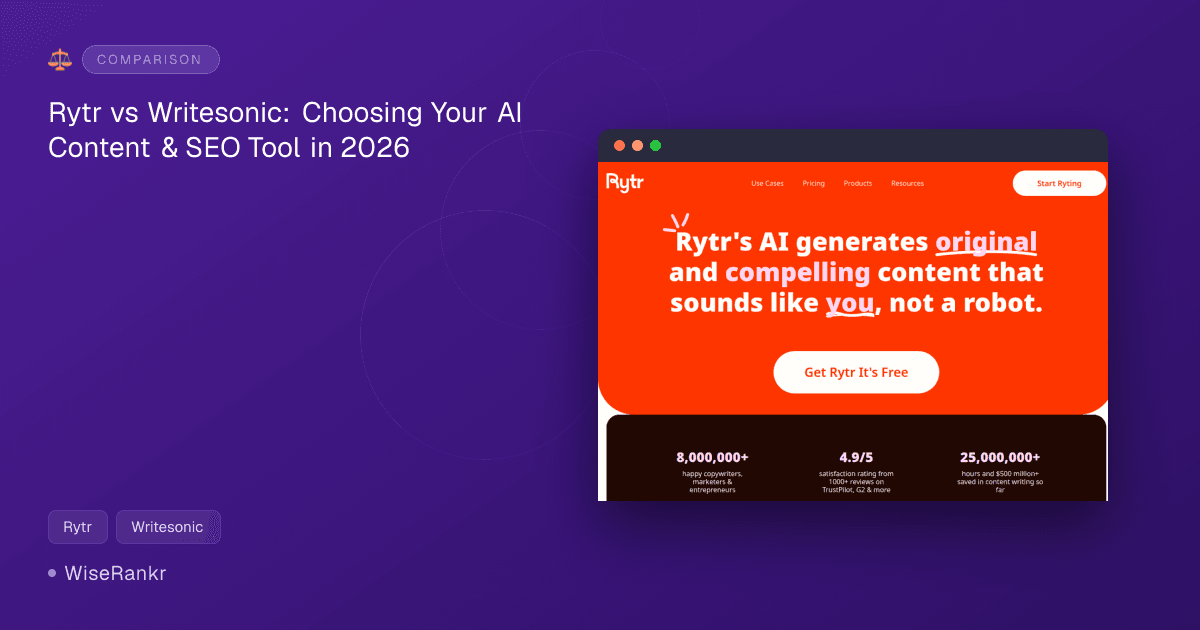
Rytr positions itself as an AI writing assistant designed to help users create high-quality content efficiently and affordably. It's lauded for its versatility, offering over 40 use cases for various content types, from blog posts to social media updates. Rytr aims to generate original and compelling content that mimics a human tone, making it suitable for individuals, freelancers, and small businesses looking to speed up their content production without breaking the bank.
Users on G2, Trustpilot, and AppSumo consistently praise Rytr for its value for money and ease of use, particularly for short-form content. However, some reviews indicate that it can struggle with generating in-depth, long-form articles, occasionally producing repetitive phrases or lacking factual accuracy. Rytr's focus remains squarely on content generation across a broad spectrum of formats.
Rytr's Key Differentiators:
- Broad Use Case Support: Over 40 templates for diverse content needs.
- Multilingual Capabilities: Supports 30+ languages for global content creation.
- Affordable Entry Point: Offers a robust free plan and cost-effective paid tiers.
- Tone Matching: Analyzes user writing to mirror tone and style.
Direct competitors in Rytr's primary niche of general AI writing assistance include tools like Jasper (often seen as a more premium option) and Copy.ai (focused on marketing and sales copy).
Writesonic: The AI Search Visibility & SEO Powerhouse
Writesonic has evolved significantly, shifting its primary focus from general AI writing to becoming an "AI Search Visibility Tracking & Optimization Platform." While it still offers AI content generation, its core value proposition in 2026 is helping brands track and boost their performance in AI search results across platforms like ChatGPT, Gemini, and Perplexity. It integrates SEO capabilities, content strategy, and AI search tracking into a comprehensive platform for optimizing digital presence.
Reviews on Capterra, G2, and Trustpilot highlight its effectiveness for generating drafts and aiding in content production, with many users praising its ability to cut writing time. However, Reddit users frequently mention that Writesonic's output can sound "robotic" and is often flagged by AI detectors, requiring significant human editing. Its current iteration is clearly targeting businesses and agencies focused on advanced SEO and Generative Engine Optimization (GEO).
Writesonic's Key Differentiators:
- AI Search Visibility (GEO): Tracks brand performance across various AI platforms.
- SEO & Content Engine: Builds strategies using Ahrefs and Keyword Planner data, with AI-driven content recommendations.
- Technical SEO Audits: AI-powered fixes for website SEO issues.
- Brand Explorer: Zero-setup research tool for understanding brand perception in ChatGPT.
For its specialized focus on AI Search Visibility and advanced SEO, Writesonic's competitors would include platforms like Semrush (with its ContentShake AI for users) and Surfer SEO (which it integrates with).
Are Rytr and Writesonic Direct Competitors?
In 2026, Rytr and Writesonic serve distinct purposes, making them less direct competitors and more complementary tools for different stages or priorities of a content strategy. Rytr excels as an affordable, versatile AI writing assistant for generating a wide array of content forms. Writesonic, on the other hand, has pivoted to a more specialized role as an AI Search Visibility and SEO optimization platform, with content generation as a supporting feature rather than its sole focus.
A business might use Rytr for quick content generation, social media posts, or initial drafts, while simultaneously leveraging Writesonic to monitor its AI search presence, optimize content for search engines, and build sophisticated GEO strategies.
Feature Comparison: Rytr vs. Writesonic
Below is a comparison of features where these tools might overlap or diverge significantly:
| Feature | Rytr | Writesonic |
|---|---|---|
| AI Content Generation (General) | Yes (40+ use cases) | Yes (AI Article Writer, Product Descriptions, etc.) |
| Long-Form Content Generation | Yes (with noted limitations for depth) | Yes (AI Article Writer, Content Engine) |
| Plagiarism Checker | Yes (up to 100 checks/month on Premium) | Not explicitly listed as built-in; focus on unique content for AI citation. |
| Multilingual Support | Yes (30+ languages) | Yes (Custom languages on Enterprise) |
| Customizable Tone/Style | Yes (Multiple custom tones on Premium) | Yes (Unlimited writing styles on Growth/Enterprise) |
| SEO Optimization Features | Limited (focus on content quality) | Extensive (Content Strategy, SEO Site Audit, AI Search Tracking) |
| AI Search Visibility (GEO) | No | Yes (Tracks ChatGPT, Gemini, Perplexity, etc.) |
| Chrome Extension | Yes | Not explicitly listed as a core feature for writing assistance. |
| AI Image Generation | Yes (5-100 images/month, depending on plan) | Not explicitly listed as a core feature. |
| Customer Support | Priority support on Premium plan | Fast turnarounds, customer-centric (per reviews), Priority support on higher plans. |
Pricing Comparison: Rytr vs. Writesonic
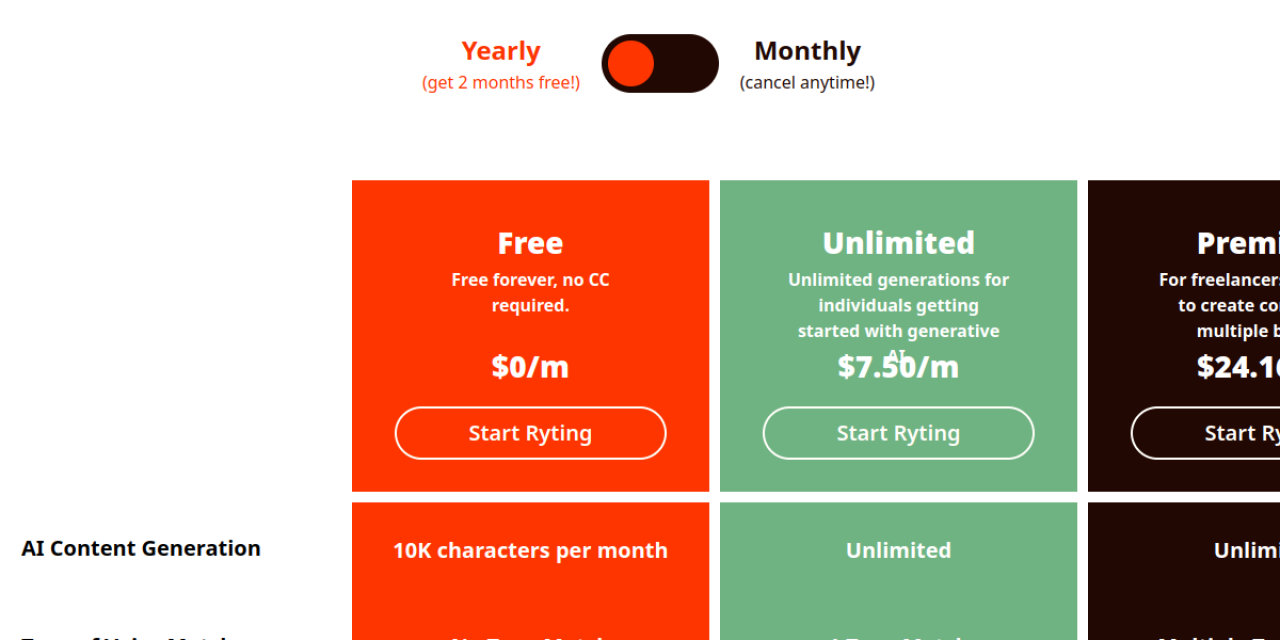
The pricing structures of Rytr and Writesonic reflect their differing target audiences and feature sets. Rytr offers a highly accessible model, while Writesonic's pricing is geared towards businesses with more advanced SEO and AI search visibility needs.
Rytr Pricing:
- Free Plan: $0/month. Includes 10,000 characters per month, 40+ use cases, 30+ languages, 20+ tones, Chrome extension, 5 AI images/month. (Ideal for beginners and casual users)
- Unlimited Plan: $9/month (or $7.50/mo billed annually ($90/yr)). Includes unlimited character generation, 50 plagiarism checks/month, 1 tone match, 20 AI images/month. (Suited for individuals and freelancers starting out)
- Premium Plan: $29/month (or $24.16/mo billed annually ($289.92/yr)). Includes unlimited character generation, 100 plagiarism checks/month, multiple tone matches, custom use cases, priority support, 100 AI images/month. (Best for freelancers and small businesses managing multiple brands/clients)
Rytr's pricing remains competitive and user-friendly, making it a strong option for those focused purely on content generation volume and variety.
Writesonic Pricing:
Writesonic's pricing reflects its shift to a comprehensive AI Search Visibility and SEO platform, with a higher entry point than Rytr.
- Free Trial: Includes 3 AI agent generations (one-time), 1 user, 1 project. (For evaluation purposes)
- Starter: $99/month (or $79/mo billed annually ($948/yr)). Includes 15 AI article generations per month, unlimited AI agent generations, 1 brand voice, AI Search Visibility (GEO) tracking for ChatGPT, Perplexity, Google AI Overviews, etc. (Aimed at growing businesses prioritizing AI search presence)
- Basic: $249/month (or $199/mo billed annually ($2388/yr)). Includes 25 AI article generations per month, unlimited AI agent generations, 1 brand voice, and more advanced GEO features. (For businesses with higher content volume needs and deeper GEO insights)
- Growth: $499/month (or $399/mo billed annually ($4788/yr)). Includes 50 AI article generations per month, unlimited AI agent generations, 5 brand voices, SEO Checker, and all writing tools. (Designed for larger teams and agencies requiring extensive content and SEO capabilities)
- Enterprise: Custom pricing. Tailored for large brands & agencies with specific needs for custom AI queries tracked, regions, languages, and dedicated support. (For enterprise-level organizations with complex requirements)
Writesonic's plans are significantly more expensive than Rytr's, reflecting its enterprise-grade features for AI search tracking and comprehensive SEO, making it suitable for larger businesses and agencies with dedicated marketing budgets.
Pros & Cons: Rytr vs. Writesonic
Rytr
Pros:
- Affordable & Accessible: Excellent free plan and cost-effective paid tiers.
- Versatile Content Generation: Over 40 use cases cover a wide range of content needs.
- User-Friendly Interface: Generally considered easy to use for quick content creation.
- Multilingual Support: Great for global content strategies.
- Tone Matching: Helps maintain brand consistency.
Cons:
- Limited for Long-Form Content: Can struggle with depth, nuance, and factual accuracy for extensive articles.
- Inconsistent Quality: Output quality can vary, often requiring significant human editing.
- Lack of Advanced SEO Features: Not designed for deep SEO analysis or AI search visibility tracking.
- Customer Service Concerns: Recent AppSumo reviews mention issues with account downgrades and support contact.
Writesonic
Pros:
- Robust AI Search Visibility (GEO): Tracks performance across multiple AI platforms, a unique selling point.
- Comprehensive SEO Tools: Integrates keyword research, content strategy, and technical SEO audits.
- High Volume Content Generation: Plans offer a significant number of AI article generations.
- Customer-Centric: Reviews praise responsive customer service.
- Advanced Features: Brand Explorer, AI Shopping Tracker, and prompt diversification enhance its utility for marketers.
Cons:
- High Price Point: Significantly more expensive, making it less accessible for small businesses or individuals.
- AI Detectability Issues: Reddit users frequently report output being flagged by AI detectors, requiring extensive humanization.
- "Robotic" Tone: Content can lack a natural, human-like flow and overuse generic phrases.
- WordPress Integration Issues: Some users report unreliability, leading to manual workarounds.
- Content Cannibalization Risk: Potential to generate content that conflicts with existing pages if not carefully managed.
Who Should Use Which Tool?
Choose Rytr if:
- You are an individual, freelancer, or small business with budget constraints.
- Your primary need is to generate a high volume of diverse, short-form content quickly (e.g., social media posts, ad copy, email drafts).
- You need multilingual content creation capabilities.
- You're looking for an easy-to-use tool to overcome writer's block and speed up initial drafts.
- You don't require advanced SEO analysis or AI search visibility tracking.
Choose Writesonic if:
- You are a growing business, marketing agency, or enterprise with a significant budget.
- Your main objective is to track and improve your brand's visibility in AI search results (ChatGPT, Gemini, Perplexity, etc.).
- You need a comprehensive platform for SEO strategy, including keyword research, technical audits, and content optimization.
- You require a high volume of AI-generated articles as part of a broader SEO and GEO strategy, understanding that human editing will be necessary for quality and AI detectability.
- You are looking for advanced insights into how AI platforms cite and perceive your brand.
The Ultimate Verdict: Complementary, Not Competing
In 2026, Rytr and Writesonic are not direct competitors. Rytr remains an excellent, affordable AI writing assistant primarily focused on generating diverse content quickly and efficiently for a broad audience. Writesonic has evolved into a sophisticated, higher-priced platform specializing in AI Search Visibility (GEO) and comprehensive SEO, targeting businesses and agencies that need to strategically optimize their presence across traditional search engines and emerging AI platforms.
For basic content generation needs and budget-conscious users, Rytr is the clear choice. For advanced SEO, AI search tracking, and a holistic approach to digital visibility, Writesonic offers a more specialized and powerful solution. Many businesses might even find value in utilizing both tools: Rytr for rapid content ideation and draft creation, and Writesonic for ensuring that content is optimized for the complex landscape of AI search.
FAQ: Rytr vs. Writesonic
Q: Can Rytr generate long-form articles suitable for SEO?
A: While Rytr offers long-form content generation, user reviews suggest it can struggle with depth, factual accuracy, and repetitiveness for extensive articles. It's generally better suited for shorter content pieces or initial drafts that require significant human refinement for SEO purposes.
Q: Is Writesonic good for avoiding AI detection?
A: Reddit users frequently report that Writesonic's output is often flagged by AI detection tools. While it's excellent for generating drafts and ideas, significant human editing and "humanization" are typically required to make the content undetectable by AI checkers and sound more natural.
Q: Which tool is more affordable for a startup in 2026?
A: Rytr is significantly more affordable, with a robust free plan and paid tiers starting at $7.50/mo billed annually. Writesonic's entry-level paid plan starts at $79/mo billed annually, making Rytr the more budget-friendly option for startups focused on content generation.
Q: Can I use both Rytr and Writesonic together?
A: Yes, they can be complementary. You could use Rytr for quick content generation, brainstorming, and diverse short-form copy, then leverage Writesonic for its advanced SEO features, AI search visibility tracking, and optimization strategies for your more critical, long-form content.