Writesonic vs. Copy.ai: Which AI Platform Powers Your 2026 GTM Strategy?
Are you struggling to choose between Writesonic and Copy.ai for your content and marketing needs in 2026? While both leverage AI, their core functionalities and target audiences have significantly diverged. This comparison will help you understand whether you need a comprehensive AI search visibility and content platform like Writesonic or a robust Go-to-Market (GTM) AI engine like Copy.ai.
Fundamentally, these tools are no longer direct competitors in the traditional sense. Writesonic has evolved into an AI Search Visibility and Optimization platform, focusing on how brands perform in AI search results and generating SEO-optimized content. Copy.ai, on the other hand, has repositioned itself as an AI-Native GTM Platform, aiming to infuse AI across sales, marketing, and customer engagement workflows. Therefore, the "better" tool depends entirely on your specific organizational goals and existing tech stack.
Writesonic: The AI Search Visibility & Content Powerhouse
Writesonic has transformed into an "AI Search Visibility Tracking & Optimization Platform." Its primary focus is on helping brands track and boost their performance in AI search results across platforms like ChatGPT, Gemini, Perplexity, and Google AI Overviews. It integrates SEO, content creation, and AI visibility actions into a single platform, making it ideal for businesses heavily invested in organic search and content marketing.
Key Features of Writesonic
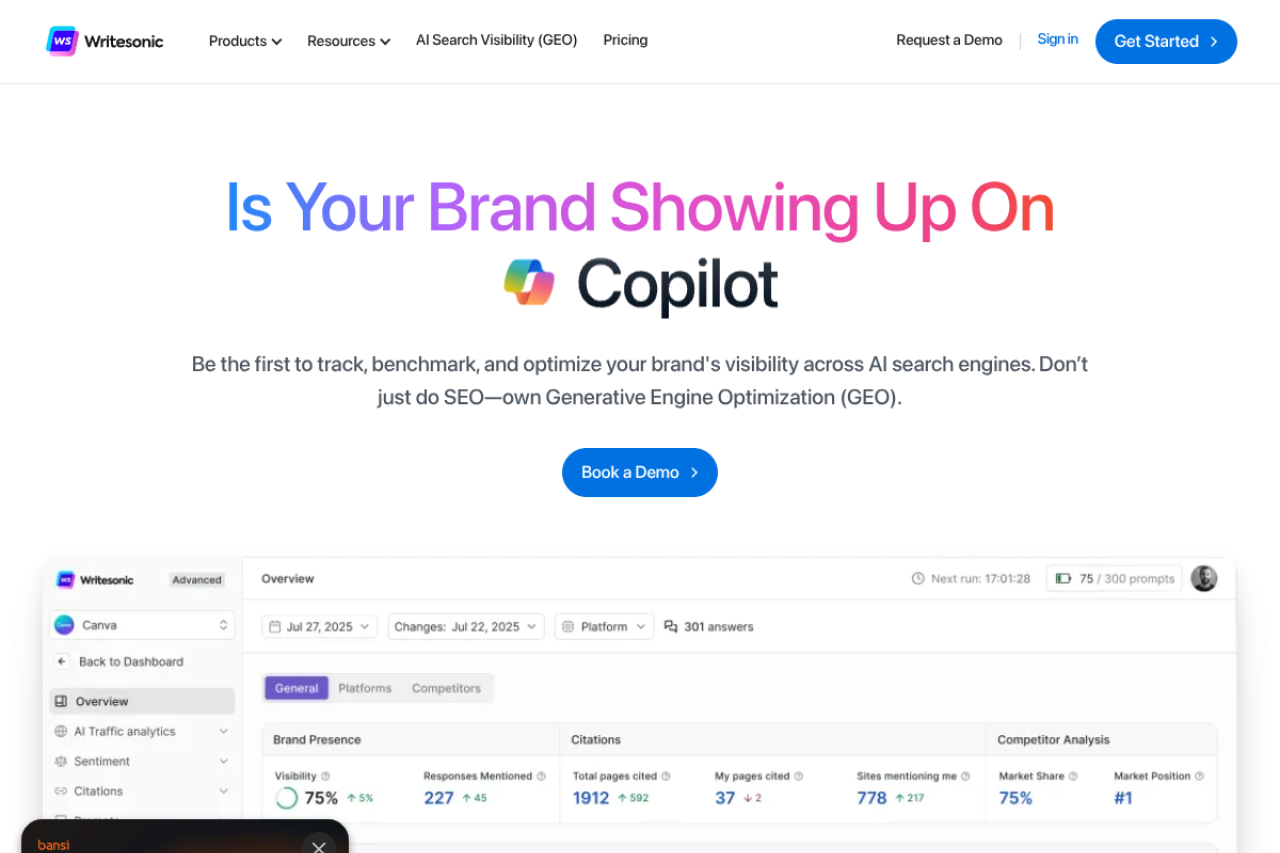
- AI Visibility Tracking: Monitors brand ranking, sentiment, and citations across 10+ AI platforms (ChatGPT, Gemini, Perplexity, Google AI Overviews, Claude, Microsoft Copilot, Grok, DeepSeek, Meta AI).
- AI Visibility Actions: Identifies citation gaps and content opportunities to improve AI search visibility.
- SEO & Content Engine: Builds SEO strategies using Ahrefs and Keyword Planner data, audits and fixes technical issues with AI, and creates/refreshes fact-checked content optimized for both Google and AI search.
- Content Optimization: Features like "GEO Content Score" and "Content Optimization" aim to ensure content is cited by AI.
- Brand Explorer & AI Shopping Tracker: Tools to see how a brand appears in ChatGPT and track product performance in AI-powered shopping recommendations.
Writesonic's Target Audience & Niche Competitors
Writesonic is designed for large brands and agencies, as evidenced by its pricing structure and enterprise-grade features. Its focus on "AI Search Visibility" and "Generative Engine Optimization (GEO)" positions it uniquely. While it still offers AI content generation, its core value proposition is now broader. Competitors in this evolving GEO space might include platforms that offer AI content optimization and visibility analytics, though direct comparisons are still emerging in 2026. Writesonic itself mentions "Omnia" as a competitor in its blog regarding AI Visibility Platforms.
Copy.ai: The AI-Native Go-to-Market Platform
Copy.ai has pivoted from a general AI copywriter to "The First AI-Native GTM Platform." It aims to unify AI across prospecting, content creation, inbound lead processing, and account-based marketing. This platform is built to codify best practices, unify data, and connect teams, eliminating the need for "dozens of copilots and point solutions."
Key Features of Copy.ai
- GTM AI Playbook: Designed to drive various use cases and connect teams across the go-to-market funnel.
- Prospecting Cockpit: Researches accounts and contacts to draft high-quality sales outreach, aiming to double pipegen per rep.
- Content Creation: Powers the content engine for SEO, thought leadership, use cases, and social media, delivering drafts in seconds.
- Inbound Lead Processing: Automatically enriches, researches, and engages marketing-generated leads to minimize speed-to-lead.
- Account Based Marketing (ABM): Provides insights and creates hyper-relevant, high-context assets at scale for ABM plays.
- Translation + Localization: Produces native speaker-level translations for any language.
- Infobase: Allows users to upload and store brand information, ensuring content accuracy and consistency by referencing it via tags.
- Content Agent Studio: (Introduced June 2025) Allows teams to train custom AI agents with just three sample inputs to retain brand tone and structure automatically.
- Integrations: Seamlessly incorporates Copy.ai outputs into existing sales engagement platforms and conversational intelligence systems.
Copy.ai's Target Audience & Niche Competitors
Copy.ai is clearly targeting businesses looking to infuse AI across their entire go-to-market engine, from sales to marketing. Its pricing tiers and emphasis on "seats" (up to 200) and "workflow credits" indicate a strong focus on mid-sized to large enterprises. Its GTM AI platform approach positions it against broader sales and marketing automation platforms that are now integrating AI, rather than just other AI writing tools. Specific competitors in the GTM AI space would depend on the exact use case, but could include CRM platforms with advanced AI capabilities, sales engagement platforms, or marketing automation suites.
Feature Comparison: Writesonic vs. Copy.ai
Given their distinct focuses, a direct feature-by-feature comparison is challenging. However, we can highlight where their functionalities might overlap or complement each other.
| Feature Category | Writesonic | Copy.ai |
|---|---|---|
| Core Focus | AI Search Visibility & Optimization, SEO Content Generation | AI-Native Go-to-Market (GTM) Platform (Sales, Marketing, Lead Gen) |
| AI Content Generation | Yes (AI Article Writer, SEO & Content AI Agent, up to 50 AI Article Generations/month on Growth plan) | Yes (Content Creation for SEO, thought leadership, social; Unlimited Words in Chat on paid plans) |
| SEO Capabilities | Extensive (AI Visibility Tracking, SEO Site Audit, Ahrefs/Keyword Planner data, Content Optimization) | Content Creation for SEO (drafts delivered in seconds), but less explicit focus on deep SEO analytics/auditing. |
| Brand Voice/Consistency | Yes (1-5 Brand Voices on paid plans, Writing Styles) | Strong emphasis (Infobase for storing brand info, Content Agent Studio to codify brand tone/structure) |
| Sales & Prospecting | No explicit features for sales outreach or prospecting. | Yes (Prospecting Cockpit, Inbound Lead Processing, Account Based Marketing, Sales Engagement Platform integrations) |
| Integrations | Surfer SEO (mentioned as key feature), Ahrefs, Keyword Planner. Google Looker Studio (for GEO data). | GTM Systems Integrations, Zapier, Workflow API endpoints, 20+ Tech Integrations. Semrush (on Growth plan). |
| AI Model Access | Not explicitly detailed, but uses GPT-3/GPT-4 based models (per research). | OpenAI, Anthropic, and Gemini models (on paid plans). |
| Custom AI Agents/Workflows | SEO & Content AI Agent, Prompt Diversification. | Content Agent Studio (train custom AI agents), Workflow Builder, Customizable Workflows, Workflow Credits. |
| User Management | Role-Based Access Control (RBAC) (5 months ago update). | Multiple seats included (5-200+ depending on plan). |
Pricing Comparison: Writesonic vs. Copy.ai
Both platforms offer free tiers and scale up to enterprise-level custom pricing, but their structures reflect their different value propositions.
Writesonic Pricing (as of 2026)
Writesonic has shifted to an article-generation-based model for content, alongside its AI Search Visibility tracking. All annual plans offer a 20% discount.
- Free Trial: Includes 3 AI agent generations (one-time), 1 user, 1 project. No credit card required.
- Starter: $99/month or $79/mo billed annually ($948/yr). Includes 15 AI article generations/month, unlimited AI agent generations, 1 brand voice, limited AI Search Visibility (GEO).
- Basic: $249/month or $199/mo billed annually ($2,388/yr). Includes 25 AI article generations/month, unlimited AI agent generations, 1 brand voice, more GEO features than Starter.
- Growth: $499/month or $399/mo billed annually ($4,788/yr). Includes 50 AI article generations/month, unlimited AI agent generations, 5 brand voices, SEO Checker, all writing tools, advanced GEO features.
- Enterprise: Custom Pricing. For large brands & agencies with tailored solution needs, including custom AI queries tracked, regions, languages, and dedicated support.
Writesonic's pricing is substantial, indicating its target market is businesses with significant content and SEO needs, particularly those concerned with AI search visibility. The move to article-based pricing rather than word count suggests a focus on quality and comprehensive outputs rather than sheer volume of short-form copy.
Copy.ai Pricing (as of March 2026)
Copy.ai's pricing is structured around user seats and "workflow credits," reflecting its GTM platform approach. Annual plans typically offer savings.
- Free Plan: 2,000 words/month, 10 chat credits/month (40 bonus in first month), 200 bonus workflow credits, 90+ tools, 1 user, access to ChatGPT and Claude.
- Chat Plan: $29/month or $24/mo billed annually ($288/yr). Includes 5 seats, unlimited words in chat, unlimited chat projects, access to OpenAI, Anthropic, and Gemini models. No workflow automation.
- Agents Plan: $249/month or $211/mo billed annually ($2,532/yr). Up to 10 user seats, 10,000 workflow credits/month, Content Agent Studio, Workflow Builder, Zapier integration, 15+ marketing/sales workflow templates.
- Growth Plan: $1,000/month or $12,000/yr billed annually. 75 Seats, unlimited words in chat, 20K workflow credits/month, Semrush integration, priority support.
- Expansion Plan: $2,000/month or $24,000/yr billed annually. 150 Seats, unlimited words in chat, 45K workflow credits/month.
- Scale Plan: $3,000/month or $36,000/yr billed annually. 200 Seats, unlimited words in chat, 75K workflow credits/month.
- Enterprise Plan: Custom pricing. Unlimited user seats, custom workflow credits, full API access, 20+ tech integrations, custom AI models, priority model access.
Copy.ai's pricing clearly targets larger teams and organizations looking for an integrated AI solution across their GTM functions. The "workflow credits" are a key differentiator, enabling automation beyond simple text generation. The high price points for Growth, Expansion, and Scale plans confirm its enterprise focus.
Pros & Cons
Writesonic
Pros:
- Advanced AI Search Visibility: Unique focus on GEO (Generative Engine Optimization) tracking across multiple AI platforms.
- Robust SEO Features: Integrates Ahrefs/Keyword Planner data, SEO site audits, and content optimization for ranking.
- High-Quality Long-Form Content: Users on Trustpilot praise its ability to generate comprehensive blog posts efficiently.
- Excellent Customer Service: Reviewers frequently highlight fast turnarounds and a customer-centric team.
- Fact-Checked Content: A crucial feature for maintaining accuracy in AI-generated content.
Cons:
- High Entry Price: The paid plans are significantly more expensive than many general AI writing tools, potentially pricing out small businesses.
- AI Detectability Concerns: Reddit users report that Writesonic's output is often flagged by AI detectors, requiring heavy human editing.
- Generic Tone: Some users find the AI output can sound "stiff" or "robotic" and overuse generic phrases.
- WordPress Integration Issues: Some users have reported unreliable WordPress integration.
- Content Cannibalization Risk: Concerns about generating content that might compete with existing pages.
Copy.ai
Pros:
- Comprehensive GTM AI: Unifies AI across sales, marketing, and lead generation, offering a holistic platform.
- Strong for Sales & Prospecting: Features like Prospecting Cockpit and Inbound Lead Processing are valuable for sales teams.
- Brand Voice Consistency: Infobase and Content Agent Studio are powerful for maintaining brand identity at scale.
- Workflow Automation: Workflow credits and the Workflow Builder enable complex, automated tasks.
- Extensive Integrations: Connects with various GTM systems, sales engagement platforms, and conversational intelligence tools.
Cons:
- Mixed User Reviews (Trustpilot): A low 1.8/5 on Trustpilot, citing poor customer service, login issues, loss of work, and buggy interface.
- High Cost for Advanced Features: The Growth, Expansion, and Scale plans are very expensive, making it accessible primarily to large enterprises.
- Content Quality Concerns: Reddit users suggest output needs heavy human editing, especially for SEO, and can be generic or detectable by AI.
- Steep Learning Curve: With a broad GTM focus and workflows, it might require significant onboarding and training.
- Vendor Lock-in Potential: Relying on a single platform for multiple GTM functions could lead to vendor lock-in.
Who Should Use Which Tool?
Choose Writesonic if:
- Your primary goal is to improve your brand's visibility and performance in AI search results (ChatGPT, Gemini, Perplexity, etc.).
- You need an integrated platform for SEO strategy, technical audits, and content optimization for both traditional and AI search.
- You produce a significant volume of long-form, fact-checked articles and blog posts and need AI assistance to scale this.
- You are a large brand or agency with a dedicated SEO and content marketing team and a budget for advanced tools.
- You prioritize strong customer service and a platform that is actively evolving with the AI search landscape.
Choose Copy.ai if:
- You are looking to infuse AI across your entire Go-to-Market (GTM) engine, including sales, marketing, and lead generation.
- Your organization has large teams (5-200+ seats) and requires workflow automation and custom AI agents for various tasks.
- You need robust tools for sales prospecting, lead processing, and account-based marketing, with deep integrations into existing GTM systems.
- Maintaining a consistent brand voice and accurate company information across all AI-generated content is critical for your business.
- You are an enterprise or a fast-growing business willing to invest significantly in a unified AI platform to reduce GTM "bloat."
Verdict: Different Paths for Different Goals
In 2026, Writesonic and Copy.ai serve increasingly distinct purposes. Writesonic is the clear choice for businesses whose core challenge revolves around winning "AI Search" and scaling SEO-optimized content. Its deep focus on Generative Engine Optimization (GEO) makes it a specialized tool for visibility in the evolving AI landscape.
Copy.ai, conversely, is for organizations seeking a broader, integrated AI solution for their entire Go-to-Market strategy. It’s less about individual content pieces and more about automating and enhancing sales, marketing, and customer engagement workflows at scale. Its higher price points and emphasis on seats and workflow credits reflect its enterprise-grade ambition.
Ultimately, neither tool is "better" than the other in an absolute sense. The decision hinges on whether your organization's primary need is to dominate AI search and content marketing (Writesonic) or to integrate AI across a comprehensive GTM playbook (Copy.ai). In many cases, a large enterprise might even find value in leveraging both, with Writesonic handling SEO and AI visibility, and Copy.ai streamlining other GTM functions.
FAQ
Q: Can Writesonic create sales copy like Copy.ai?
A: While Writesonic offers general "Ad Copy Generator" capabilities (per its original features), its current focus has shifted significantly towards AI Search Visibility and SEO-optimized articles. Copy.ai, with its "Prospecting Cockpit" and GTM AI platform, is explicitly designed for generating sales outreach and integrating with sales engagement platforms.
Q: Does Copy.ai help with AI search rankings like Writesonic?
A: Copy.ai's "Content Creation" feature can power SEO content, but it does not offer the same level of "AI Visibility Tracking" or "Generative Engine Optimization (GEO)" as Writesonic. Writesonic is specifically built to track and improve how your brand appears across platforms like ChatGPT, Gemini, and Google AI Overviews.
Q: Are Writesonic and Copy.ai suitable for small businesses?
A: Both platforms offer free plans, but their paid tiers quickly become quite expensive. Writesonic's Starter plan begins at $99/month (or $79/mo annually), and Copy.ai's Chat plan is $29/month (or $24/mo annually). While the Chat plan is more accessible, the advanced, high-value features of both platforms are clearly positioned for growing businesses and enterprises with larger budgets and scale requirements.
Q: What is "AI Search Visibility" or "Generative Engine Optimization (GEO)"?
A: AI Search Visibility, or GEO, as defined by Writesonic, refers to tracking and optimizing how your brand, products, and content appear and are cited within AI search results and large language models (LLMs) like ChatGPT, Gemini, and Perplexity. It goes beyond traditional SEO to include sentiment and citation monitoring in AI-generated answers.