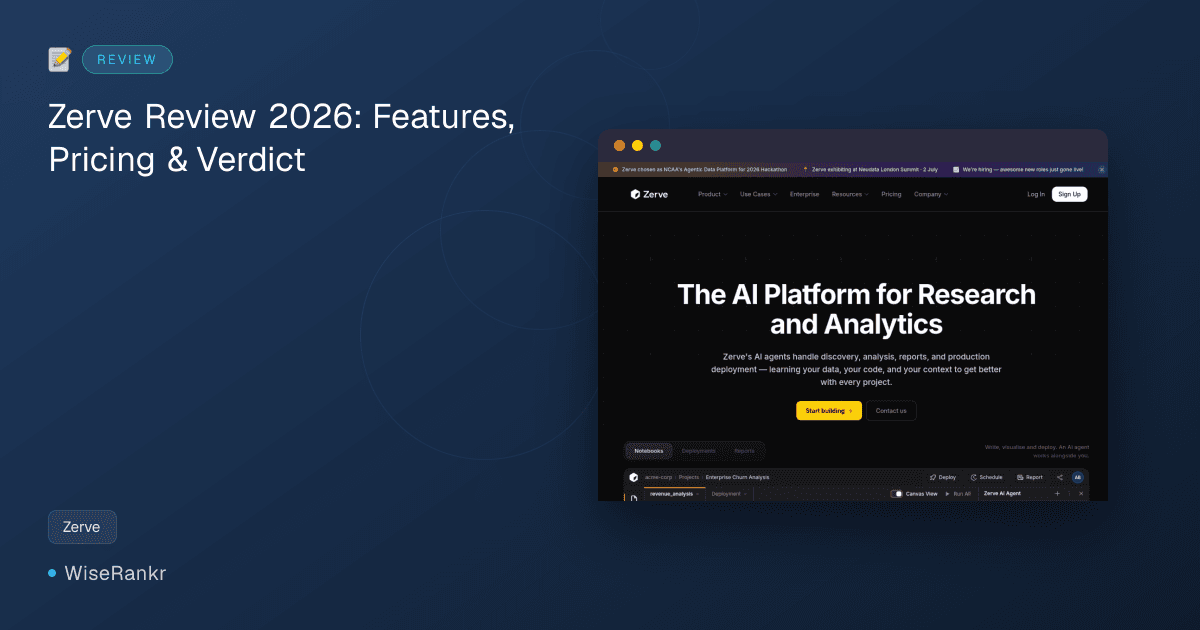
Zerve Review 2026: The Agentic AI Data Platform for Research and Analytics
Are you a data professional spending more time battling tools than solving complex problems? In the fast-evolving world of data science and analytics, efficiency and collaboration are paramount. Zerve positions itself as a groundbreaking "Agentic AI Data Platform for Research and Analytics," aiming to revolutionize how data scientists, analysts, and quants interact with their data and code.
WiseRankr.com dives deep into Zerve's offerings, examining its core features, pricing structure, and what actual users are saying in 2026. Can Zerve truly deliver on its promise of an adaptive AI collaborator that learns your context and streamlines your workflow?
What is Zerve?
Zerve is an agentic development environment built specifically for data professionals. It merges an AI-native workspace with instant deployments, aiming to unify data exploration, analysis, reporting, and production deployment. Unlike traditional notebooks or coding assistants, Zerve is designed to understand data structure, relationships, and context, allowing its AI agents to assist in building complex data pipelines, transformations, and analyses.
The platform supports multiple languages—Python, SQL, R, and GraphQL—within a reproducible and scalable environment. Zerve's mission is to empower data professionals to focus on problem-solving by providing a friction-free experience from discovery to deployment.
Essential Features of Zerve: Your AI Collaborator
Zerve's core strength lies in its agentic AI capabilities and a reimagined notebook environment. These features are designed to integrate seamlessly into the data professional's workflow.
Your Adaptive AI Collaborator (Agent)
At the heart of Zerve is its adaptive AI agent. This collaborator is designed to go beyond simple code generation, understanding the nuances of your data, code, and preferred working methods. The agent aims to:
- Understand & Act: Plan, write, and connect complex code, building real data pipelines and analyses.
- Learn Your Context: Adapt to your specific environment, data, and coding style.
- Collaborate, Not Prompt: Allow users to guide the agent, explore ideas, and iterate outputs together.
- Get Smarter Together: Improve its understanding with each project, streamlining future discoveries and deployments.
- Uncover Insights: Answer natural language questions and identify patterns within your data, converting discovery into explanations rapidly.
The Notebook, Reimagined with AI
Zerve's notebook environment is built to connect code, context, and compute within a single shared space. Key aspects include:
- Multi-language Support: Work effortlessly across Python, SQL, R, and GraphQL, either independently or with agent assistance.
- Always Reproducible: Engineered for stability and reproducibility, ensuring consistent and reliable results with every run.
- Scalable, Parallel Execution: Offers compute capabilities that extend beyond local runtimes, enabling scalable operations.
- Built-in Version Control: (Derived from "seamless collaboration" and "reproducible")
- Integrated Deployment: (Derived from "instant deployments" and "API builder & deployments")
Additionally, Zerve offers "Fleet (parallel compute)," "API builder & deployments," "App builder & deployments," and "Scheduled jobs" across its plans, indicating a strong focus on operationalizing data science projects.
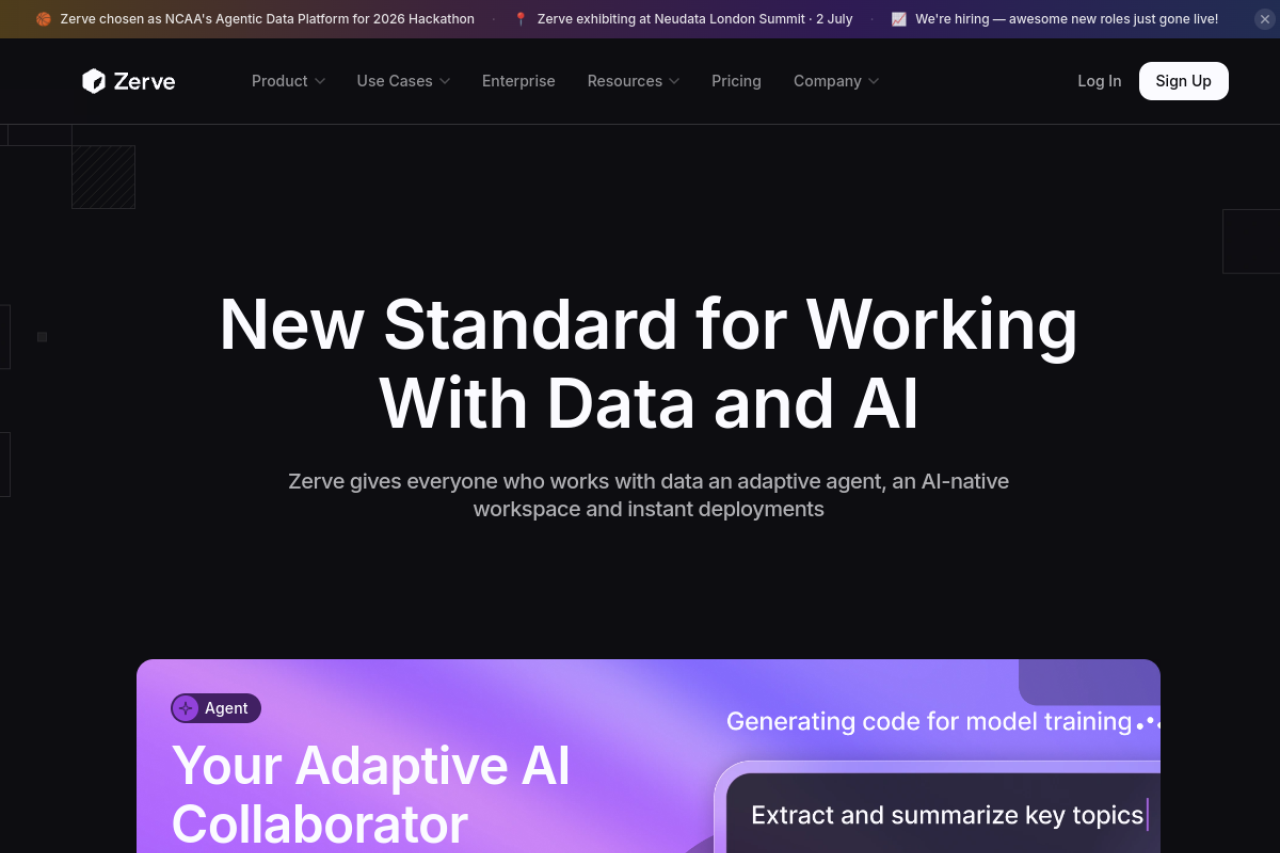
Zerve Pricing: Plans for Every Data Professional
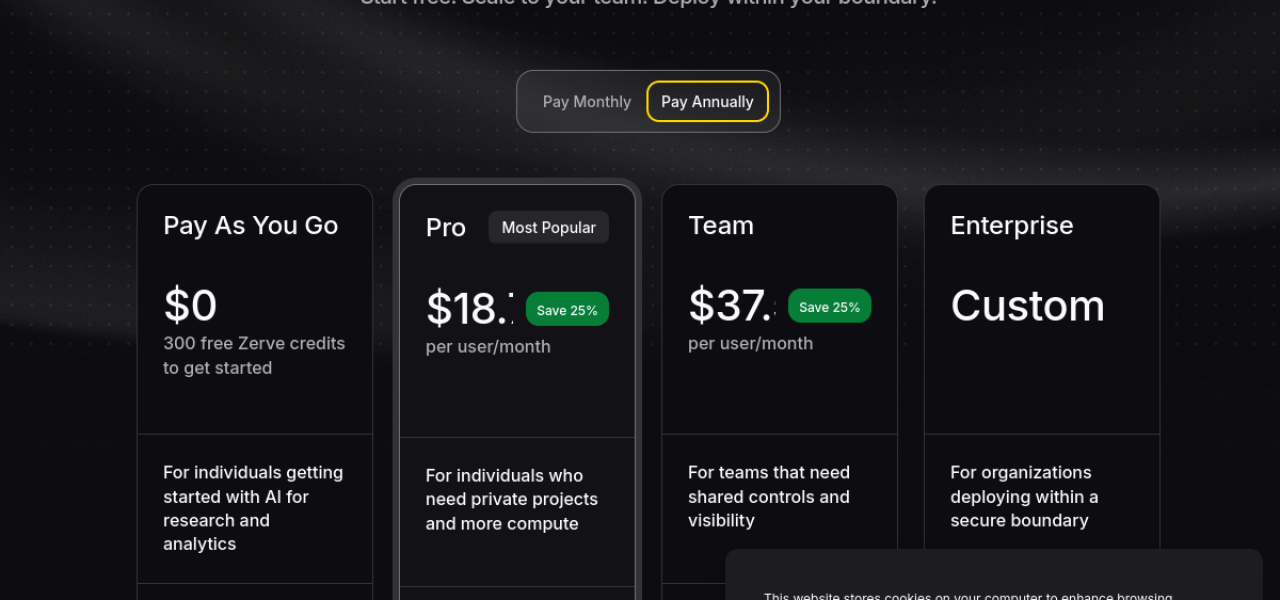
Zerve offers a flexible pricing model, starting with a free tier and scaling up to enterprise solutions. They provide both monthly and annual billing options, with incentives for annual commitments.
Note: Zerve credits are used for Agent tasks (model API cost + 20%) and compute time (Lambda, CPU, GPU). Monthly plan credits do not roll over, but add-on credits do.
1. Pay As You Go
- Price: $0
- Includes: 300 free Zerve credits to get started (for 30 days, then purchase add-on credits).
- Features: Zerve Agent, 50 Zerve credits per month, Fleet (parallel compute), reusable environments, API builder & deployments, unlimited public projects, App builder & deployments, Scheduled jobs (up to 4 editors).
- Best For: Individuals getting started with AI for research and analytics.
2. Pro
- Price: $18.75/mo billed annually ($225/yr), or $25/mo billed monthly.
- Includes: Everything in Free.
- Additional Features: 250 Zerve credits per month, add-on Zerve credits in batches of 250 for $25, self-hosting, private projects, watermark-free images, GPU compute, unlimited editors, BYOK (Bring Your Own Key) for OpenAI and Anthropic.
- Best For: Individuals who need private projects and more compute power.
3. Team
- Price: $37.50/mo billed annually ($450/yr), or $50/mo billed monthly.
- Includes: Everything in Pro.
- Additional Features: 500 Zerve credits per month, add-on Zerve credits in batches of 500 for $50, centralized billing, usage & compute metrics, SSO.
- Best For: Teams requiring enhanced collaboration, credit pooling, and administrative features.
4. Enterprise
- Price: Custom pricing.
- Includes: Everything in Team.
- Additional Features: Pooled credits, multi-cloud hosting, on-premise air-gapped deployment, dedicated support, invoicing/PO billing, purchasable through AWS Marketplace.
- Best For: Large organizations with specific security, compliance, and infrastructure requirements.
Visit Zerve.ai for the most up-to-date pricing details and any ongoing promotions.
User Reviews and Sentiment
While Zerve is a relatively new player, launching on Product Hunt in early 2024, it has garnered significant positive attention in 2026. WiseRankr's research indicates a strong initial reception.
Product Hunt & FactCheckTool.com
Zerve boasts an impressive 5/5 stars on Product Hunt based on 50 reviews (as of 2025 data). Similarly, FactCheckTool.com shows a 5.0/5 rating from 35 reviews (as of 2026).
- Users on Product Hunt report: "Love it! Great innovative product!" and praise its ability to "code in two ways simultaneously on the same platform," highlighting its user-friendly nature.
- The ease of integration, especially for Python code in data science and database exploration, is frequently mentioned, with one user stating, "Zerve ai best app in data scientist and database easy explorer integration using python code in zerve ai app."
- Many reviewers laud the absence of bugs or lags, describing it as "one of the best and easy to use tool ever!!!"
Reddit User Opinions
As of early 2026, specific Reddit user opinions on Zerve were not readily available in our research. This could indicate that while it's gaining traction, it may not yet have permeated the broader, more critical Reddit data science communities.
Common Complaints and Limitations
Despite the overwhelmingly positive feedback, some potential limitations can be inferred or were mentioned:
- Limited features in the free plan: This is a standard characteristic of freemium models, and while not a direct complaint, it means advanced users will quickly need to upgrade.
- Occasional inaccuracies: One review mentioned "occasional inaccuracies" as a potential con, though without specific examples, it's hard to gauge the severity or frequency. This is a common challenge for any AI-powered tool.
- Credit consumption: The credit-based system, while flexible, requires users to monitor usage, especially for computationally intensive tasks.
- Lack of extensive public reviews: While Product Hunt and FactCheckTool.com show strong scores, the absence of G2/Capterra/Trustpilot reviews or widespread Reddit discussions in 2026 suggests the user base might still be relatively niche or early-adopter heavy.
Integrations
While Zerve's primary focus is on its unified environment, its support for BYOK (Bring Your Own Key) for OpenAI and Anthropic in the Pro plan and above indicates a clear path for integrating with leading AI models. The multi-language support (Python, SQL, R, GraphQL) inherently allows for integration with a wide array of data sources and libraries typically used in these ecosystems.
For specific direct integrations with other platforms (e.g., cloud data warehouses, BI tools), users should visit Zerve.ai for the latest documentation.
Pros & Cons of Zerve
Pros:
- Agentic AI Collaboration: The core strength, offering an AI that learns context and assists across discovery, analysis, and deployment.
- Unified Multi-language Environment: Supports Python, SQL, R, and GraphQL in one stable, reproducible notebook.
- Seamless Deployment: Simplifies the process from exploration to production with API and app builders.
- Scalable Compute: Offers Fleet (parallel compute) and GPU options for handling intensive workloads.
- Positive User Feedback: High ratings on Product Hunt and FactCheckTool.com suggest a positive user experience.
- Flexible Hosting Options: Available as SaaS, self-hosted in your cloud, or on-premise for enterprises.
- BYOK for AI Models: Allows users to leverage their existing OpenAI and Anthropic keys, offering more control and potentially cost savings on model usage.
Cons:
- Credit-Based System: While flexible, managing credit consumption for both AI tasks and compute can be complex.
- Limited Free Plan Features: Advanced capabilities like private projects and GPU compute are locked behind paid tiers.
- Relatively New Entrant: Less established than some competitors, meaning fewer long-term public case studies or community resources.
- Potential for AI Inaccuracies: As with any AI tool, occasional inaccuracies, though rare, can occur and require user oversight.
- Lack of Widespread Public Reviews: Limited presence on major review sites like G2/Capterra or extensive Reddit discussions as of 2026.
Who Is Zerve For?
Zerve is designed for a broad spectrum of data professionals, ranging from individuals to large enterprises:
- Solo Practitioners & Freelancers: The "Pay As You Go" and "Pro" plans are ideal for individuals looking to leverage AI for their data analysis and project deployments.
- Data Scientists & Analysts: Those who regularly work with Python, SQL, and R, and seek to streamline their workflow from exploration to production, will find Zerve highly beneficial.
- Quant Researchers: Given its focus on data science and analytics, and the explicit mention of "Agentic Data Platform for Data Scientists & Quants," it's clearly targeting financial modeling and quantitative analysis.
- Data Science Teams: The "Team" and "Enterprise" plans offer features like centralized billing, SSO, and pooled credits, making it suitable for collaborative environments needing robust management.
- Organizations with Specific Hosting Needs: Enterprises requiring multi-cloud or on-premise air-gapped deployments will find Zerve's flexible architecture appealing.
- Hackathon Participants: Being chosen as NCAA's Agentic Data Platform for the 2026 Hackathon highlights its utility for rapid prototyping and problem-solving in competitive environments.
Alternatives to Zerve
Zerve operates in a vibrant and competitive landscape of AI development and data science platforms. While Zerve focuses on an "agentic" approach, other tools offer different strengths:
- Deepnote: An AI-powered data workspace that emphasizes collaboration and a modern notebook experience, often seen as a direct competitor in the interactive notebook space.
- Anaconda: An operating system for AI, providing a comprehensive platform for data science and machine learning, focusing on package management and environment consistency.
- Arize: Specializes in unified observability and evaluation for AI models, crucial for monitoring deployed models, but not a full development environment.
- Denvr Cloud: Focuses on AI Development and Operations (MLOps), offering tools for managing the entire ML lifecycle.
- Goodfire, Bria, Cognition, InstaDeep, Arcee.ai, Sema4, ezai.io, ZBrain: These tools represent a diverse set of competitors in the broader AI platform and agentic AI space, potentially offering specialized solutions for different aspects of AI development or deployment.
When considering alternatives, it's crucial to evaluate whether your primary need is an agentic assistant, a collaborative notebook, MLOps, or specific model observability.
Verdict
Zerve presents a compelling vision for the future of data science with its agentic AI approach. For data professionals tired of fragmented workflows and tool fatigue, Zerve offers a truly unified environment where an AI collaborator learns and adapts.
The overwhelmingly positive initial user feedback on platforms like Product Hunt in 2025 and FactCheckTool.com in 2026 speaks volumes about its immediate impact and usability. Its multi-language support, reproducible environment, and robust deployment options make it a powerful contender for streamlining the data science lifecycle.
However, as a relatively new platform, Zerve faces the challenge of building a larger community and proving its long-term stability and feature set against more established players. Prospective users should carefully consider the credit-based system and the initial lack of extensive third-party reviews on major B2B platforms. That said, for those seeking an innovative AI-powered partner to accelerate their data research and analytics, Zerve is definitely worth exploring, especially with its generous free tier.
People Also Ask
Q: What is Zerve's core differentiator from traditional data science notebooks?
A: Zerve's core differentiator is its adaptive AI agent, which goes beyond simple code suggestions. It learns your data, code, and context to actively assist in discovery, analysis, and deployment, functioning as a true collaborator within a unified, multi-language notebook environment.
Q: Does Zerve support multiple programming languages?
A: Yes, Zerve's notebook environment supports multiple programming languages, including Python, SQL, R, and GraphQL, allowing data professionals to work seamlessly across different tools and datasets.
Q: Can Zerve be self-hosted?
A: Yes, Zerve offers self-hosting capabilities starting from the Pro plan. For Enterprise clients, it provides options for multi-cloud hosting and even on-premise air-gapped deployment, catering to diverse infrastructure requirements.
Q: How does Zerve handle AI model usage costs?
A: Zerve uses a credit-based system where credits are consumed for both Agent tasks (which include model API costs plus a markup) and compute time (Lambda, CPU, GPU). Pro and higher plans also offer BYOK (Bring Your Own Key) for OpenAI and Anthropic, allowing users to leverage their own API access for those models.