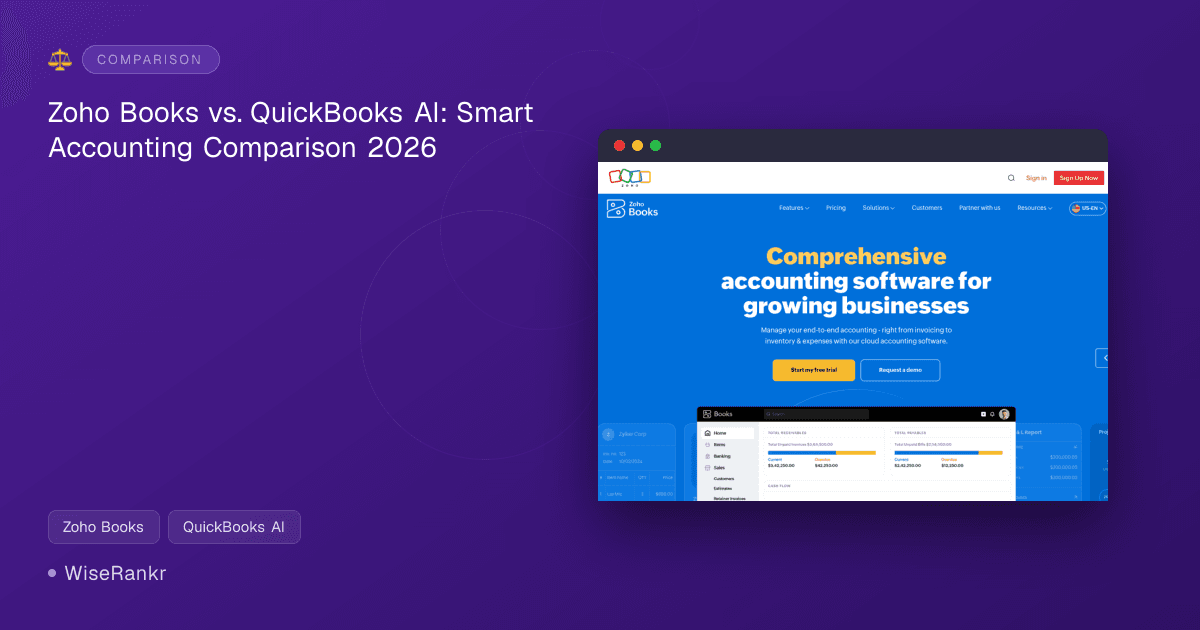
Zoho Books vs. QuickBooks AI: Choosing Your Smart Accounting Partner in 2026
Are you a small business owner or freelancer navigating the complex world of accounting, looking for a solution that leverages artificial intelligence to streamline your finances? The choice between robust, AI-enhanced accounting software can significantly impact your operational efficiency and financial clarity. This comparison dives deep into Zoho Books vs. QuickBooks AI to help you determine which platform best suits your specific needs in 2026.
While both platforms offer accounting functionalities, their approach to AI, target audience, and overall ecosystem integration present distinct advantages. We'll examine their core features, pricing structures, and user sentiment to provide a clear picture.
Overview of Each Platform
Zoho Books: The Affordable AI Accounting for Small Businesses
Zoho Books is a cloud-based accounting software designed primarily for small to medium-sized businesses and freelancers. It's part of the broader Zoho ecosystem, offering seamless integration with other Zoho applications. Zoho Books emphasizes affordability and ease of use, incorporating AI for tasks like fraud detection, smart expense categorization, and automated bank reconciliation.
Users on Capterra and Reddit frequently praise its user-friendly interface and cost-effectiveness. It's particularly well-suited for businesses that appreciate a comprehensive suite of integrated tools.
Key competitors for Zoho Books include Xero, FreshBooks, and Wave Accounting.
QuickBooks AI: The Established Leader with Intelligent Upgrades
QuickBooks, a long-standing dominant force in accounting software, is actively integrating AI capabilities across its various offerings, particularly with "Intuit Assist." QuickBooks AI aims to enhance automated transaction categorization, cash flow forecasting, and anomaly detection. It caters to a broad spectrum of small businesses, from solopreneurs to more established companies requiring payroll and advanced features.
While business-focused review platforms like G2 generally show positive ratings for its functionality, consumer complaint sites highlight significant dissatisfaction concerning customer support, pricing, and billing issues. Reddit users also frequently voice concerns about aggressive pricing and performance.
QuickBooks AI's main competitors include Sage Intacct, Microsoft Dynamics 365 Finance, and Oracle NetSuite ERP for more advanced needs, while Xero and FreshBooks compete in the small business space.
Feature Comparison: AI-Driven Accounting
Both platforms leverage AI to automate and simplify accounting tasks. Here's a direct comparison of their overlapping AI-powered features:
| Feature | Zoho Books | QuickBooks AI |
|---|---|---|
| Automated Transaction Categorization | Smart expense categorization with learning capabilities. Automated bank reconciliation. | Automated transaction categorization. Bank feed automation for reconciliations. |
| Fraud Detection / Anomaly Alerts | AI fraud detection and anomaly alerts. | Anomaly detection capabilities (implied through AI upgrades). |
| Receipt Management | Mobile receipt scanning and matching. | AI receipt capture. |
| Invoicing | Comprehensive invoicing features, customizable invoices. | Smart invoicing, easy to create and accept payments. |
| Cash Flow Forecasting | Visit Zoho Books.com for details. | Cash flow forecasting. |
| Ecosystem Integration | Strong integration with the Zoho ecosystem. | Integration with various QuickBooks products (Payroll, Time, etc.). |
While both offer core accounting, Zoho Books highlights its AI fraud detection, while QuickBooks AI emphasizes cash flow forecasting. Both excel in automating categorization and receipt capture, which are common pain points for small businesses.
Pricing Comparison: Value vs. Scalability
Understanding the pricing models is crucial, as both platforms offer various tiers. Always confirm the latest pricing on their respective websites, as these can change.
Zoho Books Pricing (Billed Annually)
- Free: For solopreneurs and micro businesses.
- Standard: $15/organization/month billed annually ($180/yr). Includes 1 user + 1 accountant. Ideal for very small businesses with basic needs.
- Professional: $40/organization/month billed annually ($480/yr). Includes 5 users. Suited for growing small businesses needing more users and features.
- Premium: $60/organization/month billed annually ($720/yr). Includes 10 users. For more established small businesses requiring additional user access.
- Elite: $120/organization/month billed annually ($1,440/yr). Includes 10 users, advanced accounting, and full-fledged inventory management. Targets businesses with more complex inventory needs.
- Ultimate: $240/organization/month billed annually ($2,880/yr). Includes 15 users, and advanced business intelligence capabilities. For businesses seeking deep financial insights.
Additional users can be added for $2.50 per user per month (billed annually). Zoho Books offers a clear, tiered structure that scales with business size, with annual billing providing better value.
QuickBooks AI Pricing (Monthly, without discounts)
QuickBooks offers a more fragmented pricing structure across various products. The following are monthly prices without initial discounts, which are often available.
QuickBooks Online:
- Simple Start: $38/month. Basic accounting for solopreneurs or very small businesses.
- Essentials: $75/month. For small businesses needing more features like bill management and time tracking.
- Plus: $115/month. Includes inventory management and project profitability.
- Advanced: $275/month. For larger small businesses requiring advanced reporting and user permissions.
QuickBooks Solopreneur:
- Solopreneur: $20/month. Specifically tailored for individual contractors and freelancers.
Additional QuickBooks Products (Monthly, without discounts):
- QuickBooks Payroll Core: $50/month + $6.50/employee/month.
- QuickBooks Time Premium: $20/month + $8 per user per month.
- QuickBooks Contractor Payments: $25/month (includes 20 contractors) + $2/additional contractor.
QuickBooks' pricing can quickly escalate, especially with added payroll or time tracking. Reddit users frequently express frustration over aggressive pricing strategies and forced subscription models, noting significant cost increases over time.
Pros and Cons: An Honest Assessment
Zoho Books
Pros:
- Affordable & Transparent Pricing: Users frequently cite its cost-effectiveness, especially with annual billing.
- User-Friendly Interface: Widely praised for ease of use, making it suitable for non-bookkeepers.
- Strong Zoho Ecosystem Integration: Seamlessly connects with other Zoho apps, which is a significant advantage for businesses already using Zoho products.
- AI Fraud Detection: A standout feature for security-conscious businesses.
- Customizable Invoices & Workflows: Allows businesses to tailor their branding and automate routine tasks.
Cons:
- Reporting Can Be Confusing: Some users on Capterra note that reporting functionalities can be less intuitive.
- Potential Feature Limitations for Large Enterprises: While solid for SMBs, it might lack some advanced features found in enterprise-grade software.
- Add-ons for Specific Features: Certain features like inventory assemblies or advanced receipt scanning might require higher-tier plans or add-ons.
QuickBooks AI
Pros:
- Industry Standard & Widespread Adoption: Many accountants are familiar with QuickBooks, which can simplify collaboration.
- Comprehensive Feature Set: Offers a wide range of accounting, invoicing, payroll, and time-tracking features, especially across its various products.
- AI-Powered Forecasting: Cash flow forecasting is a strong point for proactive financial management.
- Robust Invoicing & Payment Processing: Praised on G2 for its ease of use in creating invoices and accepting payments.
Cons:
- Significant Customer Service Issues: Trustpilot and Consumer Affairs ratings reveal severe dissatisfaction primarily due to customer support, billing errors, and aggressive pricing.
- Aggressive Pricing & Cost Increases: Reddit users report dramatic cost increases and forced subscription models, leading to high long-term expenses.
- Performance & Interface Issues: Some users find the QuickBooks Online interface laggy and less efficient compared to older Desktop versions.
- Vendor Lock-in Risk: The extensive ecosystem can make switching challenging and costly.
- Feature Removal/Changes: Users complain about "half-baked changes" and critical features being removed without warning.
Who Should Use Which?
The choice between Zoho Books and QuickBooks AI largely depends on your business size, budget, and specific priorities.
Choose Zoho Books If:
- You are a small business or freelancer seeking an affordable, user-friendly accounting solution.
- You value seamless integration with a broader business ecosystem (e.g., other Zoho products).
- AI fraud detection and smart expense categorization are high priorities for your financial security and efficiency.
- You prefer a clear, predictable pricing structure without hidden fees or aggressive price hikes.
- You want good customer service and a reliable platform, as suggested by Capterra and Gartner Peer Insights reviews.
Choose QuickBooks AI If:
- You are a small to medium-sized business that needs an industry-standard accounting solution, and your accountant is already familiar with QuickBooks.
- Cash flow forecasting and comprehensive payroll integration are critical needs, and you're willing to pay a premium for these services.
- You require a broad range of accounting functionalities and can manage the potentially higher costs and reported customer service challenges.
- You need specific features like mileage tracking or advanced project profitability that are deeply integrated into the QuickBooks ecosystem.
The WiseRankr Verdict
For most small businesses and freelancers looking for an AI-powered accounting solution in 2026, Zoho Books presents a compelling value proposition. Its affordability, user-friendly design, robust AI features like fraud detection, and seamless integration within the Zoho ecosystem make it an excellent choice for efficient and secure financial management. The positive user sentiment regarding its ease of use and consistent performance further solidifies its position.
QuickBooks AI, while offering a comprehensive suite and AI enhancements, comes with significant caveats. The widespread complaints about customer service, aggressive pricing, and performance issues reported across Trustpilot, Consumer Affairs, and Reddit cannot be overlooked. While its functionality is strong for those who can navigate these challenges, the potential for vendor lock-in and escalating costs makes it a riskier investment for businesses conscious of their budget and support needs.
Ultimately, Zoho Books offers a more balanced and user-friendly experience with predictable costs, making it the stronger recommendation for most small businesses seeking smart accounting in 2026.
Frequently Asked Questions
What is the main difference between Zoho Books and QuickBooks AI?
The main difference lies in their target audience and pricing philosophy. Zoho Books targets small businesses and freelancers with an emphasis on affordability, ease of use, and integration within the Zoho ecosystem, featuring AI for fraud detection and smart categorization. QuickBooks AI, while also for small businesses, is a more established, comprehensive system with AI for cash flow forecasting, but it comes with a higher price point and reported customer service issues.
Is Zoho Books good for freelancers?
Yes, Zoho Books is highly regarded for freelancers, offering a Free plan for solopreneurs and micro businesses. Users on Capterra and Reddit praise its invoicing capabilities and user-friendly interface, making it suitable for managing personal and business finances efficiently.
Is QuickBooks AI expensive?
QuickBooks AI can become expensive, especially when combining QuickBooks Online with additional products like Payroll or Time tracking. Reddit users frequently report significant cost increases and aggressive pricing strategies, with some seeing annual costs jump dramatically, making it a considerable investment for small businesses.
Which accounting software has better AI features?
Both have strong AI features. Zoho Books excels in AI fraud detection and smart expense categorization, learning from your habits. QuickBooks AI highlights automated transaction categorization and robust cash flow forecasting. The "better" choice depends on which specific AI-driven automation is more critical for your business operations.