The Ultimate Guide to the Best AI Music Tools in 2026
Are you struggling to find the perfect soundtrack for your content, or dreaming of composing original music without years of training? The landscape of music creation has been revolutionized by artificial intelligence, making it easier than ever to generate high-quality, unique audio. In 2026, AI music tools are not just a novelty; they are essential for content creators, marketers, developers, and even aspiring musicians.
This comprehensive guide from WiseRankr.com dives deep into the best AI music tools available today, offering an unbiased look at their features, pricing, and real-world user experiences. Discover which platform perfectly harmonizes with your creative needs and budget.
1. Mubert: Dynamic AI Music for Live Experiences

Mubert stands out for its ability to continuously generate music in real-time, adapting to mood, energy, and tempo. It's particularly well-suited for live use cases such as streaming, audio-reactive applications, and dynamic background music. Mubert leverages millions of samples from thousands of artists to create royalty-free AI music tailored to specific content needs.
The platform offers several distinct products: Mubert Render for content creators needing soundtracks, Mubert Studio for artists to contribute and earn, Mubert API for developers and brands, and Mubert Play for listeners. Users can select parameters like genre, mood, and BPM to generate extraordinary music instantly. However, user reviews on Trustpilot frequently cite issues with customer service and subscription management, with some calling it a "horrible website" and "scam." G2 reviews are more positive, with users praising its ease of use and quality for background music.
Mubert Pricing:
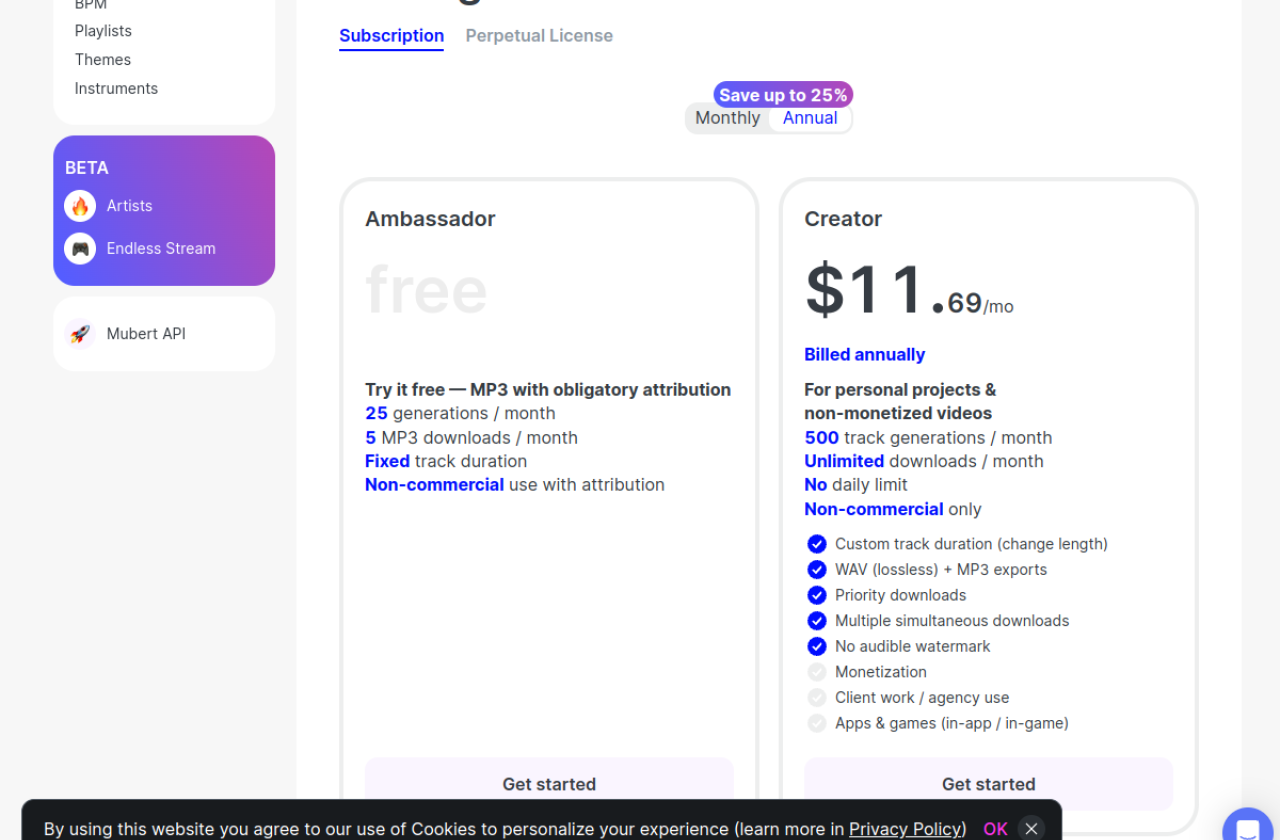
- Ambassador (Free): 25 tracks/month (MP3 only) for personal, non-commercial use with attribution.
- Creator: $14/month ($11.69/mo billed annually) for 500 tracks/month, social media & NFT use, royalty-free, no attribution.
- Pro: $39/month ($32.49/mo billed annually) for 500 tracks/month, full commercial licensing (ads, TV, radio, indie games).
- Business: $199/month ($149.29/mo billed annually) for 1,000 tracks/month, full commercial rights, dedicated support for agencies and developers.
- API / Enterprise: Custom pricing. Contact sales for custom terms and limits.
Best For: Live streamers, app developers, content creators needing dynamic, royalty-free background music for video, podcasts, and digital experiences. Not ideal for those seeking full copyright ownership or robust customer support.
2. Suno AI: Crafting Complete Songs with Vocals

Suno AI has gained significant traction for its ability to generate complete songs, including vocals, lyrics, and instruments, from a simple text prompt. Its latest v5.5 model, released in March 2026, boasts improved vocal expressiveness, custom models, and a "My Taste" feature. Suno Studio offers light DAW-style editing, allowing for more creative control.
While some Reddit users and producer Timbaland praise Suno for rapid prototyping and generating demos, recent sentiment highlights a decline in quality and consistency. Users report "abrupt shifts in output quality," "nonstop mispronunciations," and tracks cutting off. Trustpilot reviews are overwhelmingly negative, citing "nonexistent" customer service and "unauthorized charges." Commercial use rights are available only on paid plans for newly created songs.
Suno AI Pricing:
- Free Plan: $0/month. 50 credits daily (approx. 10 songs), v4.5-all model, no commercial use, shared queue.
- Pro Plan: $10/month ($8/mo billed annually). 2,500 credits monthly (up to 500 songs), v5.5 model, commercial use rights for new songs, advanced editing, stem splitting, priority queue.
- Premier Plan: $30/month ($24/mo billed annually). 10,000 credits monthly (up to 2,000 songs), all Pro features, plus Suno Studio access.
Best For: Hobbyists and creators looking to quickly generate full songs with vocals for personal use or non-critical commercial projects. Users should be aware of potential quality inconsistencies and customer support limitations.
3. Udio: Studio-Quality Instrumentals and Vocals

Udio, founded by ex-DeepMind team members, is an AI music platform lauded for generating studio-quality tracks with highly realistic, human-like vocals. It excels in instrumental quality and arrangement detail, offering timeline-style editing, an inpainting tool, and the ability to extend songs in 30-second increments. Udio has announced partnerships with major labels like Warner Music Group and Universal Music Group in late 2025.
User feedback from Reddit and other aggregated review sites suggests Udio provides "cleaner, more controlled vocals with better fidelity" than some competitors. However, a significant ethical concern revolves around its training data, with many believing it was trained on copyrighted music without permission. While praised for its power, some critics find its output "soulless" or "acoustical nonsense."
Udio Pricing:
- Free Plan: $0/month. 10 daily credits + 100 monthly credits, commercial use with attribution.
- Standard Plan: Visit Udio.com for details.
- Pro Plan: Visit Udio.com for details.
Best For: Music producers and industry professionals seeking high-fidelity instrumentals and realistic AI vocals, with a focus on editing and arrangement. Users should consider the ethical debates surrounding its training data and the potential for "soulless" output.
4. Boomy: Easy Music Creation and Distribution

Boomy offers a straightforward approach to AI music generation, allowing users to create full songs in seconds based on a chosen style. Its key differentiator is the ability to publish tracks directly to Spotify and other major streaming platforms, enabling users to earn royalties. It's particularly appealing to individuals with no musical background who want to release music quickly.
Users praise Boomy for its ease of use and the distribution feature, which automates the uploading process. However, some advanced users find the customization options limited. Reddit users note it's "great for demos" and "perfect for TikTok intros." Significant complaints include issues with account deletion, hidden royalty cuts (20%), and tracks being flagged for "artificial streaming" by platforms like Spotify. The audio quality is also often cited as lower than competitors like Suno and Udio.
Boomy Pricing:
- Free Plan: $0/month. Unlimited track creation, 5 song saves, 1 track release/month, personal use only, basic editing.
- Creator Plan: $9.99/month ($99.48/yr billed annually). 500 song saves, 3 monthly releases, 10 MP3 downloads/month, social media usage rights.
- Pro Plan: $29.99/month ($298.68/yr billed annually). Unlimited song saves, 10 monthly releases, advanced analytics, commercial usage rights, priority support, 25 MP3/WAV downloads/month.
Best For: Beginners and aspiring artists who want to generate and distribute music to streaming platforms with minimal effort. Not recommended for those seeking high-fidelity audio, extensive customization, or who are sensitive to high royalty cuts and potential distribution issues.
5. Loudly: Professional AI Music for Digital Projects

Loudly positions itself as an AI music platform for "your creative universe," enabling users to generate, customize, and release unique music for social media and streaming platforms. It prides itself on ethical AI practices, ensuring its proprietary music dataset is developed with consent and copyright compliance. Loudly generates multiple tracks based on genre with clean, professional audio and offers customizable effects.
While user opinions on Reddit highlight "remarkably human-sounding tracks" and "high-quality stem exports," Trustpilot reviews are concerning. Many users report it as a "complete scam" due to unfulfilled distribution promises, account disablement, sudden price increases on auto-renewal, and inability to withdraw royalties. The music generation itself is sometimes described as "repetitive" and "randomizers, not serious tools."
Loudly Pricing:
- Free tier: Functional free tier with limited track creations and 0.5-minute song previews.
- API (Subscription): $125/month for 1,000 track generations. Custom pricing for higher volumes (Startup, SME, Corporate).
- Pay-as-you-go (PAYG): Options available on their developer portal.
Best For: Developers and businesses needing API access for AI music generation, particularly those prioritizing ethically sourced training data. Individual creators should approach with caution due to widespread complaints regarding billing, customer service, and distribution efficacy.
6. Riffusion: Experimental Text-to-Music Generation

Riffusion, initially known for its spectrogram-based generation, allows users to create music from text prompts. It aims to be an experimental tool for different sounds and genres, capable of producing full songs. The platform has recently undergone significant changes, pivoting towards a broader "Producer.ai" interface.
Reddit users express strong frustration with Riffusion's recent updates, citing a "backlash against Riffusion's shift" and that the new model is "less responsive to specific instructions." Users report degraded audio quality, with songs sounding "tinny and distorted," and concerns about copyright and ownership. Trustpilot reviews are similarly negative, with users feeling they "can't trust this company" due to abrupt changes and deletion of user work.
Riffusion Pricing:
- Free Plan: $0/month. 4 credits/week (approx. 2 songs), 7-day history, standard audio, non-commercial use, shared queue.
- Basic Plan: $9.9/month. 200 credits/month (approx. 100 songs), 30-day history, commercial ownership, priority queue, 2 concurrent jobs.
- Starter Plan: $6/month (ToolsforHumans.ai) or $8.00/month (Techjockey UAE). 10 Studio Hours/month (approx. 600 songs), unlimited Basic generations, 8 concurrent generations.
- Plus Tier: $18/month (ToolsforHumans.ai).
- Member Plan: $48/month (ToolsforHumans.ai) or $48/month (Techjockey UAE). 70 Studio Hours/month (approx. 4200 songs), unlimited Basic generations, 16 concurrent generations, Discord access.
- One-time Credit Purchases: Starter Pack ($6.9 for 100 credits, approx. 50 songs) – credits never expire.
Best For: Users interested in experimental AI music generation and who are comfortable with a platform undergoing rapid changes and potential quality fluctuations. Not suitable for professional use or those needing reliable, consistent output and strong commercial rights.
7. AIVA: AI Composer for Cinematic and Classical Scores

AIVA (Artificial Intelligence Virtual Artist) is an AI music assistant specifically designed for composing classical pieces and cinematic soundtracks. It offers extensive customizability, allowing users to generate new songs in over 250 styles, upload audio or MIDI influences, and edit generated tracks. AIVA supports downloading in various formats, including MIDI and sheet music, making it valuable for composers and filmmakers.
While older Product Hunt reviews are positive, recent Trustpilot reviews are largely negative, citing "misleading expectations," "terrible interface," and "scam" accusations related to refunds and customer service. One Reddit user noted that AIVA's orchestral samples "sound better then the Udio and suno comparison," but overall recent sentiment is mixed. AIVA allows full copyright ownership on its Pro Plan, a significant advantage for commercial users, but has a "revenue cap" trap for studios.
AIVA Pricing (billed annually; monthly rates are higher):
- Free Plan: $0/month. 3 downloads/month, tracks up to 3 mins, MP3 & MIDI, non-commercial use (copyright by AIVA), attribution required.
- Standard Plan: €11/month ($11/mo billed annually). 15 downloads/month, tracks up to 5 mins, MP3 & MIDI, YouTube/Twitch/TikTok monetization (copyright by AIVA).
- Pro Plan: €33/month ($33/mo billed annually). 300 downloads/month, tracks up to 5.5 mins, all formats (including WAV), full copyright ownership, unrestricted monetization.
- Business Plan: $119/month ($119/mo billed annually) for 2 user seats. 200 downloads/month, commercial license, priority generation, team features.
- Enterprise Plan: Custom pricing (starts around $5,000/year). Unlimited generations, dedicated support, custom AI training.
Best For: Composers, filmmakers, and game developers needing orchestral, classical, or cinematic scores with a high degree of customization and MIDI/sheet music export. Users should be mindful of recent negative customer service reviews and the revenue cap on the Pro Plan.
8. Somio: Studio-Quality Songs with Commercial Licenses

Somio is an AI music generator that focuses on creating studio-quality songs from AI prompts, supporting both text-to-music and lyrics-to-song generation. It emphasizes full commercial licenses for every track and features smart prompt optimization. Somio aims to make music creation accessible to everyone, from beginners to experienced creators, by removing barriers like expensive equipment and technical knowledge.
The platform offers a highly customizable experience, allowing users to adjust mood, genre, and vocal gender. It also provides an AI Lyrics Assistant and the ability to generate instrumental background music. While no public reviews were found on Trustpilot, G2, or Capterra, Indevai.com gives a positive review, noting "The output quality is noticeably better than many" competitors. Somio highlights its "copyright-free" output as a key feature.
Somio Pricing:
- Visit Somio.ai for details.
Best For: Content creators, marketers, podcasters, and game developers who need original, royalty-free, studio-quality music with commercial usage rights. It's a strong contender for those prioritizing ease of use, customization, and clear licensing.
Comparison Table: Best AI Music Tools 2026
| Feature/Tool | Mubert | Suno AI | Udio | Boomy | Loudly | Riffusion | AIVA | Somio |
|---|---|---|---|---|---|---|---|---|
| Primary Focus | Dynamic, adaptive music | Full songs with vocals | Studio-quality instrumentals/vocals | Easy creation & distribution | Ethical AI, royalty-free for content | Experimental text-to-music | Cinematic/classical composition | Studio-quality songs, commercial licenses |
| Vocals | No (instrumental focus) | Yes (AI-generated) | Yes (human-like AI) | Yes (AI-generated) | No (instrumental focus) | Yes (AI-generated, varying quality) | No (instrumental focus) | Yes (AI-generated) |
| Commercial Use | Paid plans | Paid plans (new songs only) | With attribution (Free), Paid plans (visit site) | Paid plans (20% royalty cut) | Paid plans (controversial) | Paid plans | Paid plans (full ownership on Pro) | Yes (all tracks) |
| Editing Capabilities | Parameter selection | Light DAW-style (Suno Studio) | Timeline-style, inpainting | Limited style/arrangement changes | Customizable effects | Limited (basic/studio modes) | Extensive (MIDI, audio influence) | Mood, genre, vocal gender adjustment |
| Free Plan Available? | Yes | Yes | Yes | Yes | Yes | Yes | Yes | Visit Somio.ai |
| Key User Complaints | Customer service, billing | Quality inconsistency, support, charges | Ethical concerns (training data) | Account issues, royalty cuts, flags | Scam accusations, billing, support | Quality degradation, interface changes | Customer service, interface, refunds | None publicly available |
| Pricing Starts From (monthly) | $14/month | $10/month | Visit Udio.com | $9.99/month | $125/month (API) | $6/month | €11/month | Visit Somio.ai |
The Verdict: Choosing Your Best AI Music Tool
The best AI music tool for you depends entirely on your specific needs, budget, and tolerance for potential risks. For dynamic, real-time background music, Mubert offers unique capabilities, but be wary of its customer service record. If you need full songs with vocals, Suno AI and Udio are leading options, though Suno faces recent quality concerns and Udio grapples with ethical questions around its training data.
Boomy is an excellent entry point for aspiring artists who prioritize easy distribution, but the royalty cuts and reported account issues are significant drawbacks. Loudly has a strong ethical stance but is plagued by severe customer complaints regarding billing and service delivery. AIVA excels in niche areas like cinematic and classical scores, offering advanced control for composers, while Somio appears to be a promising newcomer focusing on studio quality and clear commercial licensing.
For experimental users, Riffusion can be intriguing, but its recent platform changes have alienated many. Always leverage free trials and free plans to personally assess the output quality and user experience before committing to a paid subscription. The AI music space is rapidly evolving, so staying informed is crucial.
Frequently Asked Questions about AI Music Tools
What are the best AI music tools for beginners in 2026?
For beginners, Boomy and Suno AI are often recommended due to their intuitive interfaces and ability to generate full songs quickly from simple prompts. Boomy also offers direct distribution to streaming platforms, making it easy for new creators to get their music out there.
Can I use AI-generated music for commercial projects?
Yes, many AI music tools offer commercial licensing on their paid plans. However, it's crucial to carefully review each platform's terms. Some, like Mubert, have specific restrictions (e.g., no Content ID or standalone release). Boomy takes a 20% royalty cut, and AIVA has a revenue cap on its Pro plan. Somio.ai advertises full commercial licenses for every track, which is a significant advantage.
Are AI music generators ethical, and do they use copyrighted material?
The ethics of AI music generation, particularly regarding training data, is a highly debated topic. Some tools, like Loudly, explicitly state they follow strict ethical AI guidelines and use proprietary, consented datasets. However, platforms like Udio face criticism for allegedly training on copyrighted music without permission. Users should be aware of these discussions and choose tools that align with their ethical standards.
What are the typical limitations of AI music generation?
Common limitations include generic-sounding music, repetitive loops in longer compositions, inconsistent quality, and occasional "acoustical nonsense" or mispronunciations in vocals. Customization can also be limited, and some tools have poor customer support or opaque billing practices. Users often find they need to generate multiple tracks to get one usable output.