Are you looking to generate music with AI, but unsure whether to choose a comprehensive song creation platform or a tool focused purely on instrumental generation? In the rapidly evolving landscape of AI-powered music, two prominent names, Suno AI and Somio, offer compelling solutions. However, they cater to distinct needs within the creative spectrum.
This comparison will delve into their features, pricing, and overall suitability to help you decide which AI music generator best fits your workflow in 2026.
Suno AI Overview: The Complete AI Music Generator
Suno AI positions itself as an all-encompassing AI music generator capable of creating full songs, complete with vocals, lyrics, and instruments, from a simple text prompt. Its core strength lies in transforming conceptual ideas into fully formed musical pieces, making it an attractive option for songwriters, content creators, and even experienced musicians looking for rapid prototyping.
With its latest v5.5 model, Suno AI aims for improved sound quality and lyric coherence, pushing the boundaries of AI-generated vocals. The introduction of Suno Studio provides light DAW-style editing capabilities directly within the browser, offering a degree of control over the generated tracks.
Suno AI Key Features:

- Generates complete songs with vocals and lyrics.
- Suno Studio for light in-browser editing.
- Mobile app for on-the-go creation.
- Custom mode for writing your own lyrics.
- v5.5 model for improved quality, including "Voices, Custom models and My Taste."
- Ability to split songs into up to 12 vocal and instrument stems (Pro and Premier plans).
- Record, upload, and create with your own voice; tune custom versions of v5.5 (Pro and Premier plans).
Suno AI Target Audience:
Suno AI is ideal for individuals or teams who need full song generation, including vocals, and appreciate some in-browser editing capabilities. It caters to aspiring artists, hobbyists, and even professional musicians seeking a quick way to generate demos or explore musical ideas. The Pro and Premier plans, with commercial use rights, are geared towards those looking to publish their creations.
Suno AI Competitors:
Suno AI's primary technical challenger is Udio. Other competitors in the broader AI music generation space include platforms that focus on full song creation with vocals and lyrics.
Somio Overview: AI Music Generator for Content Creators
Somio presents itself as an AI music generator focused on creating studio-quality songs from AI prompts, with a strong emphasis on providing full commercial licenses for every track. It supports both text-to-music and lyrics-to-song generation, and notably, offers an AI instrumental music generator for users who need background music without vocals.
Somio highlights its "Smart AI prompt enhancement" and "natural endings" for generated songs, aiming to produce polished, ready-to-use audio. The platform is designed to be accessible and creator-friendly, removing traditional barriers to music production.
Somio Key Features:
- Studio-quality audio with realistic vocals.
- Full commercial license for every track.
- Supports text-to-music and lyrics-to-song.
- Smart AI prompt enhancement.
- Generates full-length songs with natural endings.
- AI Instrumental Music Generator for tracks without vocals.
- Customizable mood, genre, and vocal gender.
- AI Lyrics Assistant for creative inspiration.
- Offers desktop versions for Windows and Mac, and an Android app.
Somio Target Audience:
Somio is particularly well-suited for content creators, marketers, podcasters, and game developers who require original, royalty-free background music or complete songs with commercial usage rights. Its focus on ease of use and customizable options makes it appealing for those without extensive musical training.
Somio Competitors:
While Somio itself mentions Udio in its blog as a competitor, its emphasis on royalty-free music and instrumental generation also places it in competition with other AI tools that provide background music for media production.
Feature Comparison: Suno AI vs. Somio
Here's a side-by-side look at how Suno AI and Somio compare on their overlapping features:
| Feature | Suno AI | Somio |
|---|---|---|
| Full Song Generation (Vocals & Instruments) | Yes, from text prompts. | Yes, from text prompts or lyrics. |
| Lyrics-to-Song Generation | Yes, via Custom mode. | Yes. |
| Instrumental-Only Generation | Not explicitly highlighted as a core feature, but can be achieved by omitting lyrical prompts. | Yes, dedicated "AI Instrumental Music Generator." |
| In-browser Editing / DAW-style tools | Yes, Suno Studio for light editing. | Not explicitly mentioned beyond customization options. |
| Mobile App | Yes (iOS). | Yes (Android). Desktop versions for Windows/Mac also available. |
| Commercial Use Rights | Yes, with Pro and Premier plans. Not available on Free plan. | Yes, full commercial license for every track. |
| Prompt Enhancement / Customization | v5.5 model with "Voices, Custom models and My Taste," Custom mode for lyrics. | Smart AI prompt enhancement, customizable mood, genre, and vocal gender. |
| Voice Cloning / Custom Voices | Yes, record, upload, and create with your own voice (Pro & Premier). | Not explicitly mentioned. |
Pricing Comparison: Which AI Music Generator is Right for Your Budget?
Suno AI Pricing:
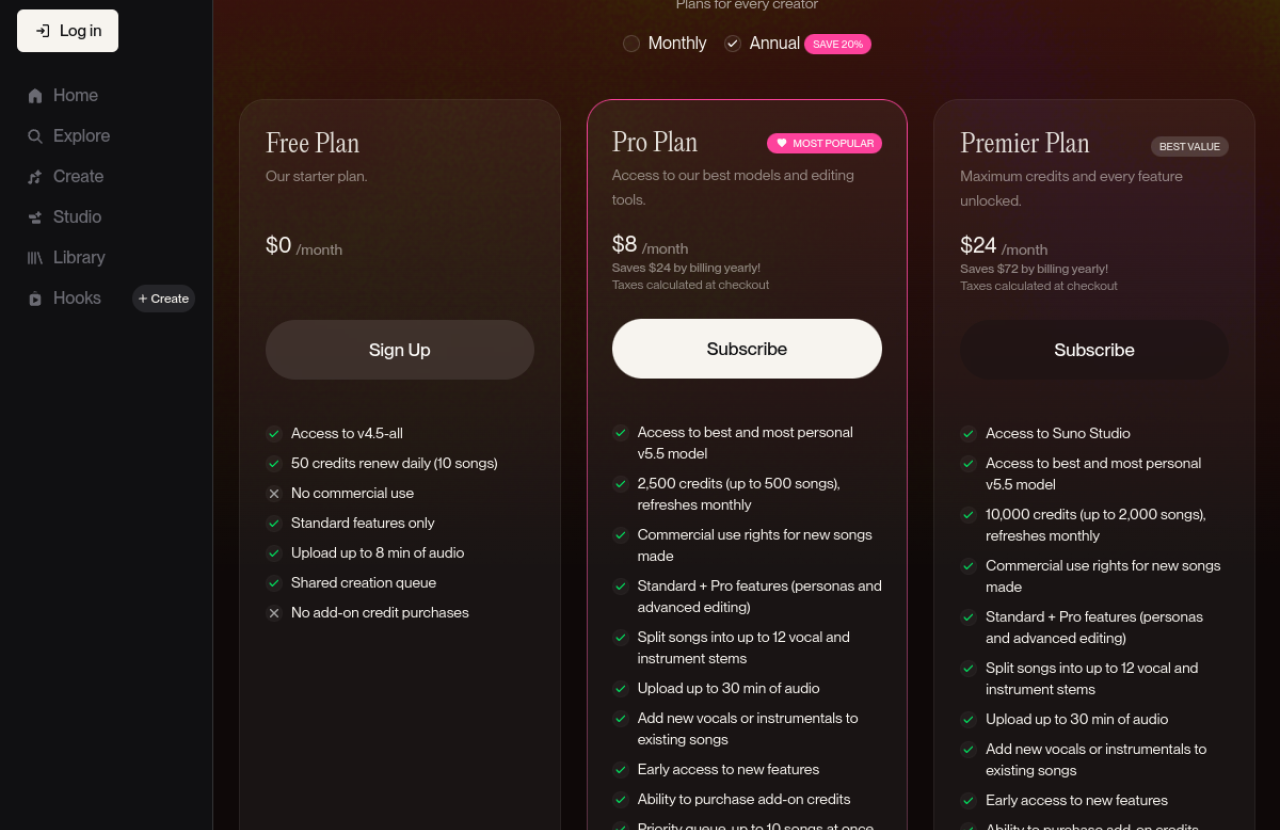
Suno AI offers three plans, with credit-based usage. Credits do not roll over, except for purchased top-up credits which require an active subscription.
- Free Plan: $0/month
- 50 credits daily (approx. 10 songs)
- Access to v4.5-all model
- No commercial use
- Standard features, shared creation queue
- Upload up to 8 minutes of audio
- Pro Plan: $8/mo billed annually ($96/yr) or $10/month billed monthly
- 2,500 credits monthly (up to 500 songs)
- Access to best and most personal v5.5 model
- Commercial use rights for new songs made
- Standard + Pro features (personas, advanced editing)
- Split songs into up to 12 vocal and instrument stems
- Upload up to 30 minutes of audio
- Early access to new features, priority queue (up to 10 songs at once)
- Ability to purchase add-on credits
- Record, upload, and create with your own voice; tune custom versions of v5.5
- Premier Plan: $24/mo billed annually ($288/yr) or $30/month billed monthly
- 10,000 credits monthly (up to 2,000 songs)
- All Pro Plan features
- Suno Studio access
The free plan is excellent for casual users or those wanting to test the waters. The Pro Plan is suitable for serious creators or small businesses needing commercial rights and more generations. The Premier Plan is designed for high-volume users, potentially larger content creators, or small studios.
Somio Pricing:
Somio's pricing details are not explicitly provided in the scraped data. The pricing page mentions "Pick the Plan That Fits Your Needs" and "Share Creation Rewards" which allows users to earn credits by promoting their creations on social media. This credit reward system runs until May 31, 2026, with rewards valid for one month.
For specific plan costs and credit allocations, users will need to visit Somio.ai directly.
Given the lack of transparent pricing, potential Somio users should be prepared to investigate directly on their website. The "Share Creation Rewards" program suggests a strong community and promotional focus, which could be a way to access the tool for free or at a reduced cost for active users.
Pros and Cons: A Balanced View
Suno AI Pros:
- Full Song Creation: Generates complete songs with vocals, lyrics, and instruments, making it a powerful tool for comprehensive music generation.
- Advanced Models: The v5.5 model offers improved quality, custom voices, and personalized models.
- Editing Capabilities: Suno Studio provides light DAW-style editing for more control.
- Mobile Accessibility: iOS app allows for creation on the go.
- Established Presence: Raised significant funding and has a notable presence in the AI music space.
Suno AI Cons:
- Inconsistent Quality: Reddit users report "abrupt shifts in output quality" and "unstable experience" with songs cutting off or having mispronunciations.
- Credit Consumption: Users often "burn hundreds — sometimes thousands — of credits to get one usable song," indicating a high credit cost for quality outputs.
- Customer Support Issues: Trustpilot and Reddit reviews consistently describe customer service as "nonexistent, unhelpful, and unresponsive," especially for billing.
- Credit Rollover: Credits included in subscriptions do not carry over, potentially leading to wasted credits if not used daily/monthly.
- Mixed Public Perception: Trustpilot rating is low (1.7/5), contrasting with higher editor scores, suggesting a gap between expert opinion and general user experience.
Somio Pros:
- Commercial Licenses: Offers full commercial licenses for every track, which is a significant advantage for content creators.
- Instrumental Generation: Dedicated feature for generating instrumental music, ideal for background tracks.
- User-Friendly: Designed for ease of use, making music creation accessible without complex software.
- Prompt Optimization: Features "Smart AI prompt enhancement" and "natural endings" for potentially higher quality output from less detailed prompts.
- Multi-platform Availability: Desktop apps (Windows/Mac) and Android app enhance accessibility.
Somio Cons:
- Lack of Public Reviews: No reviews on Trustpilot, G2, or Capterra, making it difficult to gauge widespread user satisfaction and reliability.
- Undisclosed Pricing: Specific pricing plans and credit structures are not publicly available in the provided data, requiring direct inquiry.
- Limited Editing: No mention of in-browser DAW-style editing tools like Suno Studio.
- Newer Entrant: Appears to be a newer or less publicly reviewed tool compared to Suno AI, which could imply less community support or feature maturity.
- Credit Expiration: Reward credits expire after one month, which could be limiting for some users.
Who Should Use Which AI Music Generator?
These tools, while both AI music generators, cater to slightly different needs and user profiles.
Choose Suno AI if:
- You are an aspiring songwriter, musician, or hobbyist who wants to generate complete songs with vocals and lyrics from scratch.
- You need some basic in-browser editing capabilities to refine your AI-generated tracks.
- You appreciate the ability to use custom voices or fine-tune models (on higher plans).
- You are willing to spend credits to experiment and find the right output, understanding that quality can be inconsistent.
- You need a mobile app for iOS to create on the go.
However, be prepared for potential frustrations with customer support and inconsistent output quality, as reported by users.
Choose Somio if:
- You are a content creator, podcaster, marketer, or game developer needing royalty-free instrumental background music or full songs for commercial projects.
- You prioritize ease of use and quick generation over extensive editing capabilities.
- You need full commercial licenses for all your generated tracks, without tiered restrictions based on subscription level.
- You value the ability to customize mood, genre, and vocal gender easily.
- You prefer desktop applications (Windows/Mac) or an Android mobile app for creation.
It's important to note that you'll need to visit Somio.ai to understand their pricing structure before committing.
The Ultimate AI Music Generator Verdict
Suno AI and Somio both represent powerful advancements in AI music generation, but they are not direct competitors in every aspect. Suno AI excels as a comprehensive song creation tool, particularly for those focused on lyrical and vocal compositions, albeit with reported inconsistencies and customer service challenges. Its strength lies in generating full, complex musical ideas.
Somio, on the other hand, appears to be a strong contender for content creators and businesses requiring royalty-free, high-quality instrumental or vocal tracks for various media projects. Its focus on commercial licenses and ease of use, coupled with dedicated instrumental generation, makes it highly appealing for those specific use cases. The lack of public reviews and transparent pricing, however, introduces some uncertainty.
Ultimately, your choice between Suno AI and Somio will depend on your primary goal. If you're looking to generate full, vocal-driven songs and don't mind a bit of experimentation, Suno AI, despite its user feedback challenges, offers powerful capabilities. If your need is for reliable, commercially licensed music, especially instrumental tracks, and ease of use is paramount, Somio could be the better fit, provided its pricing aligns with your budget.
FAQ: Frequently Asked Questions About AI Music Generators
Q: Can I use AI-generated music commercially?
A: Yes, with certain plans. For Suno AI, commercial use rights are granted with the Pro and Premier plans. Somio explicitly states that it offers a full commercial license for every track generated. Always check the specific terms and conditions of your chosen plan before using AI-generated music for commercial purposes.
Q: How do AI music generators create songs?
A: AI music generators like Suno AI and Somio use advanced machine learning models, often neural networks, that have been trained on vast datasets of existing music. When you provide a text prompt or lyrics, the AI analyzes your input and generates new musical elements (melody, harmony, rhythm, instrumentation, and vocals) that align with the requested style, mood, and genre.
Q: Is there a free option for AI music generation?
A: Yes, Suno AI offers a Free Plan that provides 50 daily credits, allowing users to generate approximately 10 songs. This plan is ideal for personal use and testing the platform's capabilities, but it does not include commercial use rights. Somio also mentions "Share Creation Rewards" where users can earn credits.
Q: Can I edit the songs generated by AI music tools?
A: The level of editing varies by tool. Suno AI provides "Suno Studio" for light in-browser DAW-style editing, allowing users some control over their generated tracks. Somio focuses more on customization during the generation process (mood, genre, vocal gender) rather than post-generation editing. For more extensive editing, you would typically export the stems and use a traditional Digital Audio Workstation (DAW) like Ableton Live or Logic Pro.