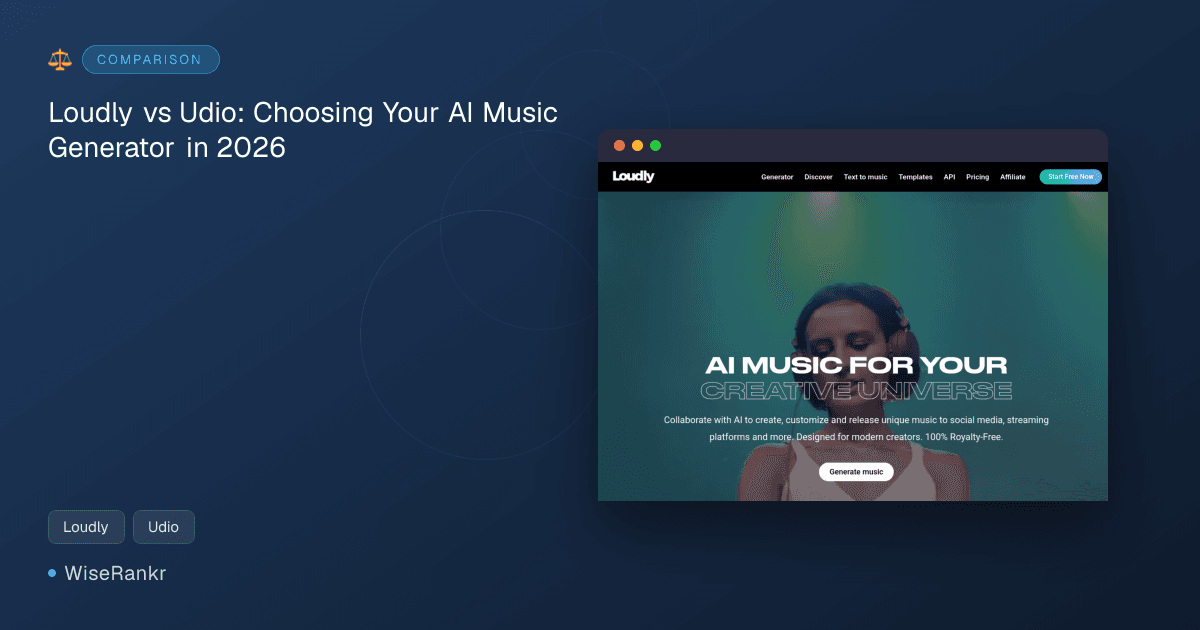
In the rapidly evolving landscape of AI music generation, two platforms, Loudly and Udio, are frequently discussed by creators. But are they direct competitors, or do they cater to different needs? This comparison will delve into their features, pricing, and user sentiment to help you decide which tool best fits your creative workflow in 2026.
While both Loudly and Udio leverage artificial intelligence to create music, they approach the task with distinct philosophies and target audiences. Loudly focuses on quick, royalty-free instrumental track generation for digital projects, emphasizing ease of use and ethical AI sourcing. Udio, on the other hand, aims for studio-quality tracks with highly realistic vocals and detailed arrangement controls, positioning itself more towards professional music production and artists.
Loudly vs. Udio: An Overview of AI Music Generation
Loudly: AI Music for Your Creative Universe
Loudly positions itself as an AI-powered music platform designed for modern creators seeking royalty-free music for digital projects. Founded on ethical AI principles, Loudly emphasizes that its proprietary music dataset is developed with consent, transparency, and copyright compliance. This allows them to safely transfer music usage rights to customers, a crucial aspect for content creators.
Loudly's core offering revolves around generating multiple instrumental tracks based on a chosen genre, with a focus on good audio quality, quick generation, and customizable effects. Their "Studio" feature also allows users to remix existing songs and create unique music. Recent updates, like VEGA-2 (launched March 2026) and their AI Sample Generator (September 2025), indicate a continuous push towards advanced instrumental and sound design capabilities.
Key competitors for Loudly in the royalty-free instrumental AI music space include Soundful, Beatoven.ai, and Musicfy.
Udio: Studio-Quality AI Music with Human-like Vocals
Udio enters the AI music scene with a strong emphasis on generating studio-quality tracks, including highly realistic human-like vocals. Founded by ex-DeepMind team members, Udio aims to provide advanced controls for music creation, such as timeline-style editing, an inpainting tool for fixing specific sections, and the ability to extend songs in 30-second increments. They position themselves as a tool for discovering, creating, and sharing music with the world, utilizing cutting-edge technology.
Udio's partnerships with major labels like Warner Music Group and Universal Music Group (announced October/November 2025) highlight its ambition to integrate AI into the mainstream music industry. While praised for its vocal realism and detailed arrangements, Udio faces significant ethical concerns regarding its training data, with many Reddit users suggesting unauthorized scraping of copyrighted music.
Udio's primary competitors in the vocal-enabled AI music generation space include Suno, Aimi, and Mubert.
Feature Comparison: Instrumental vs. Vocal Focus
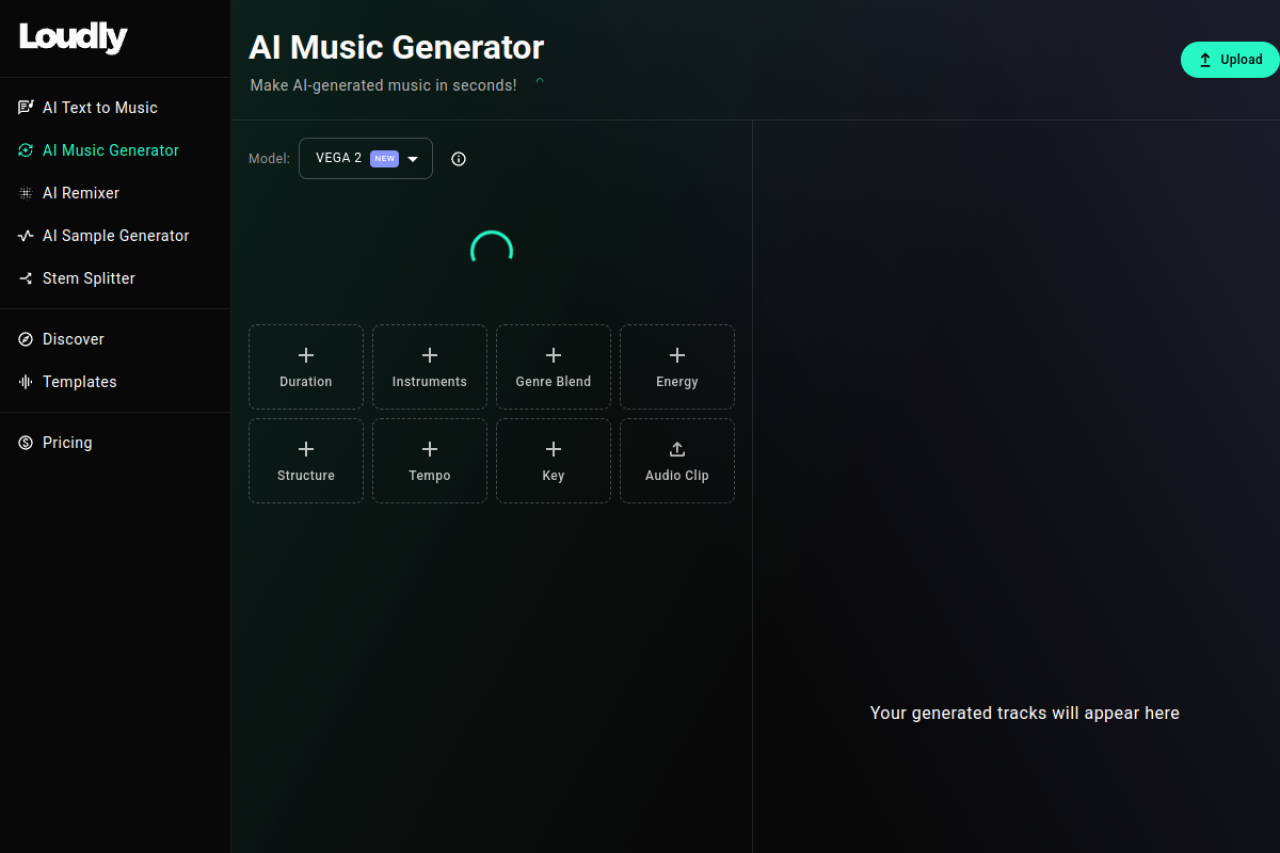
When comparing Loudly and Udio, it's essential to recognize their differing strengths. Loudly excels at instrumental track generation, while Udio stands out for its vocal realism and comprehensive production controls.
| Feature | Loudly | Udio |
|---|---|---|
| AI Music Generation | Generates multiple instrumental tracks based on genre. | Generates studio-quality tracks with human-like vocals from text/lyrics. |
| Audio Quality | Good audio quality, clean and professional. | Excellent instrumental quality and arrangement detail; high vocal fidelity. |
| Generation Speed | Quick generation of multiple tracks in seconds. | Generation can be slow, according to some users. |
| Customization/Editing | Customizable effects, "Studio" for remixing. | Timeline editing, inpainting tool, extends songs in 30-second increments. |
| Vocal Generation | Not a primary feature (focus on instrumental). | Most realistic AI vocals, captures emotion in synthetic vocals. |
| Stem Downloads | Visit Loudly.com for details on stem availability. (Feature update August 2025 mentions "AI stem splitting") | Available for paid users. |
| Royalty-Free Usage | 100% Royalty-Free, ethical AI sourcing. | Commercial use with attribution on Free Plan; unclear commercial licensing for paid tiers. |
| Ethical AI / Training Data | Strict ethical AI guidelines, proprietary music dataset via consent. | Significant user concerns about unauthorized scraping of copyrighted music. |
Pricing Comparison: Freemium Models with Different Value Propositions
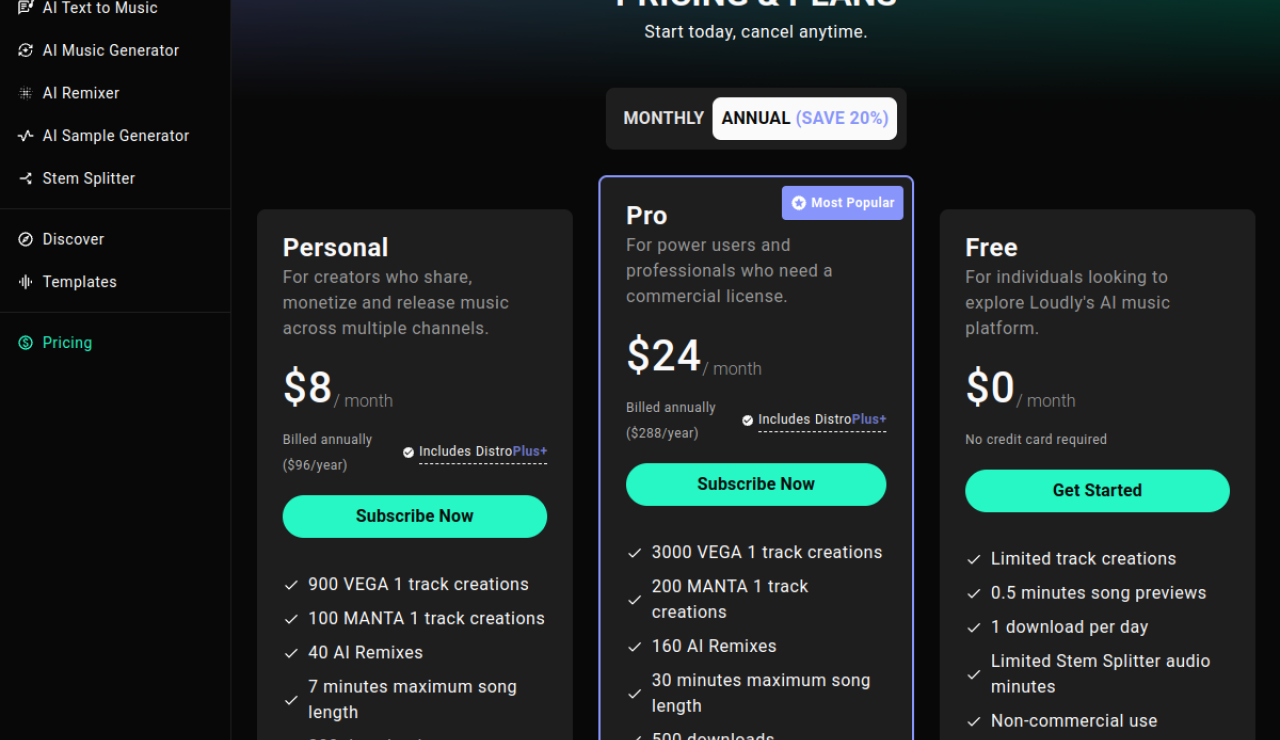
Both Loudly and Udio offer freemium models, but their paid tiers cater to different scales of use and budgets.
Loudly Pricing
Loudly's pricing is primarily structured around an API for developers, indicating a focus on businesses or power users needing high volumes of track generation.
- Free Tier: Limited track creations and 0.5-minute song previews. This tier is suitable for individuals exploring the platform or casual hobbyists.
- Developer API Subscription: $125 per month for 1,000 track generations. This translates to $0.125 per track generation.
- Custom Pricing: Available for higher volumes and different business sizes (Startup, SME, Corporate), with the price per track decreasing with increased usage. They also offer "Pay-as-you-go (PAYG) options" on their developer portal.
Potential Hidden Costs and Risks for Loudly: Users on Trustpilot and CostBench.com report significant issues, including auto-renewal price increases (sometimes double the initial fee) without notification, undisclosed additional charges, inability to withdraw accumulated royalties, and loss of content rights upon subscription cancellation. These factors suggest a need for extreme caution and thorough review of terms before committing to Loudly's paid plans.
Udio Pricing
Udio also employs a freemium model, making it accessible for a wide range of users.
- Free Plan: $0 per month. Includes 10 daily credits + 100 monthly credits. Commercial use is permitted with attribution. This is a robust free tier for casual users, students, or those testing the waters.
- Paid Plans: Visit Udio.com for details on specific paid plan pricing and features. The data indicates paid users gain access to stem downloads and potentially more advanced features.
Commercial Licensing for Udio: While the Free Plan allows commercial use with attribution, the commercial licensing terms for paid plans are unclear. This is a critical point for professional creators and businesses, who should consult Udio's official terms of service.
Pros and Cons: A Balanced Perspective
Loudly
Pros:
- Ethical AI Sourcing: Loudly explicitly states its commitment to ethical AI, with a dataset developed via consent and copyright compliance, offering peace of mind regarding royalty-free usage.
- Quick Instrumental Generation: Users praise its speed in generating multiple, good-quality instrumental tracks.
- Customization: Offers customizable effects and a "Studio" for remixing.
- Developer-Friendly: An API with volume-based pricing caters to developers and businesses.
Cons:
- Significant User Complaints: Trustpilot reviews highlight serious issues including alleged scams related to music distribution, unexpected auto-renewal price increases, undisclosed charges, and difficulty withdrawing royalties.
- Repetitive Outputs: Some users report that AI-generated tracks can be repetitive, especially in longer compositions.
- Limited Vocal Capabilities: Not designed for generating human-like vocals, focusing solely on instrumentals.
- Potential Loss of Rights: Reports suggest content rights may be lost upon subscription cancellation, creating vendor lock-in.
Udio
Pros:
- Exceptional Vocal Realism: Widely praised for generating studio-quality tracks with highly realistic, emotional, human-like vocals.
- Advanced Production Controls: Features like timeline editing, inpainting, and 30-second extensions offer more granular control over compositions.
- Strong Instrumental Quality: Delivers excellent instrumental arrangement detail alongside vocals.
- Generous Free Tier: Provides a substantial number of daily and monthly credits for free, including commercial use with attribution.
- Active Development: Regular model improvements and announcements (e.g., partnerships with major music groups) indicate ongoing innovation.
Cons:
- Ethical Concerns over Training Data: A major criticism on Reddit and other platforms is the suspected unauthorized scraping of copyrighted music for training, raising significant ethical and legal questions.
- Unclear Commercial Licensing: While the free tier allows commercial use with attribution, specific licensing for paid tiers is not clearly detailed, which is a concern for professional use.
- Generation Speed: Some users report that generation can be slow.
- "Soulless" Output: Despite vocal realism, a few critics describe the overall output as "soulless" or "acoustical nonsense" in some instances.
Who Should Use Which AI Music Generator?
Choose Loudly if:
- You are a content creator (vlogger, podcaster, game developer) needing quick, royalty-free instrumental background music for digital projects.
- You prioritize ethical AI sourcing and guaranteed royalty-free usage for your instrumental tracks.
- You need to generate multiple tracks efficiently and appreciate genre-based generation with customizable effects.
- You are a developer looking for an API to integrate AI music generation into your own applications, provided you thoroughly vet their terms and conditions, especially regarding renewals and rights.
However, be very cautious and scrutinize their terms of service due to widespread user complaints regarding billing, service delivery, and content rights. For casual hobbyists, the free tier might be sufficient for exploration.
Choose Udio if:
- You are a music producer, artist, or serious hobbyist looking to generate studio-quality tracks, especially those featuring highly realistic human-like vocals.
- You require advanced control over your music, including timeline editing, inpainting, and the ability to extend compositions.
- You are experimenting with AI for full song creation, including complex arrangements and vocal performances.
- You can tolerate the ethical ambiguities surrounding its training data and are willing to navigate potentially unclear commercial licensing terms for paid usage.
Udio's free tier is also excellent for those who want to experiment with advanced AI music generation, particularly for vocal tracks, before committing to a paid plan.
The Verdict: Different Tools for Different Tunes
Loudly and Udio are not direct competitors in the traditional sense; they cater to distinct segments of the AI music generation market. Loudly is geared towards creators who need quick, ethically sourced, royalty-free instrumental tracks for various digital projects. Its strength lies in expediting the background music creation process, although its billing practices and customer service have garnered significant negative feedback from users.
Udio, conversely, is for those who demand higher fidelity, more nuanced control, and particularly, realistic vocal performances in their AI-generated music. It's a more sophisticated tool for music production, appealing to artists and producers, despite facing controversy over its training data and less transparent commercial licensing for paid tiers.
In 2026, if your priority is efficient, ethical instrumental background music, Loudly (with extreme caution regarding subscriptions) might be an option. If you're seeking to push the boundaries of AI vocal and full song generation with advanced editing capabilities, Udio stands out, provided you're comfortable with its ethical considerations and licensing ambiguities.
Frequently Asked Questions (FAQ)
What is the main difference between Loudly and Udio?
The main difference is their focus: Loudly specializes in quick generation of royalty-free instrumental tracks for digital projects, emphasizing ethical AI sourcing. Udio excels at creating studio-quality tracks with highly realistic human-like vocals and offers more advanced production controls like timeline editing.
Can I use music generated by Loudly or Udio commercially?
Loudly states its music is 100% royalty-free due to ethical AI sourcing. Udio's free plan allows commercial use with attribution, but details for paid plan commercial licensing are not explicitly stated in the provided data. Users should always check the latest terms of service directly on their websites for commercial use policies.
Are there any known risks or complaints associated with these tools?
Yes. Loudly has significant user complaints on Trustpilot regarding alleged scams, unexpected auto-renewal price increases, undisclosed charges, and difficulty withdrawing royalties. Udio faces ethical concerns on platforms like Reddit regarding the suspected unauthorized scraping of copyrighted music for its training data.
Which tool is better for beginners in music creation?
For beginners needing simple background music, Loudly's genre-based generation might be easier to start with, but its negative user feedback is a concern. Udio's free tier is quite generous and offers a more advanced experience, which could be empowering for beginners keen on exploring full song creation with vocals, despite a potentially steeper learning curve for its editing features.