Choosing the right marketing automation platform is critical for businesses looking to streamline operations, enhance customer engagement, and drive revenue. But what happens when you're comparing two platforms that, while both powerful, cater to vastly different scales and needs? Today, we're diving deep into Salesforce Marketing Cloud vs. ActiveCampaign, two prominent players in the marketing technology space. Far from being direct competitors, these tools serve distinct purposes for businesses of varying sizes and complexities.
Salesforce Marketing Cloud (SFMC) is an enterprise-level behemoth, designed for large organizations with complex, multi-channel marketing operations and deep pockets. ActiveCampaign, on the other hand, positions itself as an autonomous marketing platform ideal for small to medium-sized businesses (SMBs) and those prioritizing robust email automation with integrated CRM capabilities. This comparison isn't about which tool is "better," but rather which tool is the right fit for your specific business context and ambitious marketing goals in 2026.
Salesforce Marketing Cloud: An Enterprise Powerhouse
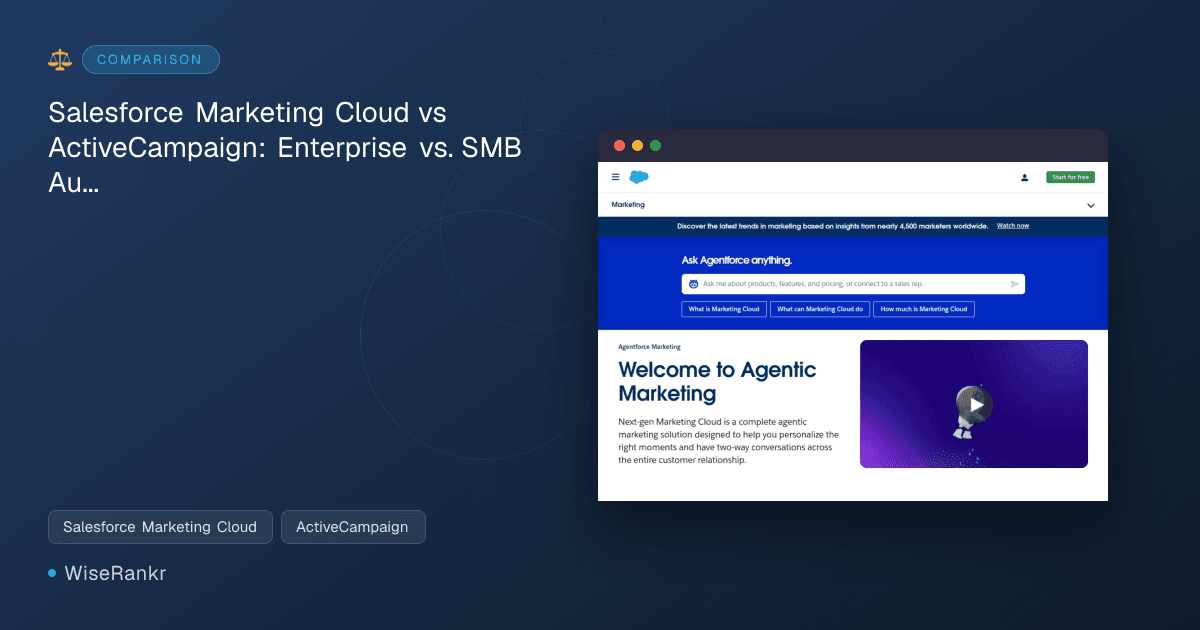
Salesforce Marketing Cloud is a comprehensive digital marketing platform built for organizations that require sophisticated cross-channel customer engagement. It's not just a tool; it's an ecosystem leveraging AI for predictive analytics, real-time personalization, and autonomous campaign management. SFMC is designed for enterprises managing vast customer datasets and executing highly intricate marketing strategies across numerous touchpoints.
Key Features of Salesforce Marketing Cloud
- Sophisticated cross-channel journey orchestration: Design and deliver seamless customer journeys across marketing, sales, service, and commerce.
- AI-powered lead management and nurturing: Utilize AI agents to nurture and route leads, optimizing the sales pipeline.
- Real-time personalization and dynamic content generation: Deliver highly relevant content based on individual customer behavior and data.
- Unified marketing data and performance analysis: Consolidate customer data for comprehensive insights and attribution measurement.
- Autonomous campaign management with AI agents: Collaborate with AI agents to plan campaigns and optimize performance in-flight.
Salesforce Marketing Cloud Pricing
Salesforce Marketing Cloud's pricing structure reflects its enterprise focus, generally billed annually. Exact costs can vary significantly based on specific needs, selected editions, and add-ons. While specific editions like "Marketing Cloud Next Growth Edition" ($1,500/Org/Month billed annually) and "Marketing Cloud Next Advanced Edition" ($3,250/Org/Month billed annually) are mentioned, these are just starting points. Salesforce also offers a "Salesforce Foundations" plan at $0 for Agent Builder, Prompt Builder, 200k Flex Credits, and 250K Data Cloud credits, allowing users to get started with Agentforce for free for any use case.
It's important to note that SFMC often involves significant implementation costs, requiring dedicated in-house teams or expert partners, as highlighted by user reviews on Capterra and Reddit. Users frequently mention the premium price point and the potential for additional "ala carte" charges for features.
For detailed, tailored pricing, businesses must contact Salesforce directly.
Target Audience and Competitors
Salesforce Marketing Cloud is unequivocally built for large enterprises, global corporations, and organizations with complex sales and marketing structures. Its robust integration capabilities, particularly with its own CRM ecosystem, make it a natural fit for existing Salesforce users. Competitors in this high-end segment include Adobe Marketo Engage and Oracle Eloqua.
ActiveCampaign: Intelligent Automation for Growth
ActiveCampaign is an autonomous marketing platform that excels at combining email automation with integrated, lightweight CRM functionality. It's designed to help businesses, particularly SMBs, create sophisticated automation workflows, personalize customer experiences, and manage their sales pipeline effectively. ActiveCampaign emphasizes "Active Intelligence" and AI agents to handle execution, act on insights, and guide marketing strategy.
Key Features of ActiveCampaign
- AI agents for campaign creation and optimization: Leverage AI to generate and optimize marketing campaigns.
- Advanced automation builder with conditional content: Create intricate, logic-based automation workflows.
- Cross-channel coordination (email, SMS, WhatsApp, social): Manage customer interactions across multiple channels.
- Dynamic audience segmentation and targeting: Segment contacts based on behavior and data for precise targeting.
- Lead scoring and qualification: Automate the process of identifying and prioritizing high-value leads.
ActiveCampaign Pricing
ActiveCampaign's pricing scales primarily with the number of contacts and the chosen plan, with annual billing offering better rates. Monthly billing is also available at a higher cost. They offer four main plans:
- Starter: From $15/month billed annually (1,000 contacts). This plan offers basic email marketing and is limited to 5 actions per automation and 1 user. It's primarily for testing the platform's core capabilities.
- Plus: From $49/month billed annually (1,000 contacts). This tier unlocks unlimited automation actions, advanced segmentation, full CRM, e-commerce integrations, landing pages, and supports 3 users. Users on Reddit and G2 consider this where ActiveCampaign's core value truly begins.
- Pro: From $79/month billed annually (1,000 contacts). Includes predictive sending, conditional content, attribution and conversion tracking, and cross-channel marketing, also for 3 users.
- Enterprise: From $145/month billed annually (1,000 contacts). This top-tier plan offers premium segmentation, 5 users, SSO, custom objects, and a dedicated account team.
It's crucial to note that ActiveCampaign charges for all contacts, including unsubscribed or bounced, which can significantly impact costs as a contact list grows. Reddit users frequently mention "sticker shock" as their contact lists expand. ActiveCampaign offers a 14-day free trial but no free plan.
For custom quotes beyond 250,000 contacts, businesses need to request pricing directly.
Target Audience and Competitors
ActiveCampaign is an excellent fit for small to medium-sized businesses, e-commerce stores, and digital marketers who need powerful email marketing automation and a capable, integrated CRM without the enterprise-level complexity or price tag. Its intuitive automation builder is frequently praised by users on G2 and Reddit. Key competitors in this space include HubSpot Marketing Hub (for SMBs), Mailchimp (for simpler needs), and Keap (formerly Infusionsoft).
Salesforce Marketing Cloud vs. ActiveCampaign: Feature Comparison
While both platforms offer marketing automation, their approach and depth vary significantly. This table highlights overlapping features and their respective strengths.
| Feature | Salesforce Marketing Cloud | ActiveCampaign |
|---|---|---|
| Target Audience | Enterprise, large corporations | Small to medium-sized businesses, e-commerce |
| AI Capabilities | AI-powered lead management, autonomous campaign management with AI agents (Agentforce), predictive analytics. | AI agents for campaign creation & optimization, Autonomous Insights, Enhanced Email Generation, Active Intelligence updates. |
| Cross-Channel Orchestration | Sophisticated journeys across email, mobile, web, social, sales, service, commerce. | Email, SMS, WhatsApp, social (integrated, but less emphasis on deeply integrated sales/service). |
| CRM Integration | Deep, native integration with Salesforce CRM, forming a unified platform. | Integrated, lightweight CRM functionality, suitable for managing sales pipelines within the platform. |
| Personalization & Dynamic Content | Real-time personalization, dynamic content generation across all channels. | Conditional content, dynamic audience segmentation for targeted messaging. |
| Automation Builder | Journey Builder for complex, multi-stage customer journeys. | Advanced automation builder, visual workflow praised for intuitiveness. |
| Reporting & Analytics | Unified marketing data and performance analysis, attribution tracking. | Attribution and conversion tracking (Pro plan), Autonomous Insights. |
| Ease of Use / Learning Curve | Steeper learning curve, requires technical expertise (coding in SSJS/SQL for full utilization). | Generally intuitive, visual automation builder, "almost too easy" for some enterprise users. |
Pros & Cons
Salesforce Marketing Cloud
Pros:
- Unmatched Scalability: Handles the most complex, high-volume marketing needs of global enterprises.
- Deep AI Integration: Advanced AI agents (Agentforce) for truly autonomous campaign management and optimization.
- Comprehensive Ecosystem: Seamless integration with the broader Salesforce suite (CRM, Sales Cloud, Service Cloud).
- Robust Personalization: Capabilities for real-time, dynamic content delivery across all customer touchpoints.
- Unified Data View: Consolidates vast amounts of customer data for holistic insights.
Cons:
- High Cost: Significantly expensive, not just for licenses but also for implementation and ongoing management.
- Steep Learning Curve: Requires specialized skills (SSJS, SQL) and often a dedicated team or expert partners to maximize its potential. Users on G2 frequently cite this as a challenge.
- Complexity: The platform can feel like "five or six different tools smashed together," making the UI challenging, as noted by Capterra reviewers.
- Vendor Lock-in: Deep integration within the Salesforce ecosystem can make switching platforms difficult.
- Limited Public Pricing: Lack of transparent pricing requires direct contact for quotes, adding to the perceived barrier to entry.
ActiveCampaign
Pros:
- Powerful Automation: Highly-regarded, intuitive visual automation builder that delivers on complex workflows. Users on Reddit praise its capabilities over competitors.
- Integrated CRM: Offers a capable, lightweight CRM directly within the platform, ideal for SMBs managing sales.
- Cross-Channel Reach: Strong capabilities for email, SMS, and WhatsApp marketing campaigns.
- AI-Driven Insights: Autonomous Insights and AI agents provide actionable recommendations for marketing optimization.
- Good Value for SMBs: Offers a rich feature set at a more accessible price point for its target audience.
Cons:
- Pricing Escalation: Costs can increase significantly as contact lists grow, leading to "sticker shock" for some users, as discussed on Reddit. Charges apply to all contacts, including unsubscribed.
- Customer Support Concerns: Trustpilot reviews and Reddit threads suggest a decline in customer support responsiveness and helpfulness over time.
- Basic for Enterprise Needs: While powerful for SMBs, its CRM and overall feature depth may be insufficient for large enterprise requirements.
- Platform Speed & Bugs: Some Trustpilot reviewers mention issues with platform speed and occasional bugs.
- No Free Plan: Only offers a 14-day free trial, which might be a barrier for very small businesses or those wanting a longer evaluation period.
Who Should Use Which?
Choose Salesforce Marketing Cloud if:
- You are a large enterprise, a global corporation, or a company with complex, multi-brand marketing needs.
- You require highly sophisticated, multi-channel customer journey orchestration that spans marketing, sales, service, and commerce.
- You already use Salesforce CRM and need deep, native integration across your entire customer lifecycle management.
- You have the budget for a premium platform, including implementation, customization, and dedicated in-house technical teams or expert consultants.
- You need advanced AI capabilities for autonomous campaign management, predictive analytics, and real-time personalization at scale.
Salesforce Marketing Cloud is an investment in a robust, scalable, and highly customizable marketing infrastructure designed to handle the most demanding enterprise scenarios. Its strength lies in its ability to unify disparate systems and data points into a cohesive customer experience platform.
Choose ActiveCampaign if:
- You are a small to medium-sized business, an e-commerce brand, or a digital marketer looking for powerful automation.
- Your primary focus is on building sophisticated email marketing campaigns and automated customer journeys.
- You need an integrated, lightweight CRM to manage your sales pipeline and customer interactions without requiring a separate, full-fledged enterprise CRM.
- You value an intuitive, visual automation builder that allows for complex logic without extensive coding.
- You are looking for a platform that offers good value and strong features for its price point, understanding that costs will increase with your contact list size.
ActiveCampaign provides a comprehensive solution for businesses that want to automate and personalize their marketing efforts effectively, offering much more power than basic email marketing tools but without the overwhelming complexity and cost of enterprise platforms.
Verdict
The comparison between Salesforce Marketing Cloud and ActiveCampaign is not a head-to-head battle for the same customer. Instead, it's a clear delineation of distinct market segments. Salesforce Marketing Cloud is the undisputed choice for large enterprises seeking an all-encompassing, highly customizable, and AI-driven platform for complex, global operations. Its strength lies in its ability to manage intricate cross-channel customer journeys and integrate deeply within the Salesforce ecosystem, albeit with a significant investment in time, resources, and budget.
Conversely, ActiveCampaign stands out as an exceptional choice for small to medium-sized businesses that prioritize powerful marketing automation, especially for email, combined with a capable integrated CRM. Its intuitive automation builder and AI-driven insights empower businesses to create personalized customer experiences without requiring an enterprise-level budget or technical team. However, potential users should be mindful of its scaling costs as their contact list grows and recent user feedback regarding customer support.
Ultimately, the "better" platform depends entirely on your business size, complexity, budget, and specific marketing objectives. For many growing businesses, ActiveCampaign offers an accessible yet powerful solution. For established enterprises, Salesforce Marketing Cloud provides the robust foundation needed for truly agentic marketing at scale.