
Typewise Review 2026: Revolutionizing Enterprise Customer Service with AI Agents
Is your customer service team struggling to keep up with an ever-increasing volume of inquiries across multiple channels? In 2026, the demand for instant, accurate, and personalized support is higher than ever. Typewise emerges as a powerful AI Agent Platform designed to tackle these challenges head-on, promising end-to-end resolution of customer interactions without sacrificing control. But does it deliver on its ambitious claims?
This review from WiseRankr.com dives deep into Typewise, an enterprise-grade AI solution that orchestrates customer service and sales workflows. We'll explore its features, pricing, user feedback, and assess whether it's the right fit for your organization's customer experience strategy.
What is Typewise?
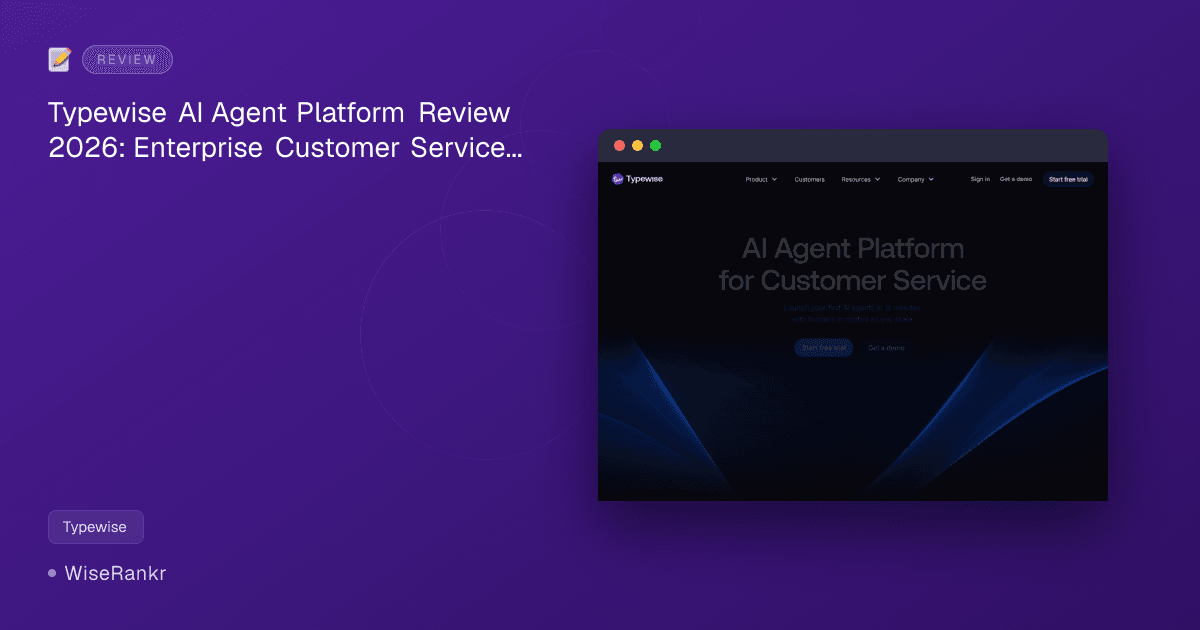
Typewise, initially known for its innovative smartphone keyboard, has evolved significantly. Today, it stands as an AI Customer Service Platform built for enterprise environments. It deploys AI agents that work across your entire tech stack, from CRM and ERP systems to billing and knowledge bases, to autonomously manage customer interactions. The platform emphasizes deep integrations, multi-language support, and the ability to handle millions of tickets.
Its core promise is to boost customer satisfaction and reduce operational costs by automating repetitive and complex tasks, freeing human agents to focus on high-value interactions.
Key Features of Typewise AI Agent Platform
Typewise offers a robust suite of features designed to empower AI agents to handle diverse customer service scenarios. It positions itself as a "new software layer" that connects disparate systems and workflows.
Multi-Agent Orchestration
At the heart of Typewise is its Multi-Agent Orchestration capability. This allows the AI to work across your entire stack, connecting various channels, policies, and actions. It acts as an "AI supervisor" managing domain specialists for support, sales, and commerce workflows, including complex tasks like returns, billing, quotes, and renewals.
The platform reads and writes data across CRM, ERP, billing, ITSM, commerce, and knowledge systems, ensuring comprehensive interaction handling. It's designed with governance in mind, adhering to defined automation levels, approvals, simulations, and audit trails.
Omnichannel, Plus AI-Native
Typewise ensures that customers can initiate contact on any channel and switch between them seamlessly, maintaining context throughout the interaction. It supports a wide range of communication channels:
- Chat
- Social
- Voice
- ChatGPT
- Claude
This omnichannel approach, coupled with its AI-native design, aims for end-to-end resolution without losing control.
Natural Language Instructions
A standout feature, Natural Language Instructions, allows business teams to define and run workflows using plain language, eliminating the need for coding. Existing documentation can be transformed into live automations directly, empowering non-technical staff to update AI behavior without IT intervention. This promises to reduce bottlenecks and accelerate deployment of new automations.
Hybrid Intelligence & Approvals
Typewise understands the need for human oversight. Its Hybrid Intelligence and Approvals system allows organizations to dictate the extent of automation. When scenarios become too complex or require a nuanced judgment, the AI can bring in a human agent for approval, partial handoff, or even full takeover of the interaction. This ensures that critical or sensitive cases receive the necessary human touch.
Typewise Pricing
For its enterprise AI customer service software, Typewise offers several plans based on a per-user, per-month model. While specific feature breakdowns for each tier are not detailed in the provided data, a general pricing structure is available:
- Tech Plan: Starting at €12/user/month
- Professional Plan: Starting at €12/user/month
- Enterprise Plan: Starting at €12/user/month
- Premium Plan: Starting at €12/user/month
It's important to note that the €12/user/month is a starting point, and custom pricing is available, likely for higher tiers or specific enterprise needs. For detailed feature lists per plan, organizations should "Visit Typewise.app for details".
Typewise also offers separate pricing for its keyboard app, which includes a Lifetime Purchase for $25.00 (one-time), Annual PRO for $9.49/user/year, and Monthly PRO for $1.99/user/month. This review focuses on the AI Agent Platform.
User Reviews and Insights
User feedback for Typewise is primarily centered around its effectiveness in improving customer service operations. G2 users, in particular, highlight significant efficiency gains.
G2 User Impressions
On G2, Typewise's AI Agent Platform is noted for its ability to increase efficiency and automate workloads. Reported metrics include "25% Workload automation," "30% Increase in efficiency," "19% Increase in Efficiency," and "17% Increase in efficiency" across various clients. These figures suggest a tangible return on investment for adopting the platform.
Users like Enrico Mulazzi, a Project Manager, state, "Typewise is a really useful AI plugin which helps customer service agents work easier." Guido Messere, a Director Service Center, adds that the tool "significantly improves the quality and understandability of communication." These testimonials underscore the platform's utility in streamlining agent workflows and enhancing communication quality.
Customer Success Stories
Typewise's customer success page features several case studies demonstrating its impact. For instance, DPD reportedly achieved a "30% boost in efficiency using AI," and IVECO "Accelerates Breakdown Assistance with Typewise AI." Mid-market users (51-1000 employees) praise its ease of integration and the quality improvement it brings. One user mentioned, "Very easy to integrate. Short instructions for users. SPOC for Customer Success. Good grammar and spell checking." Another with 1001+ employees appreciated the "Simple integration as a browser extension."
While the Trustpilot reviews mainly pertain to the keyboard app, the sentiment there (from 2020) highlighted its innovative approach to typing and reduced typos. One negative Trustpilot review from 2022 mentioned "Not Happy with typewise communication," suggesting potential issues with customer support responsiveness for their keyboard product, though this may not reflect the enterprise AI platform's support.
Reddit Discussions
While direct Reddit threads specifically about the AI Agent Platform were not found in the research, Typewise's blog references Reddit discussions. It notes that a user with progressive rheumatoid arthritis found the Typewise keyboard beneficial through a "Reddit thread," indicating a community presence. The blog also acknowledges "plenty of discussions on Reddit and such highlighting how many problems still exist with autocorrect," suggesting Typewise is aware of broader user pain points in AI-assisted writing.
Integrations and Ecosystem
Typewise prides itself on its "200+ Deep integrations," positioning itself as a central hub for customer service operations. It acts as a layer that sits above existing systems, reading and writing across various enterprise applications.
The platform explicitly states its ability to integrate with:
- CRM systems
- ERP systems
- Billing systems
- ITSM platforms
- Commerce platforms
- Knowledge systems
Furthermore, its omnichannel capabilities extend to popular communication platforms and LLMs like ChatGPT and Claude. This extensive integration capability is crucial for enterprises looking to leverage AI without overhauling their entire existing infrastructure. Typewise aims to get businesses "up & running in days. Not weeks."
Pros and Cons of Typewise
Pros:
- End-to-End Automation: Capable of resolving complex customer interactions autonomously across the entire tech stack.
- Deep Integrations: Connects with over 200 systems (CRM, ERP, billing, etc.), ensuring comprehensive data utilization.
- Omnichannel Support: Handles customer interactions across chat, email, WhatsApp, social, voice, and integrates with major LLMs.
- Natural Language Instructions: Empowers business users to define and update workflows without coding.
- Hybrid Intelligence: Offers flexible automation with human approval and takeover mechanisms, maintaining control.
- Multi-Language Support: Capable of handling "Any Language in/out."
- Proven Efficiency Gains: G2 reviews cite significant workload automation and efficiency increases (e.g., 25% automation, 30% efficiency boost).
- Fast Deployment: Advertises getting "up & running in days. Not weeks."
- Enterprise-Grade Security: Designed with robust security, admin controls, and audit trails.
Cons:
- Limited Public Pricing Details: Specific feature breakdowns for the "Tech," "Professional," "Enterprise," and "Premium" plans are not publicly available, requiring direct inquiry.
- Newer Entry in Enterprise AI: While the keyboard app has a history, the AI Agent Platform is a more recent offering in a competitive enterprise AI market.
- Potential Vendor Lock-in: Deep integration across the entire stack, while powerful, could lead to reliance on the Typewise ecosystem.
- Scalability of "Days to Go Live": While promised, real-world "go-live" times for complex enterprise environments can vary depending on integration complexity and internal processes.
- Limited Public Reviews for AI Platform: Most detailed public reviews (e.g., on Trustpilot) are for the keyboard app, not the enterprise AI platform, making broader sentiment assessment challenging.
Who Is Typewise For?
Typewise is explicitly designed for modern customer teams within mid-market to large enterprises. Its capabilities for "Multi-Agent Orchestration" and integration with complex CRM, ERP, and billing systems make it unsuitable for small businesses or startups. It targets organizations that:
- Have a high volume of customer inquiries across multiple channels.
- Need to automate repetitive and complex customer service and sales workflows.
- Operate with diverse legacy systems and require deep integrations.
- Seek to improve customer satisfaction while simultaneously reducing operational costs.
- Value control and governance over AI automation with hybrid intelligence capabilities.
- Require multi-language support for their global customer base.
It's particularly beneficial for sectors like logistics (DPD, Planzer, STEF), e-commerce (Brack.ch), automotive manufacturing (IVECO), and travel & hospitality, as highlighted by their customer success stories.
Alternatives to Typewise
The enterprise AI customer service space is competitive. Typewise's blog itself discusses alternatives to various platforms, indicating the landscape. Based on its functionalities, Typewise competes with:
- AI-powered Customer Service Platforms: Solutions like Zendesk, Freshdesk, and Intercom (with their AI add-ons) offer varying degrees of AI automation, chatbots, and omnichannel support. Typewise differentiates by emphasizing "end-to-end resolution" and "Multi-Agent Orchestration" across the entire stack.
- Generative AI Platforms: Competitors like Salesforce Einstein and even direct LLM access (ChatGPT, Claude) can be used for customer support. Typewise integrates these but adds a layer of orchestration, governance, and workflow execution specific to customer service.
- Dedicated AI Writing Assistants: While Typewise has roots in writing assistance (keyboard), its current enterprise offering is broader than tools like Superhuman, focusing on full workflow automation rather than just text generation.
- RPA (Robotic Process Automation) Tools: Some RPA tools can automate customer service tasks, but Typewise's AI agents are designed for more intelligent, conversational, and context-aware interactions.
Typewise's strength lies in its ability to act as a comprehensive "AI supervisor" that can take action across an entire enterprise stack, a capability that sets it apart from simpler chatbot solutions or basic AI writing tools.
Verdict: Is Typewise the Right AI Agent Platform for You?
Typewise presents itself as a compelling AI Agent Platform for enterprise-level customer service. Its focus on multi-agent orchestration, deep integrations, and natural language instructions addresses critical pain points for large organizations dealing with complex customer interactions.
The reported efficiency gains from G2 users and customer success stories are strong indicators of its effectiveness. The ability to go live in "days, not weeks" is a significant advantage in a market where deployment can often be lengthy and resource-intensive.
However, the lack of transparent, detailed pricing for its enterprise plans means potential customers will need to engage directly for a comprehensive understanding of costs and feature sets. While the promise of "end-to-end resolution" is powerful, organizations must carefully evaluate the real-world implications of handing over complex workflows to AI, even with hybrid intelligence safeguards.
For large enterprises struggling with fragmented customer service systems, high ticket volumes, and a need for consistent, multilingual support, Typewise offers a sophisticated, integrated solution. Its emphasis on control, audit trails, and human oversight makes it a strong contender for organizations ready to embrace advanced AI for their customer experience strategy. If you're a mid-market or enterprise company looking to significantly automate and optimize your customer and sales support, Typewise warrants a serious evaluation.
FAQ
What is Typewise's primary focus in 2026?
In 2026, Typewise's primary focus is on its AI Agent Platform for enterprise customer service, which automates end-to-end customer interactions across various channels and integrates deeply with existing business systems.
How does Typewise handle complex customer service issues?
Typewise utilizes "Multi-Agent Orchestration" with domain specialists and "Hybrid Intelligence & Approvals." This means AI agents handle routine tasks, but for complex issues, the system can bring in a human for approval, partial handoff, or full takeover, ensuring control and accuracy.
Can non-technical staff manage Typewise's automations?
Yes, Typewise features "Natural Language Instructions," allowing business teams to define and update workflows using plain language, turning existing documentation into live automations without requiring coding skills or IT involvement.
What kind of integrations does Typewise offer?
Typewise boasts over 200 deep integrations, capable of reading and writing across CRM, ERP, billing, ITSM, commerce, and knowledge systems. It also integrates with popular communication channels and large language models like ChatGPT and Claude.