Are you looking to build powerful AI applications or streamline your business processes with intelligent automation? The landscape of AI tools is vast and ever-evolving, making the choice between specialized platforms critical. Today, we're diving deep into a comparison of two distinct players: Activepieces vs Runpod. One focuses on AI-first automation and agent building, while the other provides high-performance GPU infrastructure for training and deploying AI models. Which one aligns best with your strategic goals in 2026?
This comparison will break down their core offerings, features, pricing, and user sentiment to help you make an informed decision. We'll examine Activepieces's approach to accessible AI automation and agent creation, contrasted with Runpod's robust cloud GPU services designed for demanding AI workloads.
Activepieces: AI-First Automation for Every Team
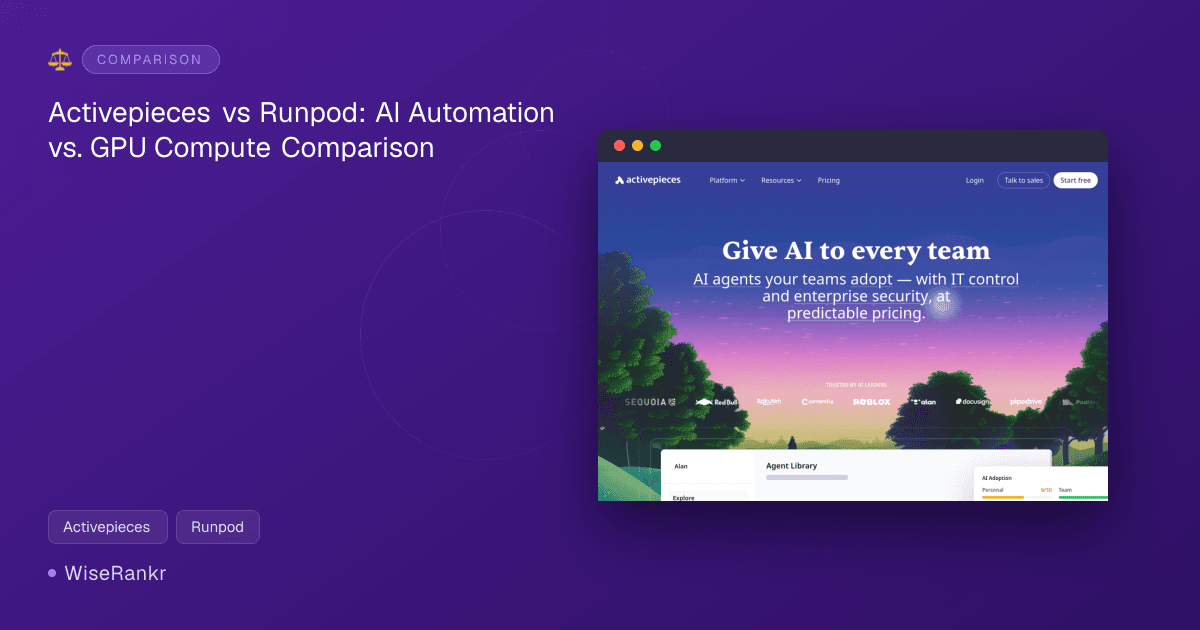
Activepieces positions itself as an "AI-first automation for every team," enabling users to build AI agents and automations that connect various applications, APIs, and data sources without requiring extensive engineering expertise. It offers both a cloud-hosted service and an open-source, self-hosted option, emphasizing user control and enterprise security.
Key Features of Activepieces
- AI Agents: Build intelligent agents for tasks like AI Support, Smart Email, and Daily Reports. The platform claims significant cost savings by deploying these agents.
- 687+ Integrations: Connects with popular apps like Gmail, OpenAI, Slack, Notion, and HubSpot.
- AI Adoption Stack: Designed to help organizations integrate AI builders, featuring white-labeling, one-click team invites, and a curated template library for various departments (HR, Finance, Marketing, Sales, Operations).
- Control & Governance: Offers features like Team & Personal Projects, Piece Access Controls, Global Connections, Custom RBAC, SSO, and Audit Logs (available in the Unlimited plan).
- Open Source Core: The Community Edition is MIT Licensed, self-hostable, and provides core features for users with technical skills.
- Personalized Onboarding & Support: The platform learns user roles and skill levels to deliver tailored automation ideas and resources. Users can also schedule calls with AI experts.
Runpod: High-Performance GPU Infrastructure for AI
Runpod is a cloud platform dedicated to providing high-performance GPU resources on demand, primarily for AI and machine learning workloads. It aims to simplify the deployment, training, and optimization of AI models at scale, catering to developers and small teams who need robust infrastructure without the complexities of managing it themselves.
Essential Features of Runpod
- On-Demand Cloud GPUs: Offers a wide array of GPU SKUs, from B200s to RTX 4090s, across 30+ regions globally. Users can launch GPU pods in seconds.
- Serverless AI: Provides a serverless option for inference workloads, designed for cost-effectiveness and auto-scaling from 0 to N workers based on demand.
- Flexible Billing: Pay-per-second or per-minute billing for GPU usage, with no long-term commitments.
- Cost Centers: A billing feature rolled out in April 2026, allowing users to tag resources and track GPU spend by team, project, or department.
- Developer-Focused: Offers a Python SDK (Flash beta) for running functions on cloud GPUs with simple decorators, along with dependency management.
- Community & Secure Cloud: Provides options for Community Cloud (aggregating GPUs from vetted providers with dynamic pricing) and Secure Cloud.
Activepieces vs Runpod: Feature Comparison
To better understand their differences, let's look at a side-by-side comparison of their core features:
| Feature | Activepieces | Runpod |
|---|---|---|
| Core Offering | AI-first automation platform, AI agent builder | Cloud GPU infrastructure for AI/ML workloads |
| Target User | Teams, businesses, developers building automations | AI/ML developers, data scientists, small teams deploying models |
| Primary Use Case | Workflow automation, AI agent creation, app integration | AI model training, inference, deployment, high-performance computing |
| Integrations | 687+ app integrations (Gmail, OpenAI, Slack, Notion, HubSpot) | Focus on GPU hardware and software environments; integrations with AI frameworks |
| Deployment Options | Cloud-hosted, self-hosted (open source) | Cloud-hosted GPU instances (Pods), Serverless GPU |
| AI Specifics | Pre-built AI agents, AI Adoption Stack, personalized AI guidance | GPU types (H200, B200, H100, RTX 4090, etc.), Flash Python SDK |
| Billing Structure | Usage-based (per active flow), annual contract for Unlimited | Per-second/per-minute for GPU usage, Serverless flex/active workers |
| Developer Focus | No-code/low-code automation builder, open-source core | Direct access to GPU environments, Python SDK, API access |
Pricing Comparison: Activepieces vs Runpod

Activepieces Pricing
Activepieces offers a straightforward pricing model with a community-driven open-source option and two cloud tiers:
- Community Edition: $0/month. This is a self-hosted, MIT Licensed version with core features and unlimited flows. It requires technical skills.
- Standard: Free, then $5 per active flow per month. This cloud-hosted plan includes 10 free active flows, unlimited runs, AI agents, unlimited MCP servers, unlimited tables, and community support.
- Unlimited: Custom pricing (annual contract). This plan offers Security & Governance features (Team & Personal Projects, Piece Access Controls, Global Connections, Custom RBAC, SSO) and Control & Compliance features (Audit Logs).
Users on Trustpilot have noted past "substantial pricing changes" without advance notice, so it's advisable to review their latest pricing directly on their website.
Runpod Pricing
Runpod's pricing is primarily based on GPU usage, offering flexibility for various workloads:
- Pods (Dedicated GPU Instances): Billed per minute while running. Costs are paused when a pod is stopped, though storage charges may continue. Specific GPU prices vary greatly by model (e.g., H200, B200, H100, RTX 4090). For example, an RTX 3090 on the Community Cloud is around $0.22/hour.
- Serverless:
- Flex Workers: On-demand pricing, scaling to zero when idle. An RTX 4000 Flex worker might cost $1.12/hour.
- Active Workers: Billed 24/7 but offer a 20-32% discount. An RTX 4000 Active worker could be $0.76/hour.
Runpod provides detailed per-second pricing for a vast array of GPUs, including H200, B200, H100 PCIe, H100 SXM, A100 PCIe, A100 SXM, L40S, RTX 6000 Ada, A40, L40, RTX A6000, RTX 5090, L4, RTX 3090, RTX 4090, and RTX A5000. Visit Runpod.io/pricing for specific per-second pricing on all available GPUs.
Activepieces: Pros and Cons
Pros of Activepieces
- AI-First Approach: Strong focus on building and deploying AI agents for business automation.
- Extensive Integrations: Over 687 integrations make it highly versatile for connecting various applications.
- Open-Source Option: The Community Edition provides a powerful, self-hostable solution for technically inclined users, offering significant control.
- User-Friendly Interface: Users on Product Hunt praise its "best of all automation tools" UX.
- White-Labeling: Allows organizations to brand the platform, fostering internal AI adoption.
- Community Support: Users on Trustpilot highlight "Great customer support / community."
Cons of Activepieces
- Pricing Model Concerns: Past unannounced pricing changes and automatic plan migrations have drawn negative feedback on Trustpilot.
- Learning Curve: While praised for UX, some users on AppSumo mentioned a learning curve for specific integrations.
- Requires Technical Skills for Self-Hosting: The open-source version is not for the non-technical user.
Runpod: Pros and Cons
Pros of Runpod
- High-Performance GPUs: Access to a wide range of cutting-edge GPUs like H200 and B200 for demanding AI workloads.
- Flexible & Cost-Effective Billing: Per-second/per-minute billing and serverless options can lead to significant cost savings compared to traditional cloud providers, especially for intermittent workloads.
- Global Deployment: Ability to run workloads across 30+ regions, offering low latency and reliability.
- Developer-Centric: Tools like the Flash Python SDK simplify running functions on GPUs.
- Responsive Customer Service: Trustpilot users frequently praise "excellent customer service" and responsiveness.
Cons of Runpod
- Technical Complexity: Reddit users indicate a steeper learning curve and potential frustrations with setup, persistence, and managing data, especially for less experienced users.
- Resource Availability: Difficulty in securing specific, popular GPU cards in certain regions has been a recurring complaint.
- Network/Startup Issues: Some users report slow file transfer speeds and long pod startup times, which can still incur billing.
- No Free Tier/Trial for GPUs: While offering competitive pricing, there isn't a readily available free tier for GPU usage, unlike Activepieces's free active flows.
Which Solution is Right for You in 2026?
The choice between Activepieces and Runpod hinges entirely on your primary needs and technical capabilities.
Choose Activepieces if:
- Your main goal is to build and deploy AI agents and automate workflows across various business applications without heavy coding.
- You need a platform with extensive pre-built integrations to connect popular SaaS tools.
- You value an open-source option for self-hosting and maximum control over your automation infrastructure.
- Your organization wants to empower non-technical teams to build AI automations with guidance and templates.
- You're looking for a solution that can be white-labeled to align with your internal branding.
Choose Runpod if:
- You are an AI/ML developer, researcher, or a team focused on training, fine-tuning, or deploying large-scale AI models.
- You require on-demand access to high-performance GPUs (like H100s, B200s, RTX 4090s) for compute-intensive tasks.
- Cost-effective GPU infrastructure with per-second billing and serverless scaling is critical for your budget and workload patterns.
- You have the technical expertise to configure and manage GPU environments, or your team includes developers proficient in AI infrastructure.
- Global deployment and low-latency access to GPU resources are important for your AI applications.
The Ultimate Verdict: Complementary, Not Competing
Ultimately, Activepieces and Runpod serve distinctly different, yet potentially complementary, purposes within the AI ecosystem. Activepieces is a high-level automation and AI agent building platform, ideal for integrating AI into business processes and connecting applications. It streamlines the "what to do" with AI.
Runpod, on the other hand, is a foundational infrastructure provider, offering the raw computational power required for the "how to do" of complex AI tasks like model training and inference. You might even use Runpod to host the very models that Activepieces agents interact with.
Therefore, the "better" tool depends solely on where your current AI development and deployment focus lies. For accessible, AI-driven business process automation, Activepieces stands out. For powerful, scalable GPU compute for core AI model development, Runpod is the clear choice.
Frequently Asked Questions (FAQ)
What is the difference between Activepieces and Runpod's approach to AI?
Activepieces focuses on AI-first automation and agent building, enabling users to create workflows that utilize AI for tasks like email management or customer support, often integrating with existing applications. Runpod, conversely, provides the underlying high-performance GPU infrastructure necessary for training, deploying, and running complex AI models themselves.
Can I self-host Activepieces?
Yes, Activepieces offers a Community Edition which is MIT Licensed and can be self-hosted. This option provides core features and unlimited flows but requires technical skills for setup and maintenance.
How does Runpod charge for GPU usage?
Runpod charges on a per-second or per-minute basis for GPU usage, depending on whether you're using Pods (dedicated instances) or Serverless options. Serverless also has "Flex Workers" (on-demand, scale to zero) and "Active Workers" (billed 24/7 with a discount).
Does Activepieces offer a free plan?
Activepieces offers a free Community Edition for self-hosting and a "Standard" cloud plan that starts free with 10 free active flows, then charges $5 per active flow per month.